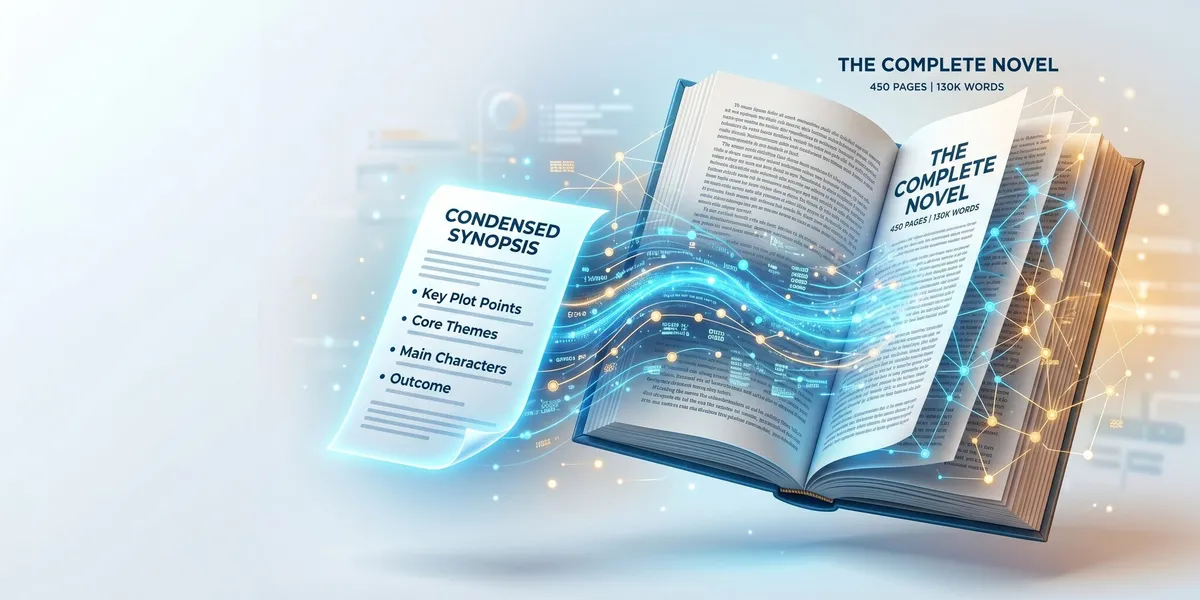
Writing a book synopsis is one of the most painful tasks for authors — condensing 70,000 words into a compelling 500-word summary feels nearly impossible. AI book synopsis generators can turn that hours-long struggle into a 10-minute process.
In this guide, you’ll learn:
- The best AI tools for generating book synopses
- How to write effective prompts that produce usable results
- Step-by-step workflows for query synopses, back cover copy, and marketing summaries
- How to edit AI-generated synopses into something that sounds like you
Here’s how to create a synopsis that actually works.
What Is an AI Book Synopsis Generator?
An AI book synopsis generator is a tool that uses artificial intelligence to condense your book’s plot, themes, and key moments into a structured summary. These tools analyze your manuscript details — characters, plot points, themes, conflict — and produce a focused synopsis you can use for query letters, back cover copy, or marketing materials.
The best results come from giving the AI detailed input about your book rather than pasting your entire manuscript. Think of it as a collaboration: you provide the raw material, the AI provides the structure.
Best AI Book Synopsis Generators in 2026
Our Pick — Chapter
Chapter includes AI-powered synopsis and summary tools designed specifically for book authors. Unlike general-purpose AI, Chapter understands book structure and produces synopses formatted for publishing industry standards. Over 2,147 authors have used the platform to create 5,000+ books.
Best for: Nonfiction authors who need professional synopses Pricing: $97 one-time Why we built it: Because writing the synopsis shouldn’t be harder than writing the book
ChatGPT (GPT-4)
ChatGPT is the most versatile option for synopsis generation. With the right prompts, it produces solid synopses for both fiction and nonfiction. The free tier works for basic summaries, while the paid tier handles longer, more nuanced manuscripts.
Best for: Writers who want maximum flexibility and don’t mind prompt engineering Pricing: Free tier available, Plus at $20/month
Claude
Claude excels at maintaining consistency across longer inputs. If you need to feed the AI extensive plot details or chapter summaries, Claude’s larger context window handles more information without losing track of key story elements.
Best for: Complex plots with many characters and subplots Pricing: Free tier available, Pro at $20/month
Sudowrite
Sudowrite is built specifically for fiction writers and includes synopsis generation as part of its story development toolkit. The AI understands narrative structure, character arcs, and genre conventions — so the synopses it generates tend to be more narratively polished than general-purpose AI output.
Best for: Fiction writers who want genre-aware synopses Pricing: Plans start at $19/month
ProWritingAid
ProWritingAid’s AI features include summary generation alongside its editing tools. This makes it useful for writers who want to generate a synopsis and then immediately refine their prose in the same tool.
Best for: Writers who also need editing and style analysis Pricing: Plans start at $10/month
How to Generate a Book Synopsis With AI (Step by Step)
Getting a good synopsis from AI isn’t about pasting your manuscript and hoping for the best. Follow this process for results you can actually use.
Step 1: Prepare Your Book Details
Before opening any AI tool, write down these elements:
- Genre and subgenre — “Literary fiction” or “Self-help / career development”
- Main characters — Name, role, core motivation (2-3 sentences each)
- Central conflict — What does the protagonist want? What stands in their way?
- Key plot points — 5-8 major turning points in order
- Theme — The underlying message or question
- Resolution — How the story/argument concludes
- Tone — Suspenseful, humorous, inspirational, academic
Step 2: Choose Your Synopsis Type
Different uses require different formats:
| Synopsis Type | Length | Purpose |
|---|---|---|
| Query letter synopsis | 250-500 words | Agent/publisher submission |
| Back cover copy | 150-200 words | Retail book description |
| Marketing summary | 100-150 words | Social media, ads, press |
| Detailed synopsis | 1,000-3,000 words | Publisher request, detailed review |
| Chapter-by-chapter | Varies | Proposal submissions |
Step 3: Write Your Prompt
Here’s a template that consistently produces strong results:
For a query letter synopsis:
Write a 400-word synopsis of my [genre] book titled "[Title]."

Main character: [Name], [brief description and motivation]
Central conflict: [What they want vs. what blocks them]
Key plot points (in order):
1. [Inciting incident]
2. [First major turn]
3. [Midpoint shift]
4. [Crisis moment]
5. [Climax]
6. [Resolution]

Theme: [Core theme]
Tone: [Desired tone]
Comparable titles: [2-3 comp titles]

Write in third person, present tense. Include the ending. Focus on emotional stakes, not just plot events. The synopsis should make an agent want to request the full manuscript.
For back cover copy:
Write compelling back cover copy (150-200 words) for my [genre] book titled "[Title]."

Hook: [The core question or conflict in one sentence]
Setup: [What the reader needs to know]
Stakes: [What happens if the protagonist fails]
Tone: [Match the book's voice]

Don't reveal the ending. End with a question or cliffhanger that makes the reader want to open the book. Use short paragraphs. Make every sentence earn its place.
Step 4: Generate and Iterate
Run your prompt and evaluate the output. Then ask the AI to:
- “Make the stakes more specific”
- “Tighten this to 350 words without losing the emotional arc”
- “Rewrite the opening hook to be more attention-grabbing”
- “Match the voice of [comp title] more closely”
Most synopses need 2-3 revision rounds to reach quality you’d actually submit.
Step 5: Edit by Hand
AI gets you 80% there. The final 20% must be you. Read the synopsis aloud. Replace generic phrases with specific details from your book. Make sure the voice matches your manuscript. Cut anything that feels like filler.
AI Synopsis Prompts for Different Book Types
Fiction Synopsis Prompt
Write a 500-word query synopsis of my [subgenre] novel.

Protagonist: [Name] is a [age, occupation, key trait] who [starting situation].
When [inciting incident], [Name] must [central goal].
But [antagonist/obstacle] threatens [specific stakes].

Key turns: [List 4-5 major plot points]
Ending: [How it resolves — don't hide this from agents]

Write in present tense, third person. Convey the emotional journey, not just the plot mechanics. Show character growth through action choices.
Nonfiction Synopsis Prompt
Write a 400-word synopsis of my nonfiction book about [topic].

The book argues that [central thesis].
Reader: [Who this is for and what problem they have]
Framework: [Your method/system name and what it includes]
Key chapters cover: [List main topics]
By the end, the reader will be able to [transformation/outcome].

Include one compelling statistic or example. Write in a tone that's [authoritative/conversational/urgent]. Position this as essential reading for [target audience].
Memoir Synopsis Prompt
Write a 500-word synopsis of my memoir about [topic/period].

The story begins when [opening situation].
The central question is: [Thematic question driving the narrative]
Key moments: [List 5-6 defining scenes/events]
The memoir ends with [resolution/reflection].

Write in first person if the query allows, otherwise third person. Emphasize the emotional transformation, not just chronological events. Show what makes this particular life story universal.
Common Mistakes When Using AI for Synopses
- Pasting the entire manuscript. AI works better with structured input (character descriptions, plot points) than raw text dumps. Give it organized details, not 80,000 unfiltered words.
- Accepting the first draft. AI-generated synopses need editing. Always run at least 2-3 revision prompts and then edit by hand.
- Generic stakes. If your AI synopsis says “everything will change” or “they must find the courage,” those are placeholder phrases. Replace them with specific consequences from your book.
- Wrong tone. A thriller synopsis shouldn’t read like a literary fiction summary. Specify tone in your prompt and compare the output to synopses of similar books in your genre.
- Forgetting the ending. Query synopses must include how the book ends. Agents need to evaluate the full arc. Back cover copy, on the other hand, should never reveal the ending.
- Using AI output without attribution awareness. Your synopsis should sound like you, not like AI. If a phrase feels generic or “AI-ish,” rewrite it in your voice.
How to Write a Synopsis Without AI
If you prefer to write your synopsis manually, here’s the structure that works:
- Opening hook (1-2 sentences) — Introduce your protagonist and their situation in the most compelling way possible
- Inciting incident (1-2 sentences) — What disrupts their world
- Rising action (3-5 sentences) — Key plot turns that escalate the conflict
- Climax (1-2 sentences) — The decisive moment
- Resolution (1-2 sentences) — How it ends and what’s changed
For more on the elements of story structure, explore our guides on writing a book and creative nonfiction.
Should You Use AI for Your Query Letter Synopsis?
AI is a powerful drafting tool for query synopses, but the final version should always be personally edited. Agents can sometimes detect AI-generated prose, and a synopsis that feels templated undermines the personal voice that makes your manuscript distinctive.
Use AI to:
- Generate a first draft quickly
- Experiment with different structures and hooks
- Tighten word count while preserving key information
- Get past the blank-page paralysis that makes synopsis writing miserable
Then rewrite every sentence in your own voice. The result should be a synopsis that’s structurally sound (thanks to AI) and distinctively yours (thanks to your editing).
For help writing the book that your synopsis will represent, check out our AI book writing guide for beginners or see how AI can help with first drafts.
FAQ
What is the best AI book synopsis generator?
The best AI book synopsis generator depends on your needs. Chapter is purpose-built for book authors and understands publishing industry formats. ChatGPT offers the most flexibility with custom prompts. Sudowrite provides genre-aware synopses specifically for fiction. For best results, use structured prompts with detailed character and plot information.
How do you write a book synopsis with AI?
To write a book synopsis with AI, prepare structured notes about your characters, plot points, conflict, and resolution first. Feed these to an AI tool using a specific prompt that defines the synopsis type, length, and tone. Generate a first draft, then run 2-3 revision prompts and edit the final version by hand to match your voice.
How long should a book synopsis be?
A book synopsis should be 250-500 words for query letters, 150-200 words for back cover copy, and 1,000-3,000 words for detailed publisher-requested synopses. Query synopses must include the ending. Back cover copy should create intrigue without revealing the resolution. Always check specific agent or publisher guidelines for length requirements.
Can agents tell if you used AI for your synopsis?
Agents may notice if a synopsis uses generic AI-style phrasing or lacks the author’s distinctive voice. The solution is to use AI for structure and drafting, then rewrite every sentence in your own voice. A well-edited AI-assisted synopsis is indistinguishable from one written entirely by hand — the key is thorough personal revision.
Is it okay to use AI to write a book synopsis?
Yes, it’s completely acceptable to use AI to write a book synopsis as a drafting and structuring tool. Most publishing professionals have no issue with AI-assisted query materials as long as the final product is polished and represents your work accurately. The synopsis is a marketing document, not creative work — using efficient tools to create it is practical, not problematic.