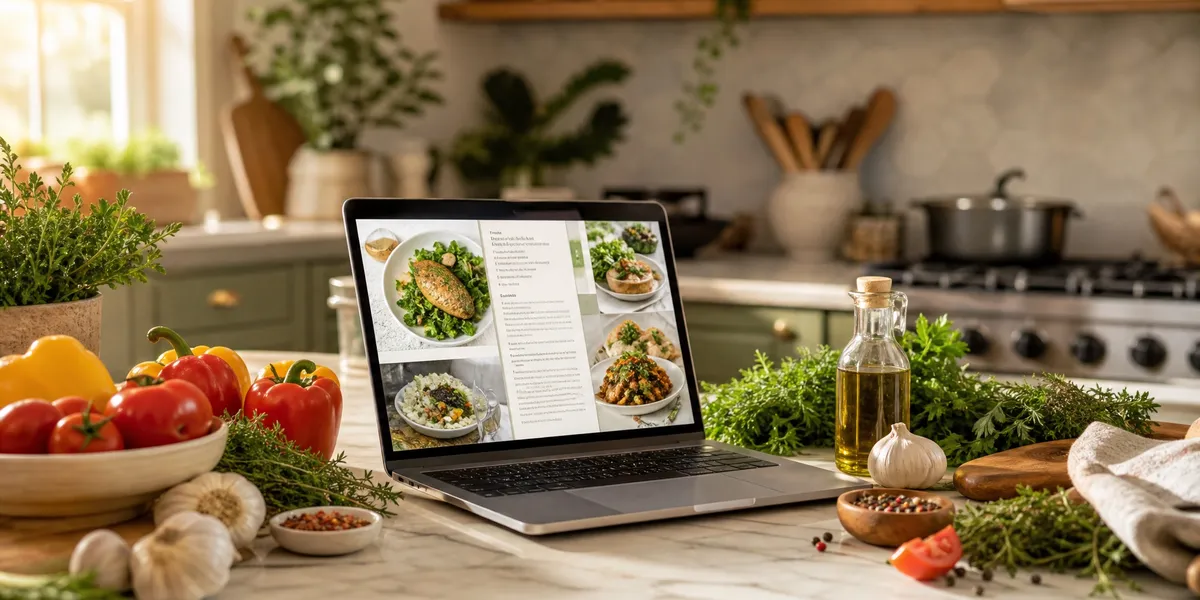
You can create a complete, professionally formatted cookbook using AI in under an hour — no design skills, no recipe testing team, no publisher required.
In this guide, you’ll learn:
- How to choose the right AI cookbook generator for your project
- The step-by-step process from concept to finished recipe book
- How to make AI-generated recipes accurate and uniquely yours
- Tips for cookbook photography, formatting, and publishing
Here’s exactly how to do it.
What Is an AI Cookbook Generator?
AI cookbook generator — A tool that uses artificial intelligence to create complete recipe books, including recipe text, ingredient lists, cooking instructions, chapter organization, and sometimes food photography, from a simple text description of your cookbook concept.
Traditional cookbook creation takes 6-12 months of recipe development, testing, photography, and design. An AI cookbook generator compresses that timeline to hours or days by automating the repetitive structural work.
You describe your concept — say, “a 30-recipe Mediterranean meal prep cookbook for busy families” — and the AI produces organized chapters, formatted recipes, nutritional information, and a table of contents. You then edit for accuracy, add your personal voice, and publish.
Cookbooks are one of the best formats for AI generation because recipes follow a predictable structure. Every recipe has a name, description, yield, prep time, cook time, ingredients, and step-by-step instructions. AI handles repeated structures extremely well.
How to Create a Cookbook With AI (Step-by-Step)
Here’s the complete workflow from concept to published cookbook.
Step 1: Define Your Cookbook Concept
Before you touch any tool, nail down these details:
- Cuisine or theme — Mediterranean, Southern comfort, one-pot meals, air fryer recipes
- Target audience — college students, busy parents, keto dieters, elderly home cooks
- Number of recipes — 25-50 for a standard cookbook, 75-100 for a comprehensive collection
- Dietary focus — vegan, gluten-free, low-carb, allergy-friendly
- Format — digital PDF, print-ready, or both
The more specific your concept, the better your AI output. “A 40-recipe air fryer cookbook for college students on a $50/week grocery budget” gives AI far more to work with than “a general cookbook.”
Step 2: Choose Your AI Cookbook Generator
Not all tools handle cookbook creation equally. Here’s what to look for and the best options available.
Our Pick — Chapter
Chapter handles the full cookbook writing workflow — from outlining your recipe book structure to generating formatted chapters with recipe introductions, headnotes, and organized instructions. You write with AI assistance while maintaining full creative control over voice and accuracy.
Best for: Authors who want a complete, publishable cookbook (not just a quick PDF) Pricing: $97 one-time (nonfiction) Why we built it: Over 2,147 authors have used Chapter to write books across every nonfiction category, including cookbooks. The guided workflow ensures your recipe book reads like you wrote it — because you did, with AI handling the heavy structural lifting.
Other solid options:
- Automateed — Best for speed. Generates a complete cookbook with AI food photography and nutritional info in under 10 minutes. Good for lead magnets and quick digital products.
- Inkfluence AI — Purpose-built for recipe book creation. Choose a blueprint, input your concept, and get a fully structured cookbook. Works well for niche recipe collections.
- ChatGPT + Canva — Best free option. Use ChatGPT to generate recipes and structure, then design in Canva’s cookbook templates. More manual work but zero cost.
Step 3: Generate Your Cookbook Structure
Start with the outline, not the recipes. Your AI tool should produce:
- Front matter — title page, dedication, introduction
- Chapter organization — group recipes by meal type, cuisine, difficulty, or course
- Recipe format — consistent layout for every recipe (yield, time, ingredients, steps, tips)
- Back matter — index, measurement conversions, acknowledgments
In Chapter, you’d start a new nonfiction project, describe your cookbook concept, and the AI generates a complete chapter outline that you can rearrange, expand, or trim before writing begins.
Step 4: Generate and Edit Individual Recipes
Here’s where most people go wrong with AI cookbooks: they accept the raw AI output without editing.
What AI does well:
- Recipe structure and formatting
- Ingredient lists with measurements
- Step-by-step instruction flow
- Nutritional estimates
- Cooking time estimates
- Recipe variations and substitution suggestions
What you MUST edit manually:
- Test the recipes — Cook at least 5-10 representative recipes. AI sometimes hallucinates measurements or cooking times.
- Adjust seasonings — AI tends toward generic seasoning amounts. Add your personal touch.
- Verify temperatures — Check that oven temps and cook times match the dish.
- Add personal headnotes — The stories and tips that make a cookbook feel human.
A recipe book created entirely by AI without human testing will contain errors. Your job is quality control and adding the personality that makes readers trust you.
Step 5: Write Your Cookbook Introduction
Your cookbook introduction is where you connect with readers. AI can draft it, but this section should feel personal.
Include:
- Why you created this cookbook
- Who it’s for
- How to use the book
- A brief personal story connecting you to the food
This is one section where spending 30 minutes writing from scratch often produces better results than editing AI output.
Step 6: Format and Design
Once your recipes are generated and edited, format your cookbook for publishing. You have several paths:
- PDF export from your AI tool (fastest)
- Professional layout using a cookbook layout template in InDesign or Canva
- Print-ready formatting if you plan to format your cookbook for print
For digital-only cookbooks, a clean PDF with consistent recipe formatting works perfectly. For print, you’ll need proper margins, bleed, and image resolution — check our guide on how to self-publish a cookbook for specifics.
Cookbook Photography Tips for AI-Generated Books
Photography makes or breaks a cookbook. You have three options with an AI cookbook generator:
Option 1: AI-Generated Food Photography
Tools like Automateed generate AI food photos for each recipe. The quality has improved dramatically — most readers can’t tell the difference. This works well for digital cookbooks and lead magnets.
Pros: Fast, consistent style, no equipment needed Cons: Can look generic, won’t perfectly match your actual recipe result
Option 2: Shoot Your Own Photos
If you’re testing recipes anyway (you should be), photograph the finished dishes. You don’t need professional equipment.
Basic setup:
- Natural window light (north-facing is best)
- White or neutral background
- Overhead angle for flat dishes, 45-degree for tall dishes
- Simple props — a clean napkin, fresh herbs, a wooden spoon
Option 3: Hybrid Approach
Use AI photography for your initial digital version, then replace with real photos as you test and cook each recipe. This lets you publish quickly while improving the book over time.
For Amazon KDP print cookbooks, real photography performs better with buyers. For digital lead magnets and Gumroad sales, AI photography is perfectly acceptable.
What Types of Cookbooks Can You Create With AI?
AI cookbook generators handle virtually any niche. The more specific, the better:
| Niche | Example Title | Why It Works |
|---|---|---|
| Dietary restriction | ”30 Days of Dairy-Free Dinners” | Structured, searchable, high demand |
| Audience-specific | ”College Kitchen: 50 Meals Under $5” | Clear value proposition |
| Cuisine-focused | ”Authentic Thai Street Food at Home” | Niche authority building |
| Appliance-based | ”Air Fryer Everything: 75 Recipes” | Trending, specific |
| Family/heritage | ”Grandma’s Kitchen: Our Family Recipes” | Personal, gift-worthy |
| Seasonal | ”Summer Grilling: 40 Backyard Recipes” | Timely, marketable |
The family and heritage cookbook category is especially interesting because AI can help you organize and format recipes you already have — handwritten cards, family texts, loose notes — into a beautiful, consistent book.
How to Sell Your AI-Generated Cookbook
Once your cookbook is ready, you have multiple publishing paths:
Amazon KDP (Highest Reach)
Upload your print-ready PDF and cover to Amazon KDP. Cookbooks sell well in both digital and paperback formats. Price digital at $4.99-$9.99 and paperback at $14.99-$24.99 depending on page count and color printing.
Gumroad or Etsy (Highest Margins)
Sell your digital cookbook directly. No middleman takes a cut beyond payment processing. Great for niche cookbooks and audience-specific collections.
Lead Magnet (List Building)
Give away a small cookbook (10-15 recipes) to build your email list, then sell the full version. AI makes this especially efficient — you can generate a lead magnet cookbook in 30 minutes.
Your Own Website
If you have a food blog or platform, sell directly to your existing audience. Bundle with meal plans or shopping lists for higher perceived value.
Common Mistakes to Avoid
- Publishing without testing recipes — At minimum, cook 25% of your recipes before publishing. AI hallucinates measurements and times.
- Using generic AI voice — Rewrite headnotes and introductions in your own words. Readers buy cookbooks from people they trust.
- Ignoring formatting — A wall of text isn’t a cookbook. Use consistent headers, spacing, and recipe card formatting.
- Skipping the index — Both digital and print cookbooks need a searchable index. Most AI tools generate this automatically.
- No dietary/allergen labels — Modern readers expect clear labeling for gluten-free, dairy-free, nut-free, and vegan recipes.
How Long Does It Take to Create an AI Cookbook?
Creating a cookbook with AI takes 2-5 hours for a basic digital recipe book, or 1-2 weeks for a polished, tested, print-ready cookbook. The generation itself takes minutes — the time investment is in editing, testing recipes, and adding your personal voice.
Here’s a realistic timeline:
| Phase | Time | What You’re Doing |
|---|---|---|
| Concept & outline | 30 min | Defining niche, audience, structure |
| AI generation | 10-30 min | Generating recipes and structure |
| Editing & testing | 3-10 hours | Cooking recipes, fixing errors, adding voice |
| Photography | 2-5 hours | Shooting or selecting images |
| Formatting | 1-2 hours | Layout, cover design, export |
| Publishing | 30 min | Upload to Amazon KDP or sales platform |
Compare that to the traditional process of 6-12 months, and you understand why AI cookbook generators are transforming food publishing.
Can You Legally Sell an AI-Generated Cookbook?
Yes. Recipes themselves (ingredient lists and basic instructions) are not copyrightable — they’re considered functional information. What is copyrightable is the creative expression: your headnotes, descriptions, personal stories, and unique phrasing.
When you use an AI generator and then add your own voice, edit for accuracy, and personalize the content, the resulting work is yours to sell. The key is adding genuine creative contribution — don’t publish raw, unedited AI output.
For detailed guidance on publishing, check our complete guide to how to write a recipe book.
How Much Does It Cost to Create an AI Cookbook?
Most AI cookbook generators cost between $0-$97 depending on the tool and output quality:
- Free options — ChatGPT + Canva templates (manual formatting required)
- $5-$20/month — Dedicated generators like Automateed or Inkfluence (subscription)
- $97 one-time — Chapter (full book writing workflow, not just recipes)
- $0-$50 additional — Cover design, stock photos, ISBN if self-publishing
Compare this to hiring a cookbook ghostwriter ($5,000-$15,000) or a publisher’s advance timeline (12-18 months), and the economics are compelling — especially for niche digital cookbooks that serve specific audiences.
AI Cookbook Generator vs. Writing From Scratch
| Factor | AI Generator | Writing From Scratch |
|---|---|---|
| Time to completion | 2-5 hours (basic) to 2 weeks (polished) | 6-12 months |
| Cost | $0-$97 | $0 (your time) or $5K+ (ghostwriter) |
| Recipe accuracy | Requires testing/editing | You develop and test everything |
| Personal voice | Added during editing | Built in from the start |
| Consistency | High (uniform formatting) | Varies without strict templates |
| Scalability | Can create multiple books quickly | One book at a time |
| Best for | Niche digital products, lead magnets, rapid publishing | Heirloom books, brand-building, professional chefs |
The sweet spot for most authors: use AI to generate the structure and first draft, then invest your time in testing, personalizing, and polishing. You get 80% of the time savings while producing a book that genuinely reflects your expertise and taste.
FAQ
What is the best AI cookbook generator?
The best AI cookbook generator depends on your goal. Chapter is the best option for authors who want a complete, publishable cookbook with full creative control. For quick digital products, Automateed generates formatted cookbooks in minutes. For free options, ChatGPT combined with Canva templates works for basic recipe collections.
Can AI write a whole cookbook for me?
AI can generate a complete cookbook draft including recipes, ingredient lists, cooking instructions, chapter organization, and introductions. However, you should always test recipes for accuracy, add personal headnotes, and edit the voice to match your style. Raw AI output contains measurement errors and lacks the personal touch readers expect.
How many recipes should an AI cookbook have?
A standard AI-generated cookbook should contain 25-50 recipes for a focused niche cookbook, or 75-100 recipes for a comprehensive collection. For digital lead magnets, 10-15 recipes is sufficient. The ideal count depends on your audience and publishing format — Amazon KDP print cookbooks perform best at 40-75 recipes.
Is it legal to sell an AI-generated cookbook?
Yes, selling an AI-generated cookbook is completely legal. Recipes (ingredient lists and basic instructions) are not copyrightable. When you add your own creative expression — personal stories, unique headnotes, custom descriptions, and editorial voice — the work is yours to sell. The key requirement is adding genuine human creative contribution beyond raw AI output.
How do I make my AI cookbook look professional?
Make your AI cookbook look professional by using a consistent recipe layout template, adding high-quality food photography (real or AI-generated), including proper front and back matter, and formatting for your target platform. Use cookbook layout templates for design guidance and ensure consistent spacing, fonts, and image placement throughout.