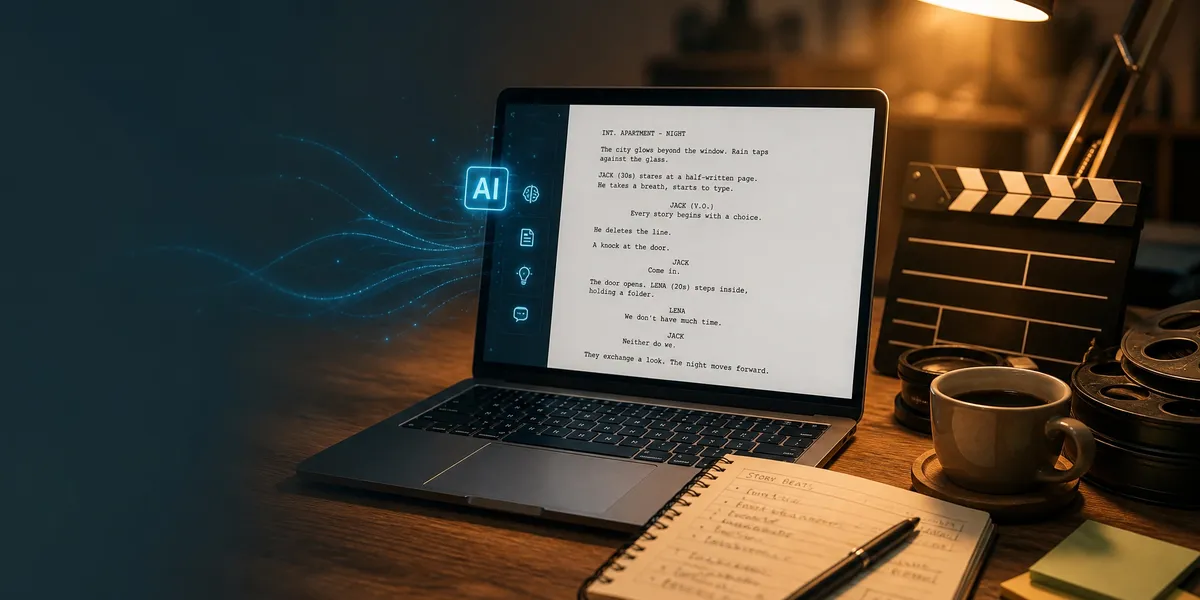
You can write a properly formatted, feature-length screenplay with an AI screenplay generator — but only if you guide it scene by scene instead of asking it to spit out a finished script in one prompt.
In this guide, you’ll learn:
- How an AI screenplay generator actually works (and where it fails)
- The exact step-by-step workflow from logline to polished draft
- The best AI screenwriting tools in 2026, honestly compared
- Prompts that produce usable scenes instead of generic filler
Here’s the full process, starting with what these tools can and can’t do.
What Is an AI Screenplay Generator?
An AI screenplay generator is software that uses artificial intelligence to draft, format, and refine scripts — generating scenes, dialogue, and action lines from your prompts in industry-standard screenplay format. The best tools understand three-act structure, character voice, and slug lines, so the output reads like a real script instead of a blog post with character names.
The technology has changed fast. Modern AI context windows have grown from roughly 4,000 tokens to over 10 million, which means an AI model can now hold multiple full screenplays in memory at once. The old technical limit on long-form scripts is gone.
What hasn’t changed is that a single lazy prompt produces a lazy script. Type “write me a thriller screenplay” into a chatbot and you’ll get clichés, flat dialogue, and a structure that collapses by page 30.
The writers getting great results treat AI as a fast, tireless collaborator — not a vending machine. That distinction shapes everything below.
Can AI Actually Write a Screenplay?
Yes — AI can write a screenplay, and the better tools produce correctly formatted first drafts with real scene structure. But AI is strongest as a drafting and structuring partner, not a finished-product machine. The depth, subtext, and emotional precision that make a script sell still come from you.
Think of it like this. AI is excellent at the mechanical 70% — formatting, generating coverage of a beat, keeping character names consistent, and breaking through the blank page. The remaining 30% — the line a character doesn’t say, the theme that ties the climax to the opening image — is where human judgment earns its keep.
That split is why this guide focuses on workflow. The tool matters less than how you direct it.
How to Write a Screenplay With AI: Step-by-Step
Here’s the workflow that turns an AI screenplay generator from a gimmick into a genuine drafting engine. Each step narrows the AI’s focus so the output stays coherent across 90 to 120 pages.
Step 1: Nail the Logline and Premise First
Before you touch any tool, write a one-sentence logline: a protagonist, a goal, a conflict, and the stakes. “A burned-out paramedic has one night to find his kidnapped daughter before the city’s power grid fails.”
A sharp premise dramatically improves everything the AI generates downstream. Vague input produces vague scenes. Feed the AI the central conflict, the protagonist’s goal, and what they stand to lose, and the draft gets focused immediately.
If you’re stuck on the core idea, an AI plot generator can help you stress-test premises before you commit.
Step 2: Generate a Beat Sheet, Not a Full Script
Ask the AI for a beat-by-beat outline that respects three-act structure — inciting incident, midpoint, low point, climax — tied to your protagonist’s flaw and the central dramatic question.
This is the single most important step. A beat sheet keeps the story coherent across the whole runtime, which is exactly where one-shot AI scripts fall apart. You’re building a skeleton the AI can hang scenes on without losing the thread.
Review and rewrite the beats yourself. Cut anything generic. The beat sheet is your roadmap, so make it specific before generating a single scene.
Step 3: Build Character Profiles for Distinct Voices
Define each major character in the tool’s story panel: their want, their wound, their speech pattern, and what they’d never say out loud.
Good AI screenwriting tools reference these profiles when generating dialogue, so each character keeps a distinct voice instead of all sounding like the same narrator. Without profiles, AI dialogue collapses into interchangeable, on-the-nose exchanges.
For a deeper character-building pass, an AI character generator can flesh out backstory and contradictions, and a strong character arc gives the AI a trajectory to write toward.
Step 4: Generate Scenes One Beat at a Time
Now work scene by scene. Feed the AI one beat, the relevant characters, the location, and the emotional shift the scene must accomplish.
Generating one beat at a time keeps quality high and lets you steer. A scene that lands gets kept; a scene that drifts gets regenerated with a tighter prompt. This is slower than “generate full script,” and that’s the point — it’s how you get a usable draft.
Add a constraint to most scenes: one location, a ticking clock, no phones, a power outage. Constraints create stakes and force visual problem-solving, which is what separates cinematic writing from talking heads.
Step 5: Punch Up the Dialogue
AI dialogue tends to be functional but flat — everyone says exactly what they mean. Your job is to add subtext.
Read every exchange aloud. Trim greetings and small talk. Remove on-the-nose lines and keep what characters avoid saying. A dedicated AI dialogue generator can give you three alternate takes on a flat line so you can pick the one with the most tension.
This pass is fast and it’s where amateur AI scripts become professional ones.
Step 6: Format, Review, and Export
Most AI screenplay generators output in industry-standard format — correct slug lines, action lines, character cues, and parentheticals. That formatting consistency is a genuine advantage over writing from scratch.
Do a full read-through for continuity: character names, timeline, setups and payoffs. Then export to PDF or Final Draft format. The AI draft is your foundation, not your final shooting script.
What to Look for in an AI Screenplay Generator
Not every tool that claims to write scripts actually understands screenwriting. The best AI screenplay generator for you should check these boxes.
- Industry-standard formatting — automatic slug lines, action lines, and character cues, with PDF or Final Draft export.
- Character memory — the tool references your character profiles so voices stay distinct across the whole script.
- Structural awareness — it generates against three-act or beat-sheet structure, not just isolated paragraphs.
- Beat-by-beat control — you can generate one scene at a time and regenerate without nuking the rest.
- Long-form coherence — the story holds together at feature length, which is where weaker tools fall apart.
A tool that only generates strong individual scenes but loses the thread across 100 pages will cost you more time in cleanup than it saves. Coherence is the feature most beginners overlook and the one professionals care about most.
Can You Write a TV Script or Short Film With AI?
Yes — an AI screenplay generator handles TV scripts, short films, web series, and stage plays, not just features. The workflow is the same: logline, beat sheet, character profiles, then scene-by-scene generation. Shorter formats are actually easier for AI because there’s less runtime over which coherence can drift.
For a TV pilot, ask the AI to respect act breaks and a strong button before each commercial break. For a short, lean hard on a single constraint or premise — short films live or die on one sharp idea executed cleanly.
This flexibility is why a tool like Squibler, which spans multiple script types, suits writers who jump between formats.
AI Screenplay Generator vs Writing From Scratch
Here’s an honest comparison of where each approach wins, so you can decide how much to lean on AI.
| Factor | AI Screenplay Generator | Writing From Scratch |
|---|---|---|
| First-draft speed | Days | Weeks to months |
| Formatting | Automatic | Manual or template-based |
| Beating writer’s block | Strong | None |
| Dialogue subtext (raw) | Weak, needs polish | Depends on writer |
| Originality of voice | Needs your direction | Fully yours |
| Cost | Free to subscription | Free (your time) |
The takeaway: AI wins decisively on speed, formatting, and momentum. Human writing still owns originality and subtext — which is exactly why the best results come from combining both rather than choosing one.
Best AI Screenplay Generators in 2026
Here are the tools worth your time, starting with our own. Each is reviewed honestly — including what it doesn’t do well.
Our Pick — Chapter
Chapter is an AI-guided writing platform built for long-form storytelling. Where most script tools generate scenes in isolation, Chapter keeps your premise, characters, and structure consistent across an entire project — so your screenplay’s voice and through-line hold from fade in to fade out.
Best for: Writers who want story coherence across a full-length project, not just one good scene Pricing: $97 one-time (nonfiction) | Varies (fiction) Why we built it: We built Chapter because most AI tools nail a single paragraph and lose the plot across a full work — and a screenplay lives or dies on that long-form consistency.
Chapter is a relevant pick because screenwriting is fundamentally a long-form structure problem. With 2,147+ authors and 5,000+ books created on the platform, its strength is keeping a narrative coherent from beginning to end. It is not a dedicated final-draft-format editor, so most users export and do their final formatting pass elsewhere.
2. Squibler — Versatile script formats
Best for: Writers juggling screenplays, TV scripts, stage plays, and podcast scripts Squibler understands screenplay conventions, dialogue formatting, and scene structure while leaving you in creative control. Its range across script types is genuinely useful if you write in multiple formats. The trade-off is that breadth can mean less depth on any single format compared to film-specific tools. Pricing: Free tier available; paid plans for full features
3. Melies — Feature-length beat-by-beat
Best for: Writers committed to a full 90–120 page feature Melies walks you through every stage — logline, treatment, character bibles, beat sheet, and full script — with a beat-by-beat approach that holds coherence across feature length. It’s purpose-built for film, which is its biggest strength and its narrowest focus. Pricing: Subscription-based
4. Sudowrite — Fiction-trained craft
Best for: Writers who care most about prose-level craft and distinct character voice Sudowrite’s fiction-trained model understands three-act structure and visual writing, and it’s strong at making characters sound different. It’s better known as a novel tool, so screenplay formatting is less central than in script-first apps. Pricing: Subscription tiers based on credits
5. Saga — Idea to storyboard to video
Best for: Filmmakers who want to go from script to visuals in one place Saga has grown from a writing tool into a full filmmaking platform — idea, screenplay, storyboard, and video — with industry-standard formatting and contextual scene generation. If you only want to write, the extra production features may be more than you need. Pricing: Subscription-based
Quick Comparison Table
| Tool | Best For | Format Strength | Pricing |
|---|---|---|---|
| Chapter (Our Product) | Long-form story coherence | Strong structure, export elsewhere | $97 one-time / varies |
| Squibler | Multiple script types | Good, broad | Free + paid |
| Melies | Feature-length film | Excellent, film-specific | Subscription |
| Sudowrite | Prose craft & voice | Good, fiction-first | Subscription |
| Saga | Script-to-video pipeline | Excellent + production | Subscription |
AI Screenplay Prompts That Actually Work
Generic prompts produce generic pages. These prompt patterns give the AI enough constraint to generate usable material.
- Beat prompt: “Write the midpoint scene. [Protagonist] discovers [reveal] in [location]. The scene must shift them from reactive to proactive. One location, real-time, no exposition dumps.”
- Dialogue prompt: “Rewrite this exchange so [Character A] never directly states their fear. Use subtext and what they avoid saying. Keep it under 8 lines.”
- Voice prompt: “[Character] is sarcastic and deflects with humor when scared. Write their reaction to [event] in three distinct takes.”
- Constraint prompt: “Write this confrontation during a citywide power outage. Use the darkness and silence as story tools, not just atmosphere.”
For more ideas to spark scenes and twists, an AI plot twist generator and a broader AI story generator both pair well with screenplay drafting.
Common Mistakes to Avoid
- Asking for the whole script in one prompt. This is the number-one failure mode. Coherence collapses past the first act. Generate beat by beat.
- Skipping the beat sheet. Without a structural roadmap, scenes drift and setups never pay off.
- Accepting flat dialogue. AI dialogue is on-the-nose by default. Always do a subtext pass.
- Ignoring character profiles. Without them, every character sounds identical.
- Treating the draft as final. The AI draft is a foundation. The selling polish is yours.
How Long Does It Take to Write a Screenplay With AI?
With an AI screenplay generator, you can produce a complete first draft in a few days to two weeks, versus the weeks or months a manual first draft takes. The AI handles formatting and beat coverage instantly, while your time goes to outlining, steering scene generation, and the dialogue polish pass.
The honest caveat: a fast draft is not a finished screenplay. Budget real time for revision, because that’s where a script becomes good enough to send out.
Is AI-Written Screenwriting Worth It?
AI-assisted screenwriting is worth it for breaking writer’s block, generating fast first drafts, and exploring alternate scene directions — and most writers report it removes the paralysis of the blank page. It’s less worth it if you expect a submission-ready script with no revision. Used as a collaborator, it speeds up the parts of screenwriting that are slow and mechanical, freeing you for the creative judgment only you can provide.
If you want to keep sharpening the craft alongside the AI workflow, our roundup of the best screenwriting books and our guide to the best AI writing tools are good next stops.
FAQ
Can an AI screenplay generator write a full feature-length script?
Yes, an AI screenplay generator can write a full feature-length script of 90–120 pages, because modern context windows hold entire screenplays in memory. The catch is coherence: you get the best results by generating beat by beat from an outline rather than requesting the whole script at once.
Are AI screenplay generators free?
Some AI screenplay generators are free, including tools like Squibler and several no-signup web generators, though free tiers usually limit length, exports, or advanced features. Paid plans unlock full-length drafting, character memory, and industry-standard formatting, which most serious writers eventually need.
Will an AI-written screenplay get rejected for being AI-generated?
A screenplay isn’t rejected simply for using AI in the drafting process — it’s rejected for weak structure, flat dialogue, or thin characters. Because AI drafts default to those exact weaknesses, your revision and subtext passes are what determine whether the script reads as professional or generic.
Do AI screenplay generators format scripts correctly?
Yes, most AI screenplay generators output industry-standard formatting — correct slug lines, action lines, character cues, and parentheticals. This automatic formatting is one of their biggest advantages, though you should always do a final continuity and formatting review before exporting to PDF or Final Draft.
What’s the best AI for screenwriting in 2026?
The best AI for screenwriting depends on your priority: Chapter for long-form story coherence, Melies for feature-length beat-by-beat structure, Squibler for multiple script formats, and Sudowrite for prose-level craft. Most writers test two or three, since workflow fit matters more than any single feature.