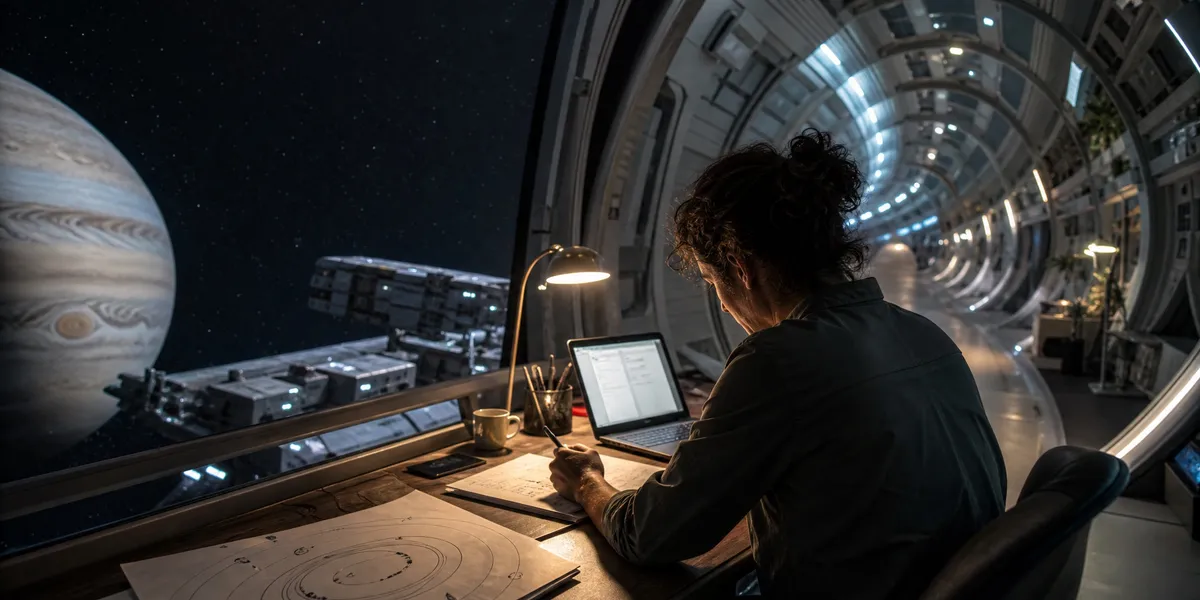
The best AI for writing a sci-fi novel is the one that still remembers your faster-than-light rules in chapter 34. That is the whole game. Prose quality is easy to fix in revision — a manuscript where your jump drive costs fuel in act one and costs nothing in act three is not.
In this comparison, you’ll get:
- A six-rule “canon drift” test you can run on any tool before you commit to it
- Why long context windows do not equal long-form consistency
- A per-tool verdict for hard SF, space opera, and near-future thrillers
- The manual guardrails that keep any AI honest about your world rules
Here is how six tools compare when you stop grading prose and start grading physics.
Quick Comparison
| Tool | Canon Control Mechanism | Full Manuscript | Best For | Pricing |
|---|---|---|---|---|
| Chapter (Our Product) | World rules held as generation constraints for the whole book | Yes — full draft in one pass | A complete, consistent sci-fi manuscript | Varies (fiction) |
| Novelcrafter | Codex entries, injected when you tag them | No — scene by scene | Disciplined worldbuilders | ~$14/mo |
| Sudowrite | Story Bible free-text fields | Partial — chapter by chapter | Prose texture and atmosphere | $19-59/mo |
| Claude (Projects) | Whole manuscript held in a large context window | No — you drive every scene | Auditing a finished draft | $20/mo |
| ChatGPT (Projects) | Project files, consulted via retrieval | No — chapter by chapter | Premise and concept brainstorming | $20/mo |
| Campfire | Structured, cross-linked worldbuilding modules | No — worldbuilding only | Building the world before drafting | Free tier + modules |
What Is Canon Drift in Sci-Fi Writing?
Canon drift — the slow contradiction of your own invented rules across a long manuscript, where established physics, technology limits, or worldbuilding facts quietly change without the story acknowledging it.
It is the single most common reason AI-drafted science fiction reads as fake. Fantasy readers forgive a fuzzy magic system. Science fiction readers do not forgive a starship that takes eight months to reach Ceres in chapter 4 and eleven days in chapter 27.
The Science Fiction and Fantasy Writers Association has spent decades publishing craft essays on the same theme: the genre’s contract with the reader is internal consistency, not scientific accuracy. Break the consistency and the whole speculative structure collapses.
The Canon Drift Test: Run This Before You Commit to a Tool
Do not take anyone’s word for how a tool handles continuity — including ours. Tool behavior changes with every model update, so a benchmark published today is stale by the next release. Run this yourself, on your own premise, in an afternoon.
Step 1: Plant six rules that contradict real-world defaults
The rules that drift are the ones fighting a prior. Write six constraints into your opening chapters that invert how the world normally works. A near-future template:
- FTL costs mass. Every jump burns 4% of ship mass as exotic fuel.
- Comms lag is real. No instantaneous messaging — light-speed delay applies everywhere.
- Gravity is spin-generated. No artificial gravity plating; corridors curve.
- Synthetic minds have no legal personhood in the Belt jurisdictions.
- Currency is water-backed, priced per ton of delivered ice.
- The alien biology is silicon-based and cannot metabolize Earth protein.
Swap in your own — the point is that each rule must be checkable in a single sentence of prose, and each must contradict something the model absorbed from a million other stories.
Step 2: Prompt for a chapter deep in the book
Ask the tool to draft chapter 28, not chapter 4. Give it a scene that puts pressure on your rules without naming them:
“Draft chapter 28. My protagonist is stranded at a remote station, needs to reach her sister on Mars urgently, has to bribe a dock official for passage, and shares a meal with the alien envoy while she waits.”
That scene quietly touches four of the six rules. A tool that holds canon will show her waiting hours for a reply, paying in ice tonnage, walking a curved floor, and watching the envoy not eat.
Step 3: Score the draft against your list
Read with the constraint list beside you and mark every contradiction. You are looking for four failure patterns:
- Instant replies across interplanetary distances — the most common failure in every tool we have used
- Free capabilities — the drive, the jump, the scanner working with no stated cost
- Default-Earth physics creeping back in: flat floors, standard gravity, normal currency
- Convenient biology — the alien eating, drinking, or breathing like a human because the scene needed a shared meal
Step 4: Repeat once
Run the same prompt twice. Consistency across two runs tells you more than a single good result, which is often luck.
The tools below are ranked on their stated, checkable canon-control mechanism — architecture, story-bible features, context handling, pricing, and genre fit — not on scores from any benchmark. Run the test to see how each behaves on your premise.
1. Chapter — Best Overall for a Full Sci-Fi Manuscript
Our Pick — Chapter
Chapter generates a complete novel-length manuscript in a single guided workflow. Your world rules are captured before drafting begins and applied across every chapter, rather than re-fed to a chat window scene by scene.
Best for: Writers who want a full sci-fi draft with world rules held consistent end to end Pricing: Varies (fiction software) Why we built it: Writers kept telling us the same thing — the AI wrote beautifully for three chapters and then forgot the entire premise. We built Chapter so the premise is structural, not something you have to keep reminding the machine about.
Canon control mechanism: world rules as generation constraints across the entire manuscript.
This is an architectural difference, not a smarter model. Chat tools generate chapter 28 in a conversation that no longer contains chapter 2. Chapter generates the manuscript as one continuous artifact, so the constraints you set apply to the last chapter as much as the first.
For science fiction specifically, that matters more than in any other genre. Your reader is actively auditing you. Hugo Award voters have been rewarding rigorous worldbuilding since 1953, and the audience that reads hard SF is the same audience that will email you about your delta-v math.
What works well for sci-fi:
- One pass, not forty prompts. You are not managing a context budget or pasting your series bible into a chat window every session.
- Rules are set once, up front. Spin gravity does not have to be re-established every time you open a new session.
- Publish-ready output. Front matter, chapter structure, and formatting suitable for KDP without a separate conversion step.
- Scale for series. Sci-fi rarely stops at one book. Consistent canon in book one is what makes book three writable.
Chapter is used by 2,147+ authors and has produced 5,000+ books, and the platform has been featured in USA Today and the New York Times.
Honest limitations: Chapter drafts the book. It does not give you a scene-by-scene co-writing chat where you nudge a single paragraph twelve times — if that granular back-and-forth is your favorite part of writing, you will want a chat tool alongside it. And it will not invent rigorous orbital mechanics for you. If your premise is physically incoherent going in, you get a coherent draft of an incoherent premise. Run the canon test on your own premise before you scale up.
2. Novelcrafter — Best Manual Canon Control
Best for: Writers who enjoy building and maintaining a structured codex themselves Pricing: Around $14/month Canon control mechanism: codex entries, injected into the prompt when tagged to a scene.
Novelcrafter’s codex is genuinely the best manual worldbuilding database attached to a drafting tool. You create entries for your FTL system, your factions, your alien biology, and tag them so relevant entries travel with the scene you are drafting.
The structural weakness follows directly from that design: an untagged entry is an invisible entry. Your canon holds exactly as well as your tagging discipline holds. When you run the canon test here, the drift you find will usually trace back to a rule you forgot to attach, not a rule the model ignored.
For a disciplined worldbuilder writing space opera with fifty named systems, that trade is often worth it. For someone drafting their first novel, the admin overhead is real. Our fuller Novelcrafter review covers the workflow in depth.
3. Sudowrite — Best Prose Texture
Best for: Writers who want atmospheric sci-fi prose and will police continuity themselves Pricing: $19-59/month Canon control mechanism: Story Bible free-text fields for characters, outline, and worldbuilding.
Sudowrite produces the most evocative sentences on this list. Its Story Bible captures your world notes and feeds them into generation, which is more than a raw chat window offers.
The catch is that free text competes with narrative momentum. When the model has to choose between an emotionally satisfying scene beat and a light-lag constraint buried in a notes field, expect the scene beat to win. Communication delay is the rule most likely to slip, because the entire training corpus of contemporary fiction assumes phones work instantly.
Treat Sudowrite as a prose engine with a continuity checklist you enforce by hand. See our Sudowrite review for the full picture.
4. Claude Projects — Strong Reasoner, Best as an Auditor
Best for: Auditing an existing manuscript for contradictions Pricing: $20/month Canon control mechanism: a large context window holding the manuscript and your notes.
This is where the most instructive misconception lives. Claude has a large context window, and the natural assumption is that a large window solves continuity. It does not.
Long context is retrieval capacity, not adherence. It means the model can find your rule. It does not mean the rule outranks the genre expectation the model absorbed from a million other stories. Rules with a strong narrative convention pulling against them — synthetic personhood, non-standard currency — are the ones to watch when you run the test.
Where Claude is genuinely excellent: hand it a finished draft plus your six-rule constraint list and ask it to flag every place the rules are contradicted. As a continuity auditor it is the strongest option here, and that is a job no other tool on this list does well. More on its strengths in Claude for creative writing.
5. ChatGPT Projects — Most Flexible, Weakest Canon Mechanism
Best for: Brainstorming premises, alien concepts, and worldbuilding prompts Pricing: $20/month Canon control mechanism: project files consulted via retrieval.
ChatGPT is the fastest to produce a readable chapter. Its canon mechanism is also the loosest on this list, and the reason is worth understanding: retrieval means your world rules are consulted when the model judges them relevant. In a fight scene, the model rarely judges the currency standard relevant — right up until it writes a bribe.
That does not make it useless. For generating the raw speculative material — alien ecologies, political systems, technology consequences — it remains the most inventive brainstorming partner here. Use it upstream, not for drafting chapter 28. If ChatGPT is your main tool, our guide to writing a novel with ChatGPT covers the guardrails.
6. Campfire — Best Pure Worldbuilding Database
Best for: Sci-fi writers who want a rigorous, queryable world before drafting anything Pricing: Free tier, paid modules Canon control mechanism: structured, cross-linked modules — it does not draft.
Campfire is not an AI drafting tool, and it is on this list for a reason. Its modular system lets you build a species module, a technology module, a timeline, and a relationship map, all cross-linked.
If you are writing hard SF where the technology is the plot, doing this work first — before any AI touches the draft — is the highest-leverage hour you will spend. It is also where your six-rule constraint list should live. Our roundup of AI worldbuilding tools covers where Campfire fits alongside generative options.
Why Do AI Tools Break Sci-Fi Rules More Than Fantasy Rules?
AI tools break sci-fi rules more often than fantasy rules because science fiction constraints contradict real-world defaults, while fantasy constraints only add to them. A model has no default assumption about how dragons work. It has an extremely strong default assumption that messages arrive instantly and that floors are flat.
Every rule you invent for a sci-fi novel is fighting a prior. That is why the test above uses constraints that specifically invert contemporary reality — spin gravity instead of plating, light lag instead of instant comms. Those are exactly the rules that quietly revert.
The practical implication: state your sci-fi rules as prohibitions, not descriptions. “Comms have light-speed delay” gets overridden. “No character ever receives a reply from off-world in the same scene” survives better, because it is a testable rule rather than a setting detail.
What Should You Do Before You Let Any AI Draft?
Write your rules down as a constraint list before you generate a single word. Not a lore document — a list of things that cannot happen.
A working sci-fi constraint list has five parts:
- Hard physics. What your universe forbids. Speed limits, energy costs, communication delays.
- Technology costs. Every capability needs a price. A jump drive that costs nothing generates no plot.
- Social consequences. How the technology reshaped law, labor, and family. This is where most AI drafts go thin.
- Biology rules. If you have alien species, what they eat, breathe, and cannot survive.
- Economic base. What backs the currency and who controls it.
Feed that list to whatever tool you use. Then check chapter 28 against it — not chapter 3, where everything is always fine. Our guide on writing sci-fi technology believably goes deeper on building costs into your inventions.
For grounding the physics itself, NASA’s public research library and the long-running Atomic Rockets reference remain the two resources working SF writers cite most.
Can AI Write a Publishable Sci-Fi Novel?
AI can write a publishable sci-fi novel, but only with a human enforcing world consistency and revising the prose. The draft handles structure, pacing, and volume. You handle the physics audit, the voice pass, and the thematic layer that makes the speculation mean something.
The market is receptive. Science fiction remains one of the strongest-selling categories on Amazon KDP, and outlets like Reactor have been documenting the genre’s expansion into new subgenres for years. What has not changed is that readers detect incoherent worlds within about forty pages.
How Long Does It Take to Write a Sci-Fi Novel With AI?
Writing a sci-fi novel with AI typically takes two to six weeks from premise to revised draft, compared to nine to eighteen months writing unaided. The generation itself is fast — with Chapter, a full manuscript comes back in roughly an hour.
The time goes into the work AI cannot do: the constraint list up front, the continuity audit after, and the revision pass that turns competent prose into your prose. Budget most of your schedule for the back half.
FAQ
What is the best AI for writing a sci-fi novel?
The best AI for writing a sci-fi novel is Chapter, because it applies your world rules across a complete manuscript instead of losing them in chat history. Novelcrafter is the strongest alternative if you prefer to manage a manual codex yourself, scene by scene.
Can ChatGPT write a full science fiction novel?
ChatGPT cannot write a full science fiction novel in one pass. It drafts chapter by chapter, and its retrieval-based project files mean world rules established early can be skipped later, when the model does not judge them relevant to the current scene.
Do AI tools understand hard science fiction?
AI tools do not reliably understand hard science fiction. They reproduce the texture of technical prose without checking the math behind it. Verify orbital mechanics, energy budgets, and travel times against real sources yourself — treat every number the AI produces as a placeholder.
Will readers know my sci-fi novel was written with AI?
Readers rarely detect AI from prose alone. They detect it from inconsistency — a rule established in chapter 2 and broken in chapter 27. Fix your canon and the question mostly disappears. A continuity audit before publication matters more than any stylistic edit.
What sci-fi subgenre works best with AI drafting?
Space opera works best with AI drafting, because its conventions are well represented in training data and its rules are more flexible. Hard SF is the hardest, since every technical claim needs verification. Near-future thrillers land in between — strong output, but heavy fact-checking on current technology.
The Verdict
If you want a complete sci-fi manuscript with your world rules applied from chapter one to the last page, Chapter is the pick — it is the only tool here that treats your canon as a constraint on the whole book rather than as context you keep re-supplying.
If you would rather assemble the book scene by scene and maintain the canon by hand, Novelcrafter is the honest second choice. And whatever you draft with, run the canon test before you commit and a continuity audit before you publish. Those two steps are what separate a science fiction novel from a collection of chapters set in vaguely the same place.
Ready to start? Try Chapter’s fiction software, or work through the fundamentals first with our guide on how to write a sci-fi novel and a batch of sci-fi writing prompts to find your premise.