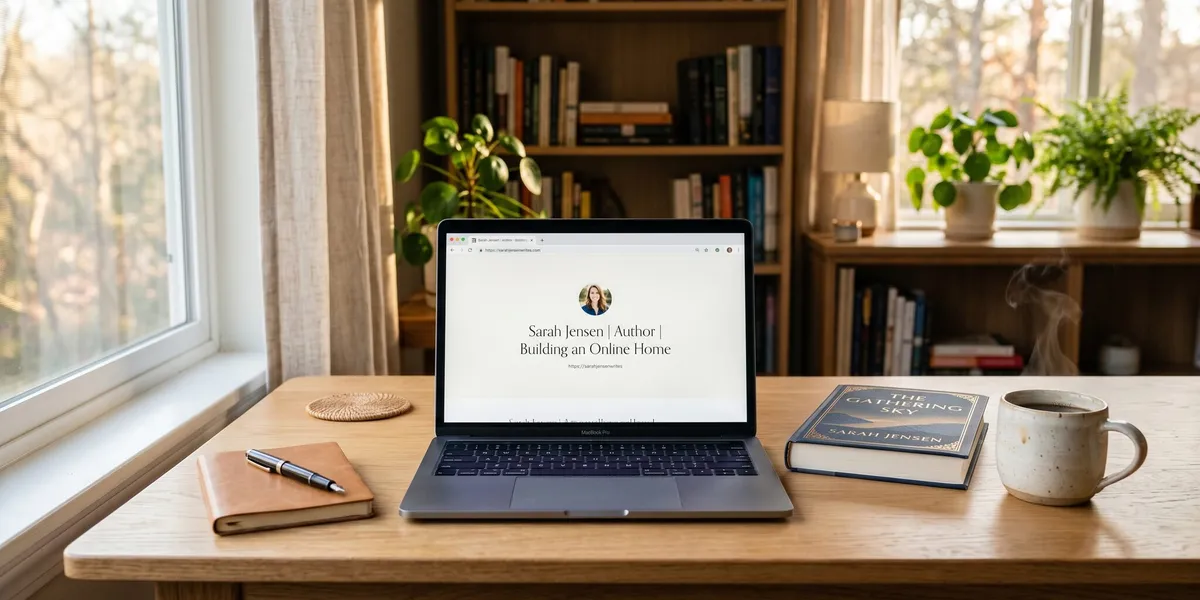
The best domain name for authors is your author name dot com — yourname.com. It is the most searchable, most memorable, and most professional option for building a lasting author platform.
In this guide, you’ll learn:
- The 9 best domain name strategies for authors (ranked by effectiveness)
- Which TLD extensions actually matter — and which look spammy
- How to handle pen names, common names, and taken domains
- Where to register your domain for the lowest cost
Here are the best domain name options for authors, ranked.
1. YourName.com — The Gold Standard
Our Pick — Chapter
If you’re building an author career, start with your name as your domain and Chapter as your writing tool. Over 2,147 authors have used Chapter to write and publish books — and every one of them needed a professional domain first.
Best for: Every author, fiction and nonfiction
Your author name as a .com is the single best domain name choice you can make. When readers search for you after discovering your book on Amazon, at a reading, or through a recommendation, they type your name into Google. JaneSmith.com is what they expect to find.
This strategy works because it is future-proof. Book titles change. Series end. Genres shift. But your name stays the same across your entire career.
Pricing: $10-15/year at most registrars
Why it works: Agents, publishers, and media check your website before reaching out. A professional YourName.com signals you take your career seriously.
2. YourNameAuthor.com — When Your Name Is Taken
Best for: Authors with common names
If janesmith.com is already registered, janesmithauthor.com is the strongest alternative. It keeps your name front and center while adding a clear professional identifier.
This works better than adding numbers or hyphens because it remains easy to say out loud. When someone asks for your website at a book signing, “janesmithauthor.com” rolls off the tongue naturally. “jane-smith-42.com” does not.
Other acceptable suffixes include writes, books, or stories — but author is the most universally understood.
3. YourNameBooks.com — For Prolific Authors
Best for: Authors with multiple titles or a series
YourNameBooks.com signals to visitors that they are landing on a bookshelf, not a personal blog. This works particularly well if you have three or more published books and want your website to function as a catalog.
The slight downside is that it ties your brand to books specifically. If you later expand into courses, speaking, or consulting, the domain feels limiting. For pure book-selling authors, though, it is an excellent choice.
4. PenName.com — The Underrated Power Move
Best for: Fiction authors writing under a pen name
If you write under a pen name, buy that domain immediately — even before your first book is published. Your pen name IS your brand, and securing the .com early prevents someone else from grabbing it after your first bestseller.
Romance authors, thriller writers, and anyone writing in a genre where pen names are standard should treat this as non-negotiable. I write under Faye Lennox, and FayeLennox.com is where my readers find me.
Pro tip: If you write in multiple genres under different pen names, buy a domain for each one. A romance reader searching for your pen name should not land on your horror catalog.
5. YourName.author — The Niche TLD
Best for: Authors who want a distinctive, modern URL
The .author top-level domain exists specifically for writers. JaneSmith.author immediately communicates what you do without adding extra words.
The trade-off is familiarity. Most readers still default to typing .com in their browsers. And .author domains are managed by Amazon through their registry, which means availability and pricing can be less predictable than traditional extensions.
If your .com is taken and you want something cleaner than janesmithauthor.com, the .author TLD is worth considering — but always buy the .com variant too and redirect it if possible.
6. YourName.me — The Personal Brand Option
Best for: Memoirists, personal essayists, and speaker-authors
The .me extension works naturally for authors whose brand is deeply personal. If you write memoirs, personal development books, or build your career around speaking and coaching, yourname.me feels intentional rather than like a backup plan.
It is also widely available, since fewer people compete for .me domains compared to .com. Registration costs are comparable at $10-20/year through most registrars.
7. YourNameWrites.com — The Action-Oriented Choice
Best for: Authors who also blog, freelance, or create content
JaneSmithWrites.com positions you as an active creator, not just someone with a book on a shelf. This domain style works well for authors who maintain a writing blog, offer freelance services, or produce regular content alongside their books.
The word “writes” is short, memorable, and professional. It avoids the generic feel of .net or .org while keeping your name as the primary identifier.
8. BookTitle.com — For Single-Title Authors (With Caveats)
Best for: Authors promoting one flagship book
If you have written one book and your entire marketing strategy revolves around that title, a book-title domain can work — temporarily. TheArtOfSlowLiving.com immediately tells visitors what the book is about.
The major downside is longevity. When you publish your second book, this domain becomes awkward. You either need to rebrand the entire site or buy a new domain and start building authority from scratch.
Recommendation: Even if you use a book title domain for a launch campaign, always own YourName.com as your long-term home base.
9. YourName.co — The Modern Fallback
Best for: Authors whose .com is taken by a non-author
The .co extension has gained legitimacy over the past decade. Major companies use it, and readers increasingly recognize it as a real website rather than a typo.
It is a solid backup if your .com is occupied by someone who is not you and is not willing to sell. The price is comparable to .com at most registrars, and the domain is short enough to print on business cards and book covers without confusion.
Quick Comparison Table
| Domain Strategy | Best For | Cost/Year | Memorability | Long-Term Value |
|---|---|---|---|---|
| YourName.com | Everyone | $10-15 | High | Excellent |
| YourNameAuthor.com | Common names | $10-15 | High | Excellent |
| YourNameBooks.com | Prolific authors | $10-15 | Medium | Good |
| PenName.com | Fiction writers | $10-15 | High | Excellent |
| YourName.author | Modern branding | $15-30 | Medium | Good |
| YourName.me | Personal brands | $10-20 | Medium | Good |
| YourNameWrites.com | Bloggers/freelancers | $10-15 | Medium | Good |
| BookTitle.com | Single title | $10-15 | High (short-term) | Poor |
| YourName.co | Backup option | $10-25 | Medium | Good |
How to Choose the Right Domain Name for Your Author Website
Picking the right domain comes down to three questions. Answer them honestly and the choice becomes obvious.
Question 1: Is your real name (or pen name) available as a .com?
If yes, buy it right now. Do not overthink this. YourName.com is the correct answer for 90% of authors. Go to Namecheap or Cloudflare Registrar and register it today.
Question 2: Do you write under a pen name?
Buy your pen name domain AND your real name domain. Your pen name domain is your public-facing author site. Your real name domain can redirect to it — or serve as a professional portfolio if you do speaking, consulting, or media.
Question 3: Is your name extremely common?
Try YourNameAuthor.com first. If that is also taken, check YourNameBooks.com or YourNameWrites.com. Avoid adding numbers, hyphens, or random words that make the URL hard to remember.
Which Domain Extensions to Avoid
Not all TLDs are created equal. Some actively hurt your credibility.
Avoid these extensions:
.biz— Looks spammy and outdated.info— Associated with low-quality sites.xyz— Too unfamiliar for most readers.site— Generic and forgettable.blog— Only works if your entire site is a blog (and even then,.comis better)
Also avoid:
- Hyphens in your domain —
jane-smith-author.comlooks unprofessional and is hard to communicate verbally - Numbers —
janesmith123.comsignals that you settled for leftovers - Subdomain-only sites —
janesmithauthor.wordpress.comorjanesmith.wixsite.comsacrifices SEO and credibility
Your domain is often the first impression you make on a potential reader. It should look intentional, not accidental.
Where to Register Your Author Domain
The registrar you choose affects price, renewal costs, and whether your personal information gets exposed publicly.
Top registrars for authors:
- Namecheap — Low prices ($8-10/year for .com), free WHOIS privacy, simple interface
- Cloudflare Registrar — At-cost pricing (no markup), excellent performance if you also use their CDN
- Porkbun — Affordable with free WHOIS privacy included, beginner-friendly
- Google Domains — Clean interface, transparent pricing, integrates well with Google Workspace
What to look for:
- Free WHOIS privacy — This hides your home address from public domain records. Some registrars charge extra; the best ones include it free
- No price gouging on renewal — Some registrars offer $1 first-year pricing then jump to $20+ on renewal. Check the renewal price before buying
- Easy DNS management — You will need to point your domain to your website builder eventually. Simple DNS settings save headaches
Domain Privacy: Why Authors Need WHOIS Protection
When you register a domain, your name, email, phone number, and home address become part of the public WHOIS database — unless you enable privacy protection.
For authors, this matters more than for most people. If you write under a pen name for privacy reasons, an unprotected domain registration can expose your real identity. If you write controversial content, your home address becomes publicly searchable.
Most reputable registrars now include WHOIS privacy for free. If yours charges extra, switch registrars. It is that important.
Should You Buy Multiple Domains?
Yes — if you can afford the $10-15/year per domain. Here is what to secure:
- Your primary author domain (the one your website lives on)
- Common misspellings of your name (redirect to your main site)
- Your pen name domains (if you write under multiple names)
- Your book title domains (optional — useful for launch campaigns, then redirect to your main site)
You do not need to build separate websites for each domain. Buy them, set up redirects to your primary site, and you are covered. This prevents squatters and ensures readers always find you regardless of what they type.
How to Connect Your Domain to Your Author Website
After buying your domain, you need to connect it to wherever your author website lives. The process depends on your platform.
For WordPress, Squarespace, or Wix:
- Log into your domain registrar’s dashboard
- Find DNS settings or nameserver settings
- Point your nameservers to your website platform (each platform provides specific nameserver addresses)
- Wait 24-48 hours for DNS propagation
For authors building with a custom setup:
Update your domain’s A record to point to your hosting server’s IP address. Your hosting provider will give you the exact IP to use.
Most website builders designed for authors include step-by-step domain connection guides. If you get stuck, their support teams handle domain connections daily.
Common Domain Name Mistakes Authors Make
Waiting too long to buy. Domains cost $10/year. Buy your author name domain the day you decide to publish, not the day your book launches. By then, a squatter might have grabbed it.
Choosing a clever name over a clear one. WordsOfWonder.com might sound creative, but nobody will find it when searching for your name. Your domain should be discoverable, not clever.
Ignoring renewals. Set your domain to auto-renew. Letting a domain expire means losing it — and potentially paying hundreds to buy it back from a domain squatter.
Skipping privacy protection. Your home address in a public database is not worth saving $5/year. Enable WHOIS privacy on every domain you own.
Building on a free subdomain. Starting with youname.wordpress.com costs you SEO authority that you will never recover when you eventually move to a real domain. Start with your own domain from day one.
What Is the Best Domain Name for Authors?
The best domain name for authors is your author name as a .com — like YourName.com or PenName.com. This format is the most memorable, most professional, and most future-proof option. Over 90% of successful authors use their name as their primary domain because it works across every genre, every book, and every stage of a writing career.
How Much Does an Author Domain Name Cost?
An author domain name costs $8-15 per year for a .com through registrars like Namecheap, Cloudflare, or Porkbun. Premium domains (short, common names) can cost more, but most author names are available at standard pricing. WHOIS privacy protection — which hides your personal address — should be free with any good registrar.
Should Authors Use Their Real Name or Pen Name for a Domain?
Authors should use whichever name appears on their book covers as their domain. If you publish under a pen name, your domain should be your pen name. If you use your real name, register that. Ideally, buy both — use your publishing name as the primary site and redirect the other to it.
Can You Change Your Author Domain Name Later?
You can change your author domain name later, but it comes with SEO costs. Every link pointing to your old domain, every Google ranking you have built, and every bookmark a reader saved will break unless you set up proper redirects. Starting with the right domain saves you from this pain. Choose carefully now so you do not have to rebrand later.
FAQ
What TLD Should an Author Use?
Authors should use the .com TLD whenever possible. The .com extension is the most recognized, most trusted, and easiest for readers to remember. If .com is unavailable, .author, .me, and .co are acceptable alternatives — but avoid .biz, .info, and .xyz, which can appear spammy.
Do I Need a Domain Name Before Publishing My Book?
Yes, you should buy your domain name before publishing your first book. Securing your author name domain early costs only $10/year and prevents someone else from registering it. You do not need to build a full author website immediately — just buy the domain and park it until you are ready.
Should I Buy My Book Title as a Domain?
Buying your book title as a domain is optional but useful for launch campaigns. You can create a simple landing page at YourBookTitle.com for pre-orders and marketing, then redirect it to your main author website after launch. Never use a book title domain as your only website — it limits your career to a single title.
What Happens if Someone Else Owns My Author Name Domain?
If someone else owns your author name as a .com, try adding “author,” “books,” or “writes” after your name — like JaneSmithAuthor.com. You can also check if the .author or .me extension is available. Avoid paying inflated prices to domain squatters unless the domain is critical to your brand. Most readers will find you through search engines regardless of your exact domain.
How Do I Protect My Author Domain From Expiring?
Protect your author domain by enabling auto-renewal in your registrar’s dashboard and keeping your payment method up to date. Set a calendar reminder 30 days before expiration as a backup. If your domain expires, you typically have a 30-day grace period to renew it before it becomes available to the public — but don’t rely on this. Auto-renew is the safest approach.