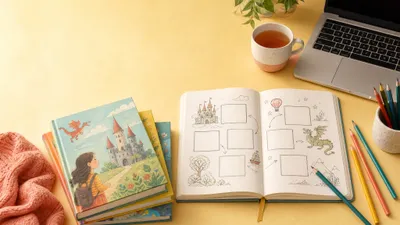
You can absolutely write a choose your own adventure book — and the format is seeing a serious revival thanks to new digital tools and reader demand for interactive stories.
In this guide, you’ll learn:
- How to plan a branching story structure without losing track of your paths
- The decision tree method that keeps your narrative manageable
- How to write multiple satisfying endings
- Which tools and platforms make CYOA writing easier in 2026
Here’s the complete process from concept to published book.
What Is a Choose Your Own Adventure Book?
Choose your own adventure (CYOA) — A book format where you, the reader, make decisions at key story moments that determine which path the narrative follows, leading to multiple possible endings.
The original Choose Your Own Adventure series launched in 1979 and sold over 250 million copies. Today the format has expanded well beyond children’s books. Adult interactive fiction, romance CYOA novels, educational branching scenarios, and AI-assisted interactive stories are all thriving.
The core mechanic is simple. You read a scene, reach a decision point, and flip to the page (or click the link) that matches your choice. But writing one requires a completely different planning approach than a linear novel.
How to Plan Your Branching Story Structure
Planning is where most CYOA projects succeed or fail. A linear novel has one path. A branching story can have dozens — and each one needs to feel complete.
Start with your core storyline. This is the main narrative arc that every reader experiences regardless of their choices. Think of it as the trunk of a tree. Your branches grow from it, but the trunk holds everything together.
Write a one-paragraph summary of your story’s central conflict, setting, and protagonist before you create a single branch. Every decision point you add later should connect back to this core.
The Decision Tree Method
Draw your story as a flowchart. Start at the top with your opening scene and branch downward at each decision point. This visual map — called a decision tree — is the single most important planning tool for CYOA writing.
Here’s a basic structure:
| Element | Description | Example |
|---|---|---|
| Opening Node | The scene every reader starts with | You wake up in a mysterious library |
| Decision Point | Where the reader chooses | Do you open the locked door or read the glowing book? |
| Branch | A path following a choice | Opening the door leads to Chapter 3 |
| Convergence Point | Where branches rejoin | Both paths lead to the underground chamber |
| Ending Node | A story conclusion | You escape with the artifact (happy ending) |
Most successful CYOA books use a diamond structure rather than a pure tree. Branches split apart at decision points but merge back together at convergence points. This keeps your total page count manageable while still giving readers meaningful choices.
Without convergence points, a story with just 10 binary decisions would need over 1,000 unique scenes. With strategic convergence, you can tell the same story in 40-60 scenes.
How to Write Decision Points That Actually Matter
Bad decision points give readers a meaningful choice and a boring choice. Good decision points make both options genuinely tempting.
Every decision point should follow these three rules:
- Both choices must be reasonable. If one option is obviously better, you haven’t written a real choice. “Do you fight the dragon or run away screaming into traffic?” isn’t a choice — it’s a trick.
- Each choice should reveal character. The best decisions force readers to pick between competing values. Safety vs. adventure. Loyalty vs. self-interest. Truth vs. kindness.
- Consequences should be proportional. A small choice (turn left or right) shouldn’t immediately kill the reader. Save high-stakes consequences for high-stakes decisions.
Aim for 2-3 choices per decision point. Two is the standard. Three works when all options feel genuinely distinct. More than three overwhelms readers and multiplies your writing workload exponentially.
How Many Endings Does a Choose Your Own Adventure Book Need?
A choose your own adventure book typically needs 5 to 15 endings depending on length and complexity. The original CYOA series averaged about 8 endings per book, with a mix of positive, negative, and ambiguous conclusions.
Here’s a breakdown that works well:
- 2-3 “best” endings — The most satisfying conclusions. Readers who made thoughtful choices reach these.
- 2-4 “good” endings — Positive but not perfect. Maybe you escaped but left something behind.
- 2-4 “neutral” endings — The story resolves but nothing spectacular happens. You survived, but barely.
- 1-3 “bad” endings — Things go wrong. Use these sparingly — more than a few and readers feel punished for exploring.
Important: keep bad endings under control. If most paths lead to failure, your reader stops feeling like they’re on an adventure and starts feeling like they’re being tricked. The original series kept bad endings to roughly one-third of total endings or fewer.
Every ending — even the bad ones — should feel like a natural consequence of the choices made, not a random punishment.
How to Outline a CYOA Book Without Losing Your Mind
The biggest challenge in CYOA writing is tracking all your branches. Here’s a practical workflow:
Step 1: Write your core path first. Draft the story as if it were a linear novel — beginning, middle, and your best ending. This becomes your “golden path.”
Step 2: Identify natural decision points. Go back through your golden path and mark every moment where the character faces a meaningful choice. You’ll probably find 8-15 of these in a typical story.
Step 3: Select 5-8 decision points to develop. You don’t need to branch at every possible moment. Pick the decisions that are most interesting and most consequential.
Step 4: Write alternative branches. For each selected decision point, write the path that diverges from your golden path. Some branches will be short (a scene or two before converging back). Others will be longer detours with their own endings.
Step 5: Map everything visually. Use a book outline template or a digital tool like Twine to see your full story structure at a glance. Color-code your branches. Mark convergence points. Flag dead ends.
Step 6: Playtest your paths. Read through every possible route from start to finish. Check that each path feels like a complete story, not a fragment that dead-ends awkwardly.
This method keeps you organized without requiring you to write a thousand scenes. A typical CYOA book using this approach has 15,000-30,000 total words across all paths, with any single readthrough covering 5,000-10,000 words.
What Tools Do You Need to Write Interactive Fiction?
You don’t need special software to write a CYOA book — a word processor and a flowchart work fine. But dedicated tools make the process significantly easier, especially for tracking branches.
Free Tools
Twine is the most popular free tool for interactive fiction. It’s open source, runs in your browser, and gives you a visual map of your story’s branching structure. Version 2.12.0 (released April 2026) supports multiple story formats including Harlowe and SugarCube. Best for digital/web-based interactive stories.
Inklewriter is a free web-based tool from the studio behind the award-winning game 80 Days. It’s specifically designed for branching narratives with a clean, distraction-free writing interface. Great for beginners.
Google Docs + draw.io — For writers who prefer traditional word processors, write your scenes in Google Docs and map your branches in draw.io (a free flowchart tool). Low-tech but effective.
Paid/Professional Tools
Ink (by Inkle Studios) is a scripting language used in professional game development. It gained AAA credibility when Vampire: The Masquerade - Bloodlines 2 shipped using Ink for its dialogue system. Best for writers comfortable with light coding.
Scrivener works well for CYOA writing because its binder system lets you organize scenes as individual documents that you can rearrange freely. Use labels and custom metadata to track which branch each scene belongs to.
Our Pick — Chapter
If you’re writing a choose your own adventure book and want AI assistance with generating scene variations, plotting branch consequences, or drafting alternative paths quickly, Chapter helps you produce multiple story branches faster than writing each one from scratch.
Best for: Writers who want AI-powered help generating branching content at scale Pricing: $97 one time, 2 books included (fiction or nonfiction), 30-day money-back guarantee Why we built it: Creating 10+ story branches means writing 3-5x more content than a linear book — AI assistance makes that workload manageable.
How to Write in Second Person for CYOA
Choose your own adventure books are written in second person point of view — “you” are the main character. This POV is rare in traditional fiction but essential for CYOA because it puts the reader directly into the story.
Tips for writing strong second-person CYOA prose:
- Be specific about what “you” experience. Instead of “You feel scared,” write “Your hands shake as the door creaks open. The smell of rust hits you before the darkness does.”
- Keep descriptions action-oriented. Readers want to do things, not passively observe. Lead with verbs. “You grab the rope. You sprint toward the ledge. You jump.”
- Avoid telling readers what they think. “You decide this is a bad idea” takes away the reader’s agency. Instead, present the situation and let the choice speak for itself.
- Stay in present tense. Most CYOA books use present tense (“You open the door”) rather than past tense (“You opened the door”). Present tense creates immediacy that matches the decision-making format.
Second person combined with present tense creates a reading experience that feels more like a game than a traditional novel — which is exactly what you want.
Can You Write a Choose Your Own Adventure Book for Adults?
Yes — and the adult interactive fiction market is growing fast. While the original CYOA series targeted middle-grade readers (ages 8-12), today’s branching narratives span every genre and age group.
Popular adult CYOA formats include:
- Literary interactive fiction — Serious narratives exploring complex themes through reader choice (think Black Mirror: Bandersnatch in book form)
- Romance CYOA — Readers choose their love interest and shape the relationship’s outcome
- Thriller/horror CYOA — Survival-style stories where wrong choices have consequences
- Business/educational scenarios — Training materials that use branching narratives to teach decision-making
- AI-assisted interactive stories — Digital stories that use AI story generators to create personalized branching content
For adult audiences, you can increase complexity. More decision points, longer branches, morally ambiguous choices, and endings that aren’t clearly “good” or “bad.” Adult readers appreciate nuance that younger audiences might find frustrating.
How to Self-Publish a Choose Your Own Adventure Book
Publishing a CYOA book works differently depending on format — print or digital.
Print Format
For print CYOA books, you’ll use page references (“Turn to page 47” or “Go to Chapter 12”). Format your manuscript so each scene starts on a new page, and include clear navigation instructions at every decision point.
Amazon KDP handles print CYOA books well. Upload your formatted manuscript as a PDF, set up your page references, and publish. The best self-publishing platforms all support this format.
Print formatting tips:
- Number your scenes, not your pages (scene numbers are easier to manage than page numbers during editing)
- Include a “how to read this book” page at the front
- Keep decision points at the bottom of a page so readers don’t accidentally see the next scene
- Test your page references multiple times — broken links ruin the experience
Digital Format
Digital CYOA books have more options. You can publish as:
- Ebook with hyperlinks — Use internal links in your epub/mobi file so readers tap their choice and jump directly to the right scene. KDP and most ebook platforms support this.
- Web-based story — Publish on platforms like itch.io using Twine or Ink. Free to publish, and you can include multimedia elements.
- App — For the most polished experience, package your story as a mobile app. This requires more technical work but gives you full control over presentation.
Digital formats are generally easier to manage because hyperlinks replace page numbers, and you can update and fix routing errors after publication.
Common Mistakes to Avoid
- Choice bloat — Adding too many decision points. Every branch multiplies your workload. Start with 5-8 key decisions, not 20.
- Meaningless choices — “Do you go left or right?” with no real consequences. Every choice should matter.
- The illusion of choice — When all paths lead to the same outcome regardless of what the reader picks. Readers notice and feel cheated.
- Unbalanced branches — One path gets 5,000 words of rich story. Another gets 200 words and a dead end. Readers who pick the short path feel robbed.
- Forgetting to playtest — You must read every path. Recruit beta readers to test different routes. Broken paths or logic errors destroy immersion.
- Not tracking your structure — Trying to keep your branching story in your head instead of mapping it visually. Use a flowchart or a tool like Twine. Your brain cannot hold 40+ scenes and their connections reliably.
How Long Does It Take to Write a CYOA Book?
A choose your own adventure book typically takes 2-4 months to write, depending on complexity. A simple CYOA with 20-30 scenes and 5-8 endings might take 6-8 weeks. A complex branching novel with 60+ scenes and 15 endings could take 4-6 months.
The total word count is always higher than a linear book of the same reading length because you’re writing multiple paths. A CYOA book that gives readers a 10,000-word experience per readthrough might contain 25,000-40,000 total words across all branches.
Using AI writing tools can significantly speed up the process, especially for generating alternative branch content and testing different story outcomes. Writers using AI-assisted workflows report cutting their CYOA drafting time by 40-60%.
What Age Group Are Choose Your Own Adventure Books For?
Choose your own adventure books originally targeted readers aged 8-14, but the format now spans all age groups. The reading level and content complexity should match your target audience.
Here’s how to calibrate:
| Age Group | Word Count Per Path | Decision Points | Endings | Complexity |
|---|---|---|---|---|
| Ages 6-8 | 1,000-2,000 | 3-5 | 3-5 | Simple binary choices |
| Ages 8-12 | 3,000-6,000 | 5-8 | 5-10 | Clear consequences |
| Young Adult | 5,000-10,000 | 8-12 | 8-15 | Moral complexity |
| Adult | 8,000-15,000 | 10-20 | 10-20 | Ambiguous outcomes |
If you’re writing for children, check out our guide on how to publish a children’s book for age-appropriate formatting and illustration considerations.
How to Use AI to Write Branching Stories Faster
AI tools are a natural fit for CYOA writing because the format requires generating multiple versions of scenes — exactly what AI does well.
Here’s a practical AI-assisted CYOA workflow:
- Outline your core path manually. AI works best when you give it structure. Write your golden path yourself using a solid book outline.
- Use AI to generate branch variations. At each decision point, prompt your AI tool to write the alternative path based on the choice made. Give it context about the story state and where this branch should eventually converge.
- Edit every AI-generated branch. AI output needs your voice and your story knowledge. Treat AI drafts as rough clay, not finished prose.
- Use AI for consistency checks. Ask your AI tool to review whether character details, timelines, and plot points remain consistent across branches. This is tedious work that AI handles well.
- Generate endings faster. Writing 8-15 endings manually is exhausting. Use AI to draft ending variations, then refine the ones that resonate.
Over 10,000 authors have used Chapter to write books, and the platform’s AI-assisted workflow is especially useful for generating the high volume of content that branching narratives demand. With 10,000+ authors on the platform, writers are finding that AI cuts CYOA production time dramatically without sacrificing story quality.
FAQ
What is a choose your own adventure book?
A choose your own adventure book is an interactive fiction format where you make decisions at key points in the story, and each choice leads to a different path and ending. The format uses second person point of view and typically includes 5-15 possible endings across multiple branching storylines.
How many pages does a choose your own adventure book need?
A choose your own adventure book needs 80-200 pages for a standard print edition, depending on the number of branches and your target age group. Children’s CYOA books tend to be 100-120 pages. Adult interactive novels can run 200+ pages. The total word count is 2-4x higher than a single readthrough because you’re writing multiple paths.
Can you still use the name “Choose Your Own Adventure”?
No — “Choose Your Own Adventure” is a registered trademark owned by Chooseco LLC. You cannot use that exact phrase in your book title or marketing without permission. Use alternatives like “interactive adventure,” “branching story,” “you decide the ending,” or “pick your path” instead.
What software is best for writing interactive fiction?
The best software for writing interactive fiction depends on your format. Twine is the top free choice for web-based interactive stories. Scrivener works well for print CYOA books. Ink is the professional standard for game-quality branching dialogue. For AI-assisted branching content, Chapter helps you generate multiple story paths quickly.
Is interactive fiction profitable?
Interactive fiction can be profitable, especially in digital formats. Successful CYOA ebooks on Amazon earn comparable royalties to traditional fiction. Web-based interactive stories on platforms like itch.io can generate income through pay-what-you-want pricing. The key is building a catalog — interactive fiction readers are voracious and loyal once they find an author they enjoy.