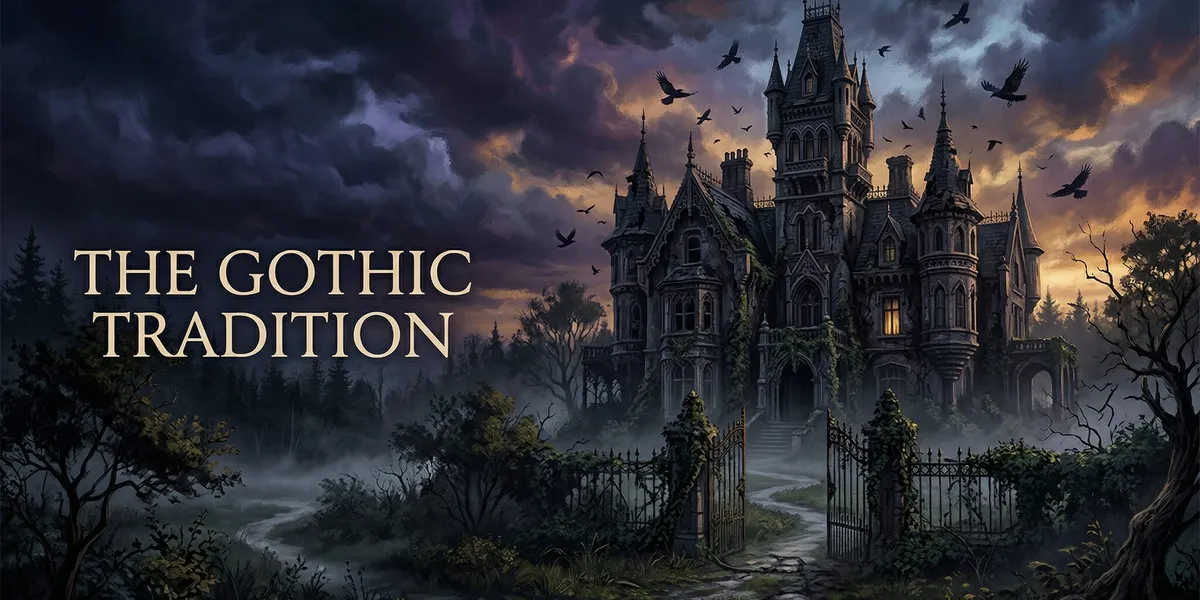
The gothic genre is fiction defined by atmosphere of dread, decaying settings, psychological tension, and encounters with the supernatural or the unknown. It’s one of the oldest and most influential genres in Western literature — and in 2026, it’s having a massive resurgence across BookTok, literary fiction, and AI-assisted writing.
In this guide, you’ll learn:
- What the gothic genre actually is (and how it differs from horror)
- The essential elements every gothic story needs
- Every major gothic subgenre, from Southern Gothic to gothic romance
- The most famous gothic novels and what makes them work
- How to write your own gothic fiction
Here’s your complete guide to the genre.
What Is the Gothic Genre?
The gothic genre is a category of fiction characterized by an atmosphere of mystery, dread, and the supernatural, typically set against a backdrop of crumbling architecture, isolated landscapes, and psychological extremity.
The genre launched in 1764 when Horace Walpole published The Castle of Otranto, subtitled “A Gothic Story.” Walpole blended medieval romance with contemporary fiction — ghosts walked castle halls, prophecies hung over noble families, and terror lurked behind every stone wall. The word “gothic” originally referenced the medieval period and its architecture. Walpole borrowed it to evoke a sense of the ancient, the mysterious, and the sublime.
Within two decades, gothic fiction had exploded across Europe. Ann Radcliffe elevated it into literary respectability with The Mysteries of Udolpho (1794). Matthew Lewis pushed it toward explicit horror with The Monk (1796). By the early 1800s, Mary Shelley had written Frankenstein (1818) — arguably the most influential gothic novel ever published — and the genre’s DNA had embedded itself into the foundations of modern fiction.
Gothic vs. Horror: What’s the Difference?
This is the question that trips up most writers. Gothic fiction and horror overlap, but they aren’t the same thing.
Horror aims to frighten. Its primary goal is visceral fear — jump scares, body horror, graphic violence, the monster leaping from the shadows.
Gothic fiction aims to unsettle. Its primary goal is atmospheric dread — the slow realization that something is wrong, the house that feels alive, the family secret that warps everyone it touches. Fear exists in gothic fiction, but it’s existential rather than visceral.
Think of it this way: horror asks “What’s behind that door?” Gothic asks “What has this house done to the people who live here?”
A novel can be both. Shirley Jackson’s The Haunting of Hill House is gothic horror — it uses gothic atmosphere and structure to deliver genuine terror. But a gothic novel doesn’t have to be scary at all. Jane Eyre is deeply gothic without being a horror novel. Rebecca by Daphne du Maurier keeps you anxious for 400 pages without a single monster.
Key Elements of the Gothic Genre
Every gothic story draws from a shared toolkit of elements. You don’t need all of them — but the strongest gothic fiction uses several working together.
1. Oppressive Setting
The setting is never just a backdrop in gothic fiction — it’s practically a character. Classic gothic settings include:
- Crumbling castles and mansions. Manderley in Rebecca. Thornfield Hall in Jane Eyre. The House of Usher in Poe’s story. The architecture reflects internal decay.
- Isolated landscapes. Moors, cliffs, dense forests, remote islands. The characters can’t easily leave — and help can’t easily arrive.
- Enclosed or claustrophobic spaces. Locked rooms, hidden passages, attics, cellars. The space itself becomes a trap.
- Weather as mood. Storms, fog, perpetual gray skies, oppressive heat. The environment mirrors the emotional state of the characters.
The gothic setting works because it externalizes internal psychology. A decaying house represents a decaying mind, a decaying family, a decaying social order.
2. Atmosphere of Dread
Atmosphere separates gothic fiction from every other genre. It’s the persistent feeling that something is wrong — not a single scare, but a sustained unease that builds across the entire story.
You create gothic atmosphere through:
- Pacing. Slow revelations. Delayed answers. Long stretches of tension before anything happens.
- Sensory detail. Drafts through hallways, distant sounds you can’t identify, the smell of damp stone, shadows that move wrong.
- Ambiguity. Is the house actually haunted, or is the narrator losing their mind? Gothic fiction thrives in the gap between explanation and mystery.
3. Psychological Complexity
Gothic fiction is deeply psychological. The real monsters are often internal — guilt, obsession, repression, madness, grief that won’t resolve.
The unreliable narrator is a gothic staple. You can never fully trust what you’re being told. The narrator of The Turn of the Screw may be seeing ghosts or experiencing a breakdown. The narrator of Rebecca may be projecting her insecurities onto every surface of Manderley. This uncertainty is the engine of gothic tension.
4. Supernatural or Uncanny Elements
Most gothic fiction includes some brush with the supernatural — ghosts, curses, prophecies, inexplicable events. But the genre’s relationship with the supernatural is more nuanced than horror’s.
Ann Radcliffe pioneered what scholars call the “explained supernatural” — events that seem ghostly but ultimately have rational explanations. Her heroines hear terrifying sounds in the night, only to discover a trapped animal or a hidden passage. This approach keeps the reader in a state of suspended belief, never quite sure whether the supernatural is real within the story’s world.
Other gothic writers embrace the supernatural fully. Poe’s stories feature reanimation, premature burial, and houses that are literally alive. Shelley’s Frankenstein centers on a reanimated corpse. The key distinction is that gothic supernatural elements carry thematic weight — they represent something about the human condition, not just a plot mechanism.
5. Secrets, Transgression, and the Past
Gothic plots almost always revolve around buried secrets — a family crime, a hidden identity, a terrible act that was supposed to stay concealed. The past refuses to stay buried, and the narrative becomes an excavation.
Common gothic plot engines include:
- Family curses. Sins of the parents visited upon the children.
- Hidden identities. Characters who aren’t who they claim to be.
- Forbidden knowledge. Characters who learn something they shouldn’t — and can’t un-know it.
- Transgressive desire. Love that crosses social, moral, or natural boundaries.
6. Power Imbalances and Entrapment
Gothic fiction frequently explores dynamics of power — who has it, who’s trapped by it, and what happens when it’s abused. The classic “damsel in distress” locked in a tower has evolved, but the underlying structure persists: characters who are controlled, confined, or unable to escape a situation.
In modern gothic fiction, the imprisonment is often psychological rather than physical. A character might be trapped by a marriage, a family obligation, a small town’s social pressure, or their own mental state. The gothic villain isn’t always a mustache-twirling tyrant — sometimes it’s an institution, a tradition, or a way of thinking.
7. The Byronic Hero
The Byronic hero is a gothic archetype — a charismatic, brooding, morally ambiguous figure who attracts and repels in equal measure. Named after Lord Byron (who himself embodied the type), this character is:
- Intelligent and self-aware
- Emotionally tortured
- Socially defiant
- Haunted by a secret past
- Simultaneously attractive and dangerous
Rochester in Jane Eyre. Heathcliff in Wuthering Heights. The Phantom in The Phantom of the Opera. The Byronic hero persists because readers are drawn to complexity — characters who are neither purely good nor purely evil.
Gothic Subgenres: Every Type Explained
The gothic genre has fractured into dozens of subgenres over its 260-year history. Here are the ones you need to know.
Gothic Romance
Gothic romance is where the genre began, and it remains one of its most popular forms. These stories center on a romantic relationship set against a backdrop of mystery, danger, and atmospheric dread. The heroine typically arrives at a remote estate, falls for a mysterious figure, and uncovers dark secrets.
Key conventions: Female protagonist, isolated grand house, mysterious love interest with a hidden past, suspense-driven plot, romance that survives the darkness.
Touchstone works: Jane Eyre by Charlotte Bronte, Rebecca by Daphne du Maurier, My Cousin Rachel by Daphne du Maurier, Mexican Gothic by Silvia Moreno-Garcia.
Southern Gothic
Southern Gothic transplants gothic conventions into the American South. Instead of crumbling castles, you get decaying plantations. Instead of aristocratic curses, you get the legacy of slavery, poverty, and rigid social hierarchies. The supernatural often manifests through folklore, faith, and the land itself.
Key conventions: American South setting, social inequality, grotesque characters, dark humor, moral ambiguity, decaying communities.
Touchstone authors: Flannery O’Connor, William Faulkner, Carson McCullers, Toni Morrison, Jesmyn Ward.
Southern Gothic is uniquely positioned to examine systemic injustice through the gothic lens. The “buried secret” isn’t a family ghost — it’s an entire history of violence and exploitation that the community has agreed to ignore.
Gothic Horror
Gothic horror combines gothic atmosphere with genuine horror intent. These stories want to unsettle and terrify. The supernatural isn’t ambiguous — it’s real, it’s dangerous, and it’s coming for the characters.
Key conventions: Supernatural threats, escalating dread to outright terror, body horror elements, psychological breakdown, the monstrous as metaphor.
Touchstone works: Dracula by Bram Stoker, The Haunting of Hill House by Shirley Jackson, The Shining by Stephen King, House of Leaves by Mark Z. Danielewski.
Dark Romance
Dark romance overlaps heavily with gothic romance but pushes further into morally complex territory. These stories feature relationships that involve power imbalances, moral ambiguity, taboo dynamics, and emotional intensity that goes beyond traditional romance boundaries.
Key conventions: Morally gray love interests, power dynamics, intense emotional stakes, dark themes handled with intention, often explicit content.
Domestic Gothic (Domestic Noir)
Domestic gothic sets the horror within the home itself — marriages, families, and intimate relationships become the source of dread. The “haunted house” is a metaphor for a toxic relationship, a controlling partner, or a family system that devours its members.
Key conventions: Domestic setting, intimate relationships as the source of threat, psychological manipulation, everyday life becoming uncanny, female protagonists navigating confinement.
Touchstone works: We Have Always Lived in the Castle by Shirley Jackson, The Silent Patient by Alex Michaelides, Gone Girl by Gillian Flynn (which borrows heavily from gothic structure).
Modern Gothic (Contemporary Gothic)
Modern gothic takes the genre’s core elements — dread, secrets, decay, power imbalances — and places them in contemporary settings. No castles required. The crumbling mansion might be a decaying suburban home, a failing startup’s office, or a gentrifying neighborhood.
Key conventions: Contemporary setting, gothic structure and atmosphere, social commentary, psychological complexity, updated archetypes.
Touchstone works: Mexican Gothic by Silvia Moreno-Garcia, The Essex Serpent by Sarah Perry, Piranesi by Susanna Clarke.
EcoGothic
EcoGothic is the newest branch — gothic fiction that channels environmental anxiety. The decaying setting is the planet itself. Nature isn’t a backdrop; it’s an active, hostile, or grieving presence. This subgenre has gained significant traction as climate fiction grows, with scholars noting that gothic literature is uniquely equipped to express ecological dread.
Key conventions: Nature as threat or victim, environmental decay, human complicity in destruction, landscape as character, deep time and geological horror.
Famous Gothic Novels Every Writer Should Read
Understanding the gothic genre means knowing its landmark works. Here are the essential texts, organized by era.
Foundational Gothic (1764-1820)
| Novel | Author | Year | Why It Matters |
|---|---|---|---|
| The Castle of Otranto | Horace Walpole | 1764 | Invented the genre |
| The Mysteries of Udolpho | Ann Radcliffe | 1794 | Established the “explained supernatural” |
| The Monk | Matthew Lewis | 1796 | Pushed gothic into transgressive territory |
| Frankenstein | Mary Shelley | 1818 | Fused gothic with science fiction |
| Northanger Abbey | Jane Austen | 1818 | First gothic parody (and proof the genre had arrived) |
Victorian Gothic (1830-1900)
| Novel | Author | Year | Why It Matters |
|---|---|---|---|
| Jane Eyre | Charlotte Bronte | 1847 | Defined gothic romance |
| Wuthering Heights | Emily Bronte | 1847 | Byronic hero at his most extreme |
| The Strange Case of Dr Jekyll and Mr Hyde | Robert Louis Stevenson | 1886 | Gothic as psychological allegory |
| The Picture of Dorian Gray | Oscar Wilde | 1890 | Gothic meets aestheticism |
| Dracula | Bram Stoker | 1897 | The definitive gothic monster novel |
Modern Gothic (1900-Present)
| Novel | Author | Year | Why It Matters |
|---|---|---|---|
| Rebecca | Daphne du Maurier | 1938 | Reinvented gothic romance for the 20th century |
| The Haunting of Hill House | Shirley Jackson | 1959 | Set the template for psychological gothic horror |
| The Shining | Stephen King | 1977 | Gothic hotel, disintegrating family |
| Beloved | Toni Morrison | 1987 | Gothic as a lens for historical trauma |
| Mexican Gothic | Silvia Moreno-Garcia | 2020 | Decolonized the gothic genre |
How to Write Gothic Fiction
If you want to write in the gothic genre, here’s the practical framework. These principles apply whether you’re writing a gothic novel, a gothic short story, or weaving gothic elements into another genre.
Start With Setting — Then Make It Mean Something
Your setting isn’t scenery. It’s a thematic mirror. Before you describe the house, the landscape, or the town, decide what it represents.
A crumbling mansion might represent a family’s moral decay. An overgrown garden might represent suppressed desire. A fog-bound coastline might represent the impossibility of seeing the truth clearly.
Once you know what the setting means, every descriptive detail reinforces your theme. You’re not just writing atmosphere for atmosphere’s sake — you’re building meaning.
Build Dread Through Withholding
The most common mistake in gothic writing is revealing too much, too fast. Gothic dread depends on the gap between what the reader suspects and what the reader knows.
Practical techniques:
- Delay explanations. Let a strange event sit unresolved for chapters.
- Use partial reveals. Show a fragment of the truth — enough to deepen the mystery, not enough to resolve it.
- Let characters notice things the narrator doesn’t explain. A character who flinches at a closed door tells you more than a paragraph of backstory.
- Layer your mysteries. Don’t rely on a single secret. Gothic plots work best with multiple buried truths that intersect.
Create Characters Who Are Trapped
Gothic characters need to feel stuck — unable to leave, unable to change their situation, unable to escape the past. The source of entrapment can be:
- Physical (locked in a house, stranded in a remote location)
- Social (bound by marriage, family duty, or community pressure)
- Psychological (trapped by guilt, obsession, grief, or denial)
- Economic (dependent on someone who controls them)
The most powerful gothic fiction combines multiple forms of entrapment. Jane Eyre is physically confined at Thornfield, economically dependent on Rochester, and socially constrained by her class position. That layered entrapment is what gives the novel its tension.
Use an AI Writing Assistant for Gothic Atmosphere
Gothic fiction demands dense, layered prose — the kind of writing where every sentence contributes to mood. That’s also the kind of writing where AI tools can help you iterate fastest.
Our Pick — Chapter
Chapter’s AI writing assistant helps you draft gothic scenes with consistent tone and atmosphere, then refine them until every paragraph builds dread. It’s built specifically for book-length fiction, so it maintains your voice across an entire novel — not just a single scene.
Best for: Writing full-length gothic novels with consistent atmospheric prose. Pricing: $97 one-time (nonfiction) | Varies (fiction). Why we built it: Because gothic fiction is one of the hardest genres to sustain across a full manuscript, and AI-assisted drafting lets you experiment with atmosphere at the sentence level without losing momentum.
Balance Ambiguity and Resolution
One of the hardest craft decisions in gothic writing is how much to explain. The genre thrives on ambiguity — but too much ambiguity frustrates readers, and too little kills the atmosphere.
A useful framework: resolve the plot, but leave the theme open. Your protagonist can escape the house, uncover the family secret, and survive — but the larger questions (Is evil inherited? Can the past ever be buried? Are we haunted by what we’ve done or what’s been done to us?) should linger after the last page.
Gothic Tropes and Motifs
These recurring motifs appear across centuries of gothic fiction. Use them intentionally — they carry tremendous weight with readers who know the genre.
- The discovered manuscript. A diary, letter, or hidden document that reveals the truth. (Dracula is built entirely from documents.)
- The double / doppelganger. A character confronted by their mirror image or shadow self. (Dr Jekyll and Mr Hyde, The Picture of Dorian Gray.)
- The madwoman in the attic. A hidden, confined figure — originally literal, now often metaphorical. (Jane Eyre, The Yellow Wallpaper.)
- The revenant. The dead who return — as ghosts, memories, or influences that won’t fade. (Beloved, The Turn of the Screw.)
- The labyrinth. Physical or psychological — passages that confuse, trap, and disorient. (House of Leaves, The Shining.)
- The portrait. An image that holds power, reveals truth, or changes over time. (The Picture of Dorian Gray.)
- Pathetic fallacy. Weather and environment that mirror emotional states. (Every gothic novel ever written.)
Why the Gothic Genre Matters in 2026
The gothic genre is experiencing one of its strongest periods in decades. BookTok has driven massive interest in dark romance and gothic romance. Literary fiction is leaning into gothic structures — Mexican Gothic, The Essex Serpent, and Piranesi all became bestsellers by updating gothic conventions for contemporary readers.
For writers, this means opportunity. Readers are actively seeking gothic fiction, and the genre’s flexibility means you can write gothic romance, gothic horror, gothic literary fiction, gothic fantasy, or gothic thriller — and find an audience for each.
The genre endures because it speaks to something permanent in human psychology. We’re drawn to darkness, to secrets, to the feeling that something is just slightly wrong. The gothic genre gives that feeling a structure, a tradition, and a vocabulary.
Common Mistakes in Gothic Writing
Avoid these pitfalls when writing gothic fiction:
- Confusing atmosphere with purple prose. Atmospheric writing is precise, not excessive. Every detail should earn its place.
- Frontloading backstory. Gothic stories reveal the past gradually. Don’t dump the family history in chapter one.
- Making the supernatural the whole story. Ghosts are most effective when they represent something — guilt, trauma, the weight of history. A ghost that’s just a ghost is a horror movie, not gothic fiction.
- Neglecting character interiority. Gothic fiction lives in characters’ minds. If your protagonist is just moving through set pieces, the atmosphere won’t land.
- Resolving everything neatly. Gothic fiction should leave some questions unanswered. Perfect resolution kills the lingering unease the genre depends on.
Is Gothic Fiction the Same as Dark Academia?
Gothic fiction and dark academia share some DNA — moody aesthetics, old buildings, secrets, intellectual obsession — but they’re distinct genres. Dark academia is a newer genre (popularized in the 2010s) that focuses on academic settings, intellectual pursuit, and moral corruption within elite institutions. Gothic fiction is broader, older, and defined by atmosphere and structure rather than setting.
That said, many dark academia novels — like Donna Tartt’s The Secret History — use gothic techniques extensively. If you’re drawn to dark academia, understanding the gothic genre will deepen your writing in that space.
Can You Mix Gothic With Other Genres?
Absolutely — and this is where some of the most exciting fiction is being written right now. The gothic genre functions as a mode as much as a genre, meaning you can apply its techniques to almost any category.
- Gothic + fantasy = dark fantasy, grimdark, or works like The Priory of the Orange Tree
- Gothic + romance = gothic romance, dark romance, or works like Mexican Gothic
- Gothic + mystery = gothic thriller, domestic noir, or works like Rebecca
- Gothic + science fiction = works like Frankenstein, Annihilation by Jeff VanderMeer
- Gothic + literary fiction = works like Beloved, The Essex Serpent
The key is maintaining the atmospheric core. If your story has dread, secrets, psychological complexity, and a setting that functions as metaphor, it’s gothic — regardless of what other genre it also belongs to.
How to Get Started Writing a Gothic Novel
If the gothic genre calls to you, here’s a simple starting framework:
- Choose your setting and decide what it symbolizes. Write a one-paragraph description that captures the mood.
- Identify your buried secret. What happened in the past that the story will gradually uncover?
- Create your protagonist — someone who is trapped, curious, and psychologically complex. Give them a reason they can’t just leave.
- Decide your relationship with the supernatural. Will your story include real ghosts, explained phenomena, or pure psychological horror?
- Outline your revelation structure. Plan when and how the reader learns each piece of the truth. Space revelations unevenly — cluster them toward the end.
Then start writing. Gothic fiction rewards patience in drafting. Your first version will probably over-explain. Your revision will be about cutting back — letting the shadows stay shadows, letting the silences speak.
FAQ
What is the gothic genre in simple terms?
The gothic genre is a type of fiction built on atmosphere, dread, and dark secrets. Gothic stories typically feature crumbling settings, psychological tension, buried pasts, and encounters with the supernatural or the uncanny. The genre started in 1764 with The Castle of Otranto and includes classics like Frankenstein, Dracula, and Jane Eyre.
What are the 5 main elements of gothic literature?
The five main elements of gothic literature are oppressive settings (castles, mansions, isolated landscapes), atmosphere of dread (sustained unease rather than jump scares), psychological complexity (unreliable narrators, obsession, madness), supernatural or uncanny elements (ghosts, curses, inexplicable events), and buried secrets (family crimes, hidden identities, and pasts that refuse to stay buried).
What is the difference between gothic and horror?
The difference between gothic and horror is intent and approach. Horror aims to frighten through visceral fear — monsters, violence, jump scares. Gothic fiction aims to unsettle through atmospheric dread — slow-building unease, psychological tension, and existential questions. A novel can be both (like The Haunting of Hill House), but gothic fiction doesn’t require being scary. Jane Eyre and Rebecca are gothic without being horror.
Is gothic fiction still popular in 2026?
Gothic fiction is extremely popular in 2026. BookTok has driven massive reader interest in gothic romance and dark romance. Literary bestsellers like Mexican Gothic and Piranesi use gothic structures. The genre’s flexibility — gothic romance, gothic horror, gothic fantasy, gothic literary fiction — means writers can find audiences across multiple markets. For authors, this is one of the strongest periods for gothic fiction in decades.
Who are the most famous gothic authors?
The most famous gothic authors span three centuries of literature. Foundational authors include Horace Walpole, Ann Radcliffe, Mary Shelley, and Matthew Lewis. Victorian masters include the Bronte sisters, Bram Stoker, Edgar Allan Poe, and Robert Louis Stevenson. Modern gothic writers include Shirley Jackson, Daphne du Maurier, Stephen King, Toni Morrison, and Silvia Moreno-Garcia.