You write a mystery plot by starting with the solution and working backward — designing the crime, the suspects, and the clue trail before you draft a single chapter, so every scene either advances the investigation or misdirects the reader.
That one habit is what separates mysteries that hold up on a reread from ones that collapse at the reveal.
In this guide, you’ll learn:
- The 10-beat mystery plot structure, mapped to exact story percentages
- How to design your crime, clues, and red herrings before drafting a single chapter
- The “Suspect Grid” method that keeps your mystery airtight
- The two-timeline trick that stops alibis and clue order from contradicting each other
- How to write a satisfying plot twist that feels earned, not cheap
Here’s the complete process, from blank page to finished mystery.
What Is a Whodunit?
Whodunit — A mystery subgenre where the central question is the identity of the criminal, and the reader has access to the same clues as the detective to solve the puzzle alongside them.
The whodunit is the purest form of the mystery genre. Unlike thrillers (where you know the villain and watch the chase) or noir (where atmosphere matters more than the puzzle), a whodunit is a fair-play intellectual game between you and your reader.
Agatha Christie, Arthur Conan Doyle, and modern authors like Anthony Horowitz and Tana French all work within this tradition. The form has survived for over a century because the core appeal never fades: readers want to solve the puzzle before the detective does.
What Is a Mystery Plot?
Mystery plot — A story structure built on concealed information, where a crime or unexplained event opens the story, a sleuth pursues the truth through clues and false leads, and the narrative closes when the concealed information is revealed to both sleuth and reader.
Every mystery plot runs two stories at once. There is the story of the crime, which happened before page one and is revealed in fragments. And there is the story of the investigation, which is what your reader actually reads. Plotting a mystery means building the first story completely, then deciding the order in which the second story leaks it.
That is why mystery plotting feels different from plotting other genres. In a romance or a quest narrative, you invent forward. In a mystery, you invent backward and reveal forward.
The 10-Beat Mystery Plot Structure
Most published mysteries hit the same beats in roughly the same places. Use this as a skeleton, not a straitjacket — but if you are stuck at the midpoint, it is almost always because you skipped a beat.
| # | Beat | Where | What Happens |
|---|---|---|---|
| 1 | Sleuth in context | 0-5% | We meet the investigator doing something that shows their skill and their flaw |
| 2 | The crime | 5-12% | The body, theft, or disappearance surfaces — the inciting incident |
| 3 | The commitment | 12-20% | The sleuth takes the case, often for a personal reason |
| 4 | The suspect sweep | 20-35% | First interviews; every suspect gets motive, means, and opportunity on the page |
| 5 | The wrong theory | 35-45% | Evidence points convincingly at the wrong person and the sleuth acts on it |
| 6 | Midpoint collapse | 50% | The theory breaks — an alibi holds, or a second crime rules the suspect out |
| 7 | Escalation | 55-70% | Stakes turn personal: a second victim, a threat, or the sleuth becomes a suspect |
| 8 | The dark moment | 70-80% | The sleuth is discredited, locked out, or out of leads |
| 9 | The click | 80-90% | A detail from earlier is re-read correctly and the solution assembles |
| 10 | Reveal and restore | 90-100% | Confrontation, explanation, and the community returns to order |
Beats 5 and 6 are where most first mysteries fail. Writers give their sleuth a wrong theory that nobody believed anyway, so its collapse costs nothing. The wrong theory has to be genuinely persuasive — persuasive enough that your reader would have arrested the same person.
Step 1: Start With the Solution
This is the single most important rule in plotting a whodunit: know your answer before you write the question.
Before you draft Chapter 1, you need to know:
- Who committed the crime
- Why they did it (motive)
- How they did it (method)
- When they did it (timeline)
- What evidence they left behind
Write a one-page “crime report” as if a detective already solved the case. Include every detail — the weapon, the alibi the criminal used, the mistake that ultimately gives them away. This document becomes your plotting bible.
Working backward from the solution is what separates published mystery authors from writers who get stuck at the midpoint. When you know the destination, every clue, every red herring, and every suspect interrogation serves the larger puzzle.
Step 2: Build Your Suspect Grid
Here’s where most plotting guides stop at vague advice. Instead, use a Suspect Grid — a structured tool that maps every suspect against the three pillars of criminal investigation: motive, means, and opportunity.
| Suspect | Motive | Means | Opportunity | Alibi | Alibi Flaw |
|---|---|---|---|---|---|
| The Guilty Party | Inheritance | Access to poison | Alone with victim at 8 PM | Claims they were at a dinner party | Dinner ended at 7:30 |
| Suspect B | Jealousy | Owns a similar weapon | Was in the building | Was on a phone call | Call logs confirm |
| Suspect C | Revenge | Had training | Was nearby | Was with a witness | Witness is unreliable |
| Suspect D | Financial | No clear means | Was in town | Out of the country | Has a passport stamp |
Why the grid works: It forces you to give every suspect a plausible reason to have committed the crime. Readers who can eliminate a suspect in Chapter 3 because they obviously had no motive will feel cheated. The grid also reveals weak spots in your plot — if Suspect D has no means, you either need to give them one or cut them from the suspect list.
Build your grid with four to six suspects. Fewer than four and the mystery feels thin. More than six and you risk confusing your reader. Character development for each suspect should be deep enough that readers could believe any of them did it — and your investigator needs the same care, which we cover in how to write a detective character.
Step 3: Design Your Clue Timeline
A whodunit lives or dies on clue placement. Drop too many clues early and your reader solves the mystery by Chapter 5. Hold them all until the end and the solution feels like a magic trick rather than a deduction.
Use a Clue Timeline that maps revelations across your three-act structure:
Act 1 (First 25%): The Crime and the Setup
- Introduce the crime (usually a murder, but theft, disappearance, or fraud all work)
- Establish the setting and the cast of suspects
- Plant 1-2 genuine clues hidden in plain sight
- Introduce your detective’s first theory (which should be wrong)
The inciting incident in a whodunit is almost always the discovery of the crime. Don’t delay it. Mystery readers pick up your book to solve a puzzle — give them the puzzle fast.
Act 2 (Middle 50%): The Investigation
- Alternate between clues (truth) and red herrings (misdirection)
- Each chapter should either reveal new information or eliminate a suspect
- Include a midpoint reversal — the detective’s primary theory collapses
- Plant your most important clue here, but disguise it inside an emotional scene
This is where pacing matters most. A useful rhythm: clue, red herring, character scene, clue, red herring, revelation. Each rising action beat should increase the stakes and narrow the suspect list.
Act 3 (Final 25%): The Reveal
- The detective assembles the clues in a way the reader could have but probably didn’t
- The reveal scene should reference specific earlier moments (“Remember when she said she hadn’t been to the garden? But her shoes had mud on them in Chapter 4.”)
- Tie up every red herring — explain why it was misleading
- Deliver a climax that feels both surprising and inevitable
The Two-Timeline Method: The Story You Hide and the Story You Tell
Here is the tool that fixes the single most common mystery plot failure — the timeline contradiction that a reader catches on page 240.
Keep two separate documents while you plot:
Timeline A: The crime timeline. Every event of the crime in real chronological order, with timestamps. Where each suspect actually was. When the victim was last seen. When the killer moved the body, cleaned the room, forged the note. This document is never shown to the reader in full until the reveal.
Timeline B: The reveal timeline. The order in which your reader receives fragments of Timeline A, chapter by chapter.
A worked example:
| Timeline A (what happened) | Timeline B (what the reader gets) |
|---|---|
| 6:40 PM — Victim argues with the nephew | Ch. 9 — A neighbor mentions “raised voices,” time unspecified |
| 7:30 PM — Dinner party ends early | Ch. 14 — Caterer’s invoice shows an early finish |
| 8:00 PM — Killer administers the poison | Never shown directly |
| 8:15 PM — Killer washes a second glass | Ch. 3 — Described as tidiness, dismissed |
| 9:05 PM — Body discovered | Ch. 1 — Opening scene |
Read down the right column and you can see whether a careful reader could reach the answer. Read across the rows and you can see whether the facts are consistent. Almost every plot hole in an unpublished mystery is a row where those two columns disagree.
Two rules make the method work:
- Never let Timeline B contradict Timeline A — it may only omit. Withholding is fair; lying to the reader in narration is not.
- Every row in Timeline A that matters to the solution needs a row in Timeline B before the reveal. That is the fair-play rule in spreadsheet form.
If you are writing a locked-room mystery, this method is not optional. The mechanics of the impossible crime live entirely in Timeline A, and a single unaccounted minute destroys the trick.
Step 4: Plant Clues Using the “Hide in Plain Sight” Method
The best mystery clues are ones the reader sees but doesn’t recognize as important until the reveal. Here are five proven techniques for hiding clues:
1. Bury the clue in a list. Mention the critical detail alongside two or three irrelevant ones. “The desk held a coffee mug, a stack of receipts, a prescription bottle, and a framed photo of the family dog.” The prescription bottle is the clue — but the reader’s eye slides past it.
2. Attach the clue to an emotional moment. When your detective learns that a suspect’s marriage is falling apart, the reader focuses on the drama. They miss that the suspect mentioned being at a specific location at a specific time — which contradicts their alibi.
3. Let a character dismiss the clue. Have a secondary character say “That’s not important” about a detail that turns out to be critical. Readers trust character judgments more than they realize.
4. Use the clue for a different purpose first. A broken window might seem like evidence of a break-in. Later, the detective realizes it was broken from the inside — the killer staged the scene.
5. Make the clue part of the setting. Describe the weather, the room, the landscape — and embed a detail that matters. “The garden gate was open, as it always was in summer.” Except it wasn’t summer when the crime happened.
These techniques come directly from the tradition of foreshadowing in fiction, and there are more of them in our deeper guide to planting clues in mystery writing. The difference in mystery writing is that foreshadowing isn’t just literary texture — it’s the structural backbone of your entire plot.
Step 5: Craft Red Herrings That Actually Work
A red herring is a false clue that leads the reader (and often the detective) toward the wrong conclusion. Bad red herrings feel arbitrary. Good ones feel logical in the moment and obvious in hindsight.
Three types of effective red herrings:
The Misleading Suspect. Give an innocent character a suspicious behavior that has a perfectly innocent explanation. The neighbor who was seen near the crime scene at midnight? She was walking her dog, something she does every night. But the reader doesn’t learn this until Chapter 12.
The Misinterpreted Evidence. A piece of physical evidence points toward the wrong person. The fingerprints on the weapon belong to the victim’s spouse — but they handled it earlier that day for an unrelated reason.
The Half-Truth. A character tells a partial lie to hide something embarrassing but not criminal. They say they were “out” when the crime happened. They were actually at a secret AA meeting. The lie makes them look guilty, but the truth clears them.
The key to every red herring: it must have a logical explanation. If you introduce a suspicious detail in Chapter 3, you must resolve it before the book ends. Unresolved red herrings are plot holes, not misdirection.
Step 6: Follow the Fair-Play Rule
The fair-play rule — The principle that readers must have access to the same clues as the detective, giving them a genuine chance to solve the mystery before the reveal.
This rule separates a satisfying whodunit from a frustrating one. Your detective cannot suddenly produce a clue the reader never saw. The solution cannot depend on specialized knowledge you never established the detective having.
Here’s a practical checklist:
- Every clue used in the final solution appeared earlier in the story
- The detective’s key deduction follows logically from available evidence
- No critical information was hidden from the reader through the detective’s inner monologue
- The guilty party appeared “on-screen” before the reveal
- The solution doesn’t depend on coincidence or deus ex machina
Ronald Knox codified these principles in his Ten Commandments of Detective Fiction in 1929. The rules still hold. Modern readers are even more attuned to fairness because they’ve consumed thousands of mystery plots across books, TV, and film.
Writing a Satisfying Plot Twist
A great whodunit doesn’t just reveal the killer — it reframes everything the reader thought they knew. Writing a satisfying plot twist requires setup, misdirection, and payoff working in harmony.
The three elements of a twist that lands:
1. Inevitability. After the twist, the reader should be able to flip back through the book and see every clue pointing to the truth. “Of course it was the doctor — he was the only one who knew about the allergy.” If the twist can’t survive a reread, it’s not earned.
2. Surprise. The reader must not see it coming on first read. This is where your red herrings and clue-hiding techniques do their work. If 80% of readers guess the killer by the midpoint, your misdirection failed.
3. Emotional resonance. The best twists aren’t just intellectual — they’re emotional. The killer isn’t just revealed; the revelation changes the meaning of a relationship, a sacrifice, or a lie that ran through the entire story.
Agatha Christie’s The Murder of Roger Ackroyd remains the gold standard because it satisfies all three criteria. The twist is surprising, inevitable on rereading, and fundamentally changes how you understand the narrator’s role in the story.
Common twist mistakes to avoid:
- The killer is a character introduced in the final chapter
- The twist depends on information the reader never received
- The twist contradicts established facts rather than recontextualizing them
- The detective solves the case through a lucky break, not deduction
Cozy Mystery Checklist
Cozy mysteries are the most popular whodunit subgenre, and they follow specific conventions. If you’re plotting a cozy, run through this checklist:
| Element | Cozy Standard | Example |
|---|---|---|
| Setting | Small, contained community | A village, a bookshop, a bakery |
| Detective | Amateur sleuth, not law enforcement | A librarian, a baker, a retired teacher |
| Violence | Off-page, not graphic | The body is discovered, not the murder |
| Tone | Warm, often humorous | Light banter, quirky side characters |
| Suspects | All known to the detective personally | Neighbors, customers, friends |
| Stakes | Personal, not world-ending | Clearing a friend’s name, saving a business |
| Romance | Optional subplot, always clean | A charming love interest, slow burn |
| Resolution | Justice served, community restored | The guilty party is caught, normalcy returns |
For the full conventions of the subgenre, see our guide to writing a cozy mystery. Cozy mysteries also follow the fair-play rule, but the detective’s methods lean on intuition and local knowledge rather than forensic science. Your amateur sleuth solves the case because they know the community — not because they can analyze DNA.
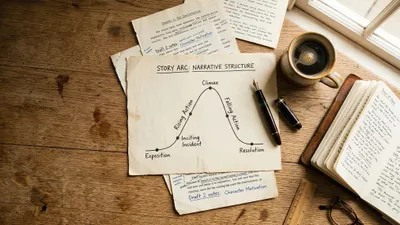
For a deeper look at building your mystery’s world, see our guide on story arcs and how to structure satisfying narrative arcs within genre conventions.
How to Outline Your Whodunit (Putting It All Together)
Now that you have your crime, suspects, clue timeline, and red herrings, here’s how to organize everything into a working book outline:
1. Write your crime report (Step 1). One page, complete solution.
2. Build your suspect grid (Step 2). Four to six suspects with motive, means, opportunity, alibi, and alibi flaw.
3. Create your chapter-by-chapter clue map. For each chapter, note:
- Which clue or red herring appears
- Which suspect is in focus
- What the reader learns (and what they don’t)
- How the chapter moves the investigation forward
4. Test the fair-play rule. Read through your outline and ask: could a careful reader solve this mystery with the information provided? If not, add clues. If the solution is too obvious, add red herrings.
5. Write your first draft. With a solid outline, you can draft with confidence because every scene serves the puzzle. If you want a broader view of the craft beyond structure, our guide to mystery writing covers voice, dialogue, and suspense.
If outlining feels overwhelming, tools like Chapter can help you organize your mystery’s structure, track plot threads across chapters, and keep your clue timeline consistent as you draft.
How Long Should a Whodunit Be?
Most whodunits fall between 70,000 and 90,000 words. Cozy mysteries run shorter — 60,000 to 75,000 words. Complex, multi-layered mysteries (think Tana French or Kate Atkinson) can reach 100,000 words.
The right length depends on your suspect count and subplot complexity. A straightforward four-suspect cozy needs fewer pages than a six-suspect locked-room mystery with a subplot about the detective’s personal life.
Don’t pad your word count. Mystery readers are pattern-seekers — they notice filler. Every scene should either advance the investigation, develop a suspect, or plant a clue. If a scene doesn’t do one of these three things, cut it.
Can You Write a Whodunit With AI?
AI writing tools can accelerate your mystery plotting process significantly. You can use AI to brainstorm suspect motives, generate alibi scenarios, and test whether your clue placement is too obvious or too obscure.
Chapter’s fiction writing tools are designed for exactly this kind of structured storytelling. You can outline your mystery, develop your suspect profiles, and draft chapters with AI assistance — while keeping full creative control over your puzzle’s solution.
Over, including mysteries and thrillers. The key is using AI as a brainstorming partner for your plot structure, not as a replacement for the careful clue-weaving that makes a whodunit satisfying.
Common Mistakes When Plotting a Whodunit
- Starting without knowing the solution. You’ll write yourself into corners and leave plot holes. Always start with the answer.
- Making the guilty party too obvious. If the most suspicious character in Act 1 turns out to be the killer, readers feel cheated. Use red herrings to deflect suspicion.
- Making the guilty party too random. If the killer has no real connection to the story, the reveal falls flat. The killer should be someone the reader knows well.
- Ignoring the timeline. Alibis, opportunities, and clue sequences must be chronologically consistent. One timeline error can collapse your entire mystery.
- Forgetting to resolve red herrings. Every false lead needs an explanation. Unresolved red herrings read as plot holes.
FAQ
What are the five elements of a mystery plot?
The five elements of a mystery plot are the crime, the sleuth, the suspects, the clues, and the reveal. The crime raises the central question, the sleuth pursues it, the suspects supply competing explanations, the clues let the reader compete with the sleuth, and the reveal resolves the question in a way that is both surprising and consistent with everything already on the page.
How do you structure a mystery plot?
You structure a mystery plot across ten beats: the sleuth in context, the crime, the commitment, the suspect sweep, the wrong theory, the midpoint collapse, the escalation, the dark moment, the click, and the reveal. Map these onto a three-act structure — crime and suspects in Act 1, investigation and reversal in Act 2, deduction and reveal in Act 3 — and keep a separate crime timeline so the facts stay consistent.
How many suspects should a whodunit have?
A whodunit should have four to six suspects for the strongest plot structure. Fewer than four makes the mystery too easy to solve, while more than six risks confusing your reader and diluting each suspect’s character development. Each suspect needs a believable motive, means, and opportunity to keep the puzzle challenging.
What is the fair-play rule in mystery writing?
The fair-play rule in mystery writing means giving your reader access to the same clues the detective has, so they have a genuine chance to solve the mystery. You cannot introduce new evidence in the final chapter or have the detective rely on information the reader never received. This rule was formalized by Ronald Knox in 1929 and remains the foundation of the whodunit genre.
How do you plant clues without making them obvious?
You plant clues without making them obvious by hiding them inside emotional scenes, burying them in lists of irrelevant details, or letting characters dismiss them as unimportant. The best mystery clues are ones the reader sees but doesn’t recognize as significant until the reveal. Techniques like the “hide in plain sight” method and misdirection through red herrings keep your puzzle fair but challenging.
What is the difference between a whodunit and a thriller?
A whodunit focuses on identifying the criminal through clues and deduction, while a thriller focuses on stopping a known threat through action and suspense. In a whodunit, the reader solves the puzzle alongside the detective. In a thriller, the reader watches the protagonist race against time. Both use rising action and tension, but the core engagement is intellectual (whodunit) versus visceral (thriller).
How long does it take to plot a whodunit?
Plotting a whodunit typically takes two to six weeks before you write the first draft. This includes building your crime report, suspect grid, clue timeline, and chapter outline. Experienced mystery authors report spending more time plotting than drafting because a solid outline prevents the plot holes and timeline errors that require major revisions later. AI tools like Chapter can compress this timeline by helping you test plot structures and brainstorm suspect scenarios faster.