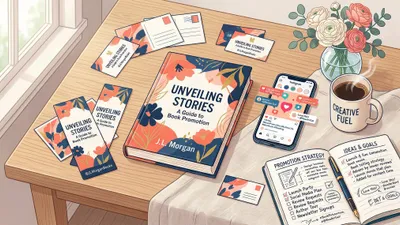
Yes, you can promote your book successfully as a first-time author — even with no audience, no budget, and no publisher behind you. The authors who sell well are not the most famous ones. They are the ones who start early and layer a few proven channels into a simple system.
In this guide, you’ll learn:
- The exact promotion timeline to follow, starting 6 months before launch
- How to build an email list and ARC team from zero
- Which free and paid channels actually move copies in 2026
- How to keep selling long after launch week ends
Here’s the step-by-step process, in the order a first-time author should tackle it.
How do you promote a book as a first-time author?
To promote a book as a first-time author, build an email list and a small launch team before publishing, optimize your Amazon metadata, run a coordinated launch week, and keep promoting for months afterward. Start marketing 3 to 6 months before release — the work you do before launch matters more than anything you do after.
Most debut authors get this backwards. They finish the manuscript, hit publish, and then think about marketing. By that point, the highest-leverage opportunities — pre-orders, advance reviews, launch-day momentum — are already gone.
Promotion is not one big push. It is a sequence of small, consistent actions across a handful of channels. You do not need all of them. You need three or four done well.
Start with your “why” and a one-page plan
Before you spend a dollar or post a single thing, write down what success actually means for you. Is it 1,000 copies sold? Speaking invitations? Building a backlist that pays for itself over years?
Your goal shapes every decision. An author who wants speaking gigs promotes differently than one chasing Amazon rank. As the team at PR by the Book notes, a clear purpose keeps you working smarter instead of just busier.
Keep the plan to one page: your goal, your target reader, the three or four channels you’ll focus on, and your launch date. That single page will save you from chasing every shiny tactic you see online.
Build your author platform early (6–12 months out)
Your author platform is your owned, ongoing connection to readers — your email list, social following, and website. It is the foundation every other promotion strategy stands on, so start building it long before your book is finished.
You do not need a huge following. You need a real one. A few hundred engaged readers who trust you will outsell thousands of passive followers every time.
Start a simple author website with your bio, book details, and an email signup. Claim your name on the one or two social platforms where your readers actually spend time — not all of them. Spreading yourself thin across five platforms is worse than going deep on one.
Build an email list before you publish
Your email list is the single most valuable promotion asset you will ever own. Unlike social media, you control it completely — no algorithm decides whether your readers see your message.
Offer something free in exchange for signups: a sample chapter, a bonus scene, a short prequel, or a useful checklist tied to your book’s topic. This is your lead magnet, and it converts curious visitors into subscribers.
According to BookBub’s launch research, email consistently outperforms social media for driving actual sales — subscribers are loyal and conversion-ready. Aim to build your list steadily in the months before launch. Our full guide to email list building for authors walks through the setup, and you can plan your messages with an author newsletter from day one.
Recruit a launch team and send ARCs
A launch team is a small group of readers who get your book early and agree to post honest reviews around release day. ARCs — advance reader copies — are free pre-publication versions you send to reviewers, bookstagrammers, and BookTubers 6 to 8 weeks before launch.
The timing matters. Send ARCs too early and reviewers forget; too late and they cannot finish in time. Six to eight weeks is the sweet spot.
Recruit your team from your email list, genre Facebook groups, and Goodreads. Twenty engaged readers who post reviews on launch day will outperform a hundred who never get around to it. Learn the full system in our guide to building a book launch team, and use it to get book reviews on Amazon right when they count most — early reviews trigger the algorithm and reassure browsing readers.
A quick note on ethics: never pay for reviews or trade them directly. Amazon removes incentivized reviews, and the credibility hit is not worth it.
Optimize your Amazon metadata
Your metadata — title, subtitle, description, keywords, and categories — determines whether Amazon’s algorithm shows your book to readers searching for one like it. This is free, high-leverage promotion that most first-time authors neglect.
Your book description is a sales page, not a synopsis. Lead with a hook, build curiosity, and end with a reason to click “Buy.” Our guide to writing a book description that sells breaks down the formula, and a strong book blurb does the heavy lifting on the listing.
Choose categories where you can realistically rank, and fill all seven Amazon keyword slots with terms readers actually search. Use a KDP keyword research tool to find them. The right keywords mean Amazon does some of your marketing for you, every single day.
Plan a coordinated launch week
Launch week is about concentrating your momentum. Strong early sales and reviews push your book up the charts, which makes Amazon show it to more readers — a flywheel that only spins if you stack your efforts into a tight window.
Set up pre-orders so sales accumulate before release day, then release them all at once for a ranking spike. Email your list, activate your launch team, and consider a special launch-week price to drive volume.
A virtual launch party on Instagram Live, Zoom, or YouTube turns release day into an event your readers can attend. Pair it with a clear book launch checklist so nothing slips through the cracks during the busiest week of your author life. IngramSpark’s marketing guide is a useful second reference for coordinating retail availability beyond Amazon.
Use social media — but pick one platform
You do not need to be everywhere. You need to be consistent somewhere. Choose the one platform where your target readers already gather, and go deep instead of wide.
Follow the 80/20 rule: 80% of your posts should give value, entertain, or build community, and only 20% should directly promote your book. Readers follow people, not billboards.
For fiction, BookTok remains the most powerful discovery engine in 2026 — short, emotional videos about your book’s tropes and themes routinely send debut novels to bestseller lists. Our guides to going viral on BookTok and promoting a book on TikTok cover the formats that work. For nonfiction, Pinterest and LinkedIn often outperform. The principle holds across all of them, as Writelight Group’s 2026 marketing guide emphasizes: relationships convert, broadcasts do not.
Get visibility through podcasts, guest posts, and communities
Borrowed audiences are the fastest way for an unknown author to reach new readers. Find podcasts, YouTube channels, and blogs that feature authors in your genre or niche, and pitch yourself as a guest.
A single relevant podcast appearance can introduce your book to thousands of engaged listeners who trust the host’s recommendation. Search for shows in your space, then send a short, specific pitch explaining what you’d talk about and why their audience would care.
Reader communities work the same way. Participate genuinely in Goodreads groups, niche Facebook communities, and subreddits for months before you ever mention your book. Show up as a member first; the promotion comes naturally once you’ve earned a place there.
Use AI to do twice the marketing in half the time
For a first-time author handling everything alone, time is the real constraint. AI tools in 2026 act as a speed layer — drafting and A/B testing ad copy, generating metadata and keyword ideas, writing social caption drafts, and repurposing one piece of content into ten.
Used well, AI lets a solo author run the kind of multi-channel campaign that used to require a team. Used lazily, it produces generic noise. The difference is always your direction and your voice.
Our Pick — Chapter
If writing the book is still the bottleneck, Chapter gets you from idea to a finished, publishable manuscript far faster — so you can actually reach the promotion stage. It also helps you draft sales-ready book descriptions and supporting content.
Best for: First-time authors who want to write and ship a book without a multi-month slog. Pricing: $97 one time, 2 books included (fiction or nonfiction), 30-day money-back guarantee Why we built it: Over 10,000 authors have used Chapter to create books — and a finished book on a strong backlist makes every promotion strategy compound. Chapter has been featured in USA Today and the New York Times.
If you want to learn the workflow first, see our guide to writing a book with AI and selling it and our overview of AI for book marketing.
Budget wisely for paid ads
You do not need a big budget to promote a debut book, but a small, targeted spend can accelerate everything else. Most indie authors in 2026 invest 10% to 20% of expected book revenue in marketing.
A realistic first launch budget runs $300 to $800, covering launch ads, ARC distribution, and a few promotional assets. The most cost-effective paid channel is Amazon ads, which put your book in front of readers already browsing for titles like yours.
Start small, track which ads earn back more than they cost, and scale only the winners. If you’re starting from zero, our list of free book promotion strategies will carry you a long way before you ever spend a cent.
Keep promoting long after launch week
Launch week is a spike, not the finish line. The authors who sell consistently treat promotion as an ongoing habit, not a one-time event — they keep their books visible for months and years through steady, low-effort activity.
Run periodic price promotions, like a 99-cent ebook deal, and submit to book promotion sites that email deal-hunting readers. Keep showing up on your chosen platform, keep emailing your list, and cross-promote each new release to the readers who loved the last one.
Every backlist title makes the next launch easier. A second book gives readers a reason to find your first — which is why finishing more books is itself a marketing strategy.
Common mistakes first-time authors make
- Starting too late. Waiting until publication day to think about marketing wastes the most valuable months — the ones before launch.
- Trying every channel at once. Spreading yourself across five platforms guarantees mediocrity on all of them. Pick three or four and commit.
- Skipping the email list. Chasing social followers while ignoring email is building on rented land.
- Treating the description as a synopsis. Your Amazon listing is a sales page. Write it to sell, not to summarize.
- Quitting after launch week. Most book sales happen in the months after release, not during it.
How long does it take to promote a book?
Effective book promotion takes 3 to 6 months of active work before launch and ongoing effort for months afterward. Platform-building ideally starts 6 to 12 months out, ARC outreach happens 6 to 8 weeks before release, and post-launch promotion continues indefinitely. There is no overnight version that works.
The good news: most of the early work is one-time setup. Once your website, email list, and core platform exist, maintaining them takes only a few hours a week.
How much should a first-time author spend on book promotion?
A first-time author should budget $300 to $800 for a debut launch, covering targeted ads, ARC distribution, and basic promotional assets. That is roughly 10% to 20% of expected book revenue — the range most indie authors invest in 2026.
You can promote effectively with $0 by leaning on email, social media, reader communities, and free promotion sites. Paid ads simply accelerate results once you’ve confirmed your book converts.
Can you promote a book with no audience?
Yes, you can promote a book with no audience — every successful author started with zero. Build an email list with a free lead magnet, recruit a small launch team from genre communities, and borrow other people’s audiences through podcasts, guest posts, and BookTok. Your first hundred true readers come from showing up consistently where readers already gather, not from already being famous.
FAQ
What is the best way to promote a book as a first-time author?
The best way to promote a book as a first-time author is to build an email list and launch team before publishing, optimize your Amazon metadata, and run a coordinated launch week. Start 3 to 6 months early and focus on three or four channels rather than spreading yourself thin across every platform.
How do first-time authors get their first readers?
First-time authors get their first readers by offering a free lead magnet to build an email list, joining genre-specific reader communities, and recruiting a launch team from those connections. Borrowing audiences through podcasts, guest blogs, and BookTok reviews reaches new readers faster than building a following from scratch.
Do I need to be on social media to sell books?
You do not need to be on every social platform, but one consistent social presence helps significantly — especially BookTok for fiction. Choose the single platform where your readers gather and follow the 80/20 rule: 80% value and community, 20% promotion. Email remains more reliable than social media for actual sales.
When should I start marketing my book?
You should start marketing your book 6 to 12 months before launch for platform-building, and 3 to 4 months out for active promotion. ARC outreach happens 6 to 8 weeks before release. The pre-launch period drives pre-orders and early reviews, which fuel launch-day momentum on Amazon.
Is it worth paying for book ads as a debut author?
Paying for book ads is worth it for a debut author once your book converts — when its cover, description, and reviews already turn browsers into buyers. Start with a small Amazon ads budget of $300 to $800, track return on spend, and scale only the ads that earn back more than they cost.