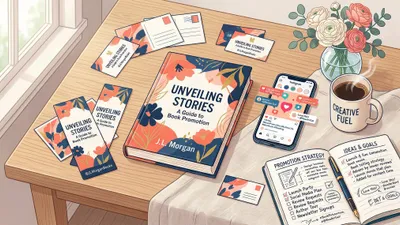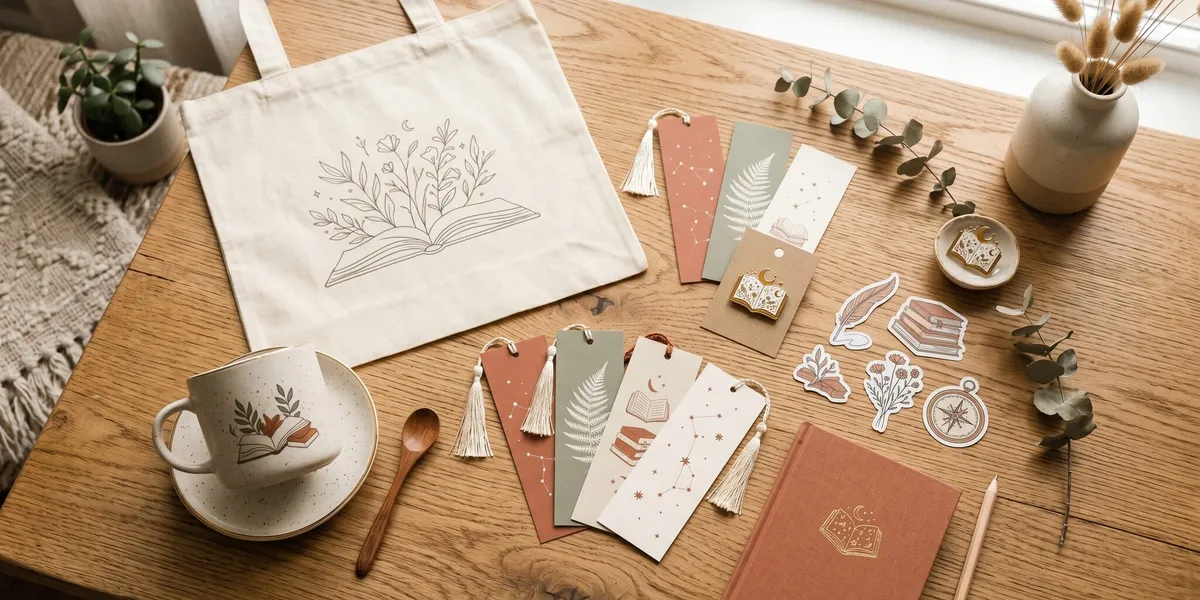
You can sell book merchandise without a warehouse, a design degree, or a massive fanbase — print-on-demand platforms handle production and shipping while you focus on creating products your readers actually want.
In this guide, you’ll learn:
- Which merchandise ideas sell best for authors (and which flop)
- How to design merch that reflects your book’s brand
- The best print-on-demand platforms for author merchandise
- How to set up your store, price your products, and market them to your audience
Here’s the complete process from first product idea to first sale.
What Is Book Merchandise?
Book merchandise — often called “book merch” or “author merch” — is any physical or digital product branded with elements from your book, series, or author identity. Think character art on t-shirts, iconic quotes on mugs, or map prints from your fantasy world.
Merchandise extends your book’s presence beyond the page. It turns readers into walking advertisements and gives superfans a way to express their connection to your story.
The key difference from selling books themselves: merch creates an entirely separate revenue stream that doesn’t depend on royalty rates or retailer algorithms.
Why Should You Sell Book Merchandise?
Selling merch isn’t just about extra income — though that matters. Here’s what it does for your author business:
Additional revenue. A single t-shirt sale at $25 with a 40-50% profit margin earns you $10-12 per unit. That’s comparable to multiple ebook royalties from a single transaction.
Brand visibility. Every tote bag at a coffee shop, every sticker on a laptop — those are free impressions that no ad budget can replicate. Readers wearing your merch spark conversations that lead to new readers.
Community building. Merchandise creates a sense of belonging. When readers wear matching “Book Club” hoodies or display your character art, they feel part of something bigger than a solo reading experience.
Reader loyalty. Fans who invest in merch are your most engaged readers. They’re the ones who leave reviews, share your launches, and pre-order every new release.
What Merchandise Ideas Sell Best for Authors?
Not all merch is created equal. The best-selling items share three qualities: they’re useful, they’re visible, and they connect to your book’s themes.
High-Performing Merchandise
| Product | Why It Works | Price Range | Profit Margin |
|---|---|---|---|
| T-shirts & hoodies | Visible, wearable, conversation starters | $22-45 | 40-50% |
| Tote bags | Readers carry books — give them a branded bag | $15-25 | 50-60% |
| Stickers | Low price point, impulse buys, high margin | $3-6 | 60-70% |
| Bookmarks | Directly tied to the reading experience | $3-8 | 50-65% |
| Mugs | Daily-use item with strong gift potential | $15-22 | 40-50% |
| Art prints & posters | Great for fantasy/sci-fi with rich worldbuilding | $12-30 | 50-60% |
| Enamel pins | Collectible, shareable, affordable | $8-15 | 45-55% |
| Notebooks & journals | Natural fit for writing-themed audiences | $12-20 | 40-50% |
Niche Products That Work for Specific Genres
Romance authors: Candles named after characters, “book boyfriend” themed items, chapstick with character quotes, cozy blankets for reading.
Fantasy/sci-fi authors: Map prints, faction-themed items (think house colors), character art prints, custom playing cards.
Thriller/mystery authors: “Trust no one” themed items, evidence-board style posters, cipher bookmarks.
Children’s book authors: Coloring pages, plush characters, activity kits, character stickers.
What to Avoid
Skip products with no connection to your book or brand. Generic “I Love Reading” merch won’t sell when your readers can buy that anywhere. Your advantage is specificity — products that only YOUR readers would understand and want.
Also avoid products with high manufacturing minimums until you’ve validated demand. Start with print-on-demand items where you invest nothing upfront.
How to Design Book Merchandise That Sells
Great merch starts with great design — but you don’t need to be a professional designer.
Identify Your Brand Elements
Pull design elements directly from your book:
- Iconic quotes — Lines your readers highlight, share, and tattoo. Short quotes (under 8 words) work best on products.
- Character art — Commissioned illustrations of beloved characters.
- Symbols and logos — A faction crest, a magical sigil, a recurring motif.
- Maps and worldbuilding — Fantasy maps make stunning prints and posters.
- Color palettes — Consistent colors that match your book covers and author brand.
Design Approaches
DIY with Canva or Adobe Express. Good for text-based designs like quote shirts and simple graphics. Start here to test ideas before investing in professional art.
Hire a freelance designer. Platforms like Fiverr, 99designs, and Behance connect you with artists who specialize in merchandise design. Budget $50-300 per design depending on complexity.
Collaborate with fan artists. If your book has fan art, reach out to artists about licensing their work. This builds community goodwill and gets you designs that readers already love. Always formalize the agreement in writing.
Design Rules That Sell
- High contrast. Designs need to be legible at a distance, especially on apparel.
- Less is more. Simple, bold designs outsell busy, cluttered ones.
- Don’t slap your cover on a shirt. Book covers rarely translate well to merch. Extract elements instead.
- Test before committing. Order samples of every product before listing them.
Check Your Rights
Before putting any image on merchandise, verify you have the rights. If a designer created your book cover using stock images, those images likely can’t be used on merchandise without a separate license. Commission original art for merch to stay safe.
Best Print-on-Demand Platforms for Author Merchandise
Print-on-demand (POD) eliminates the biggest barrier to selling merch: upfront inventory costs. You upload designs, customers order, and the platform prints and ships directly.
Top POD Platforms Compared
| Platform | Best For | Product Range | Integration | Base Costs |
|---|---|---|---|---|
| Printful | Overall quality & selection | 340+ products | Shopify, Etsy, WooCommerce | Medium |
| Printify | Budget-friendly options | 900+ products | Shopify, Etsy, WooCommerce | Low-Medium |
| Redbubble | Passive merch income | 70+ products | Built-in marketplace | Free to list |
| Spring (Teespring) | Social media selling | 50+ products | YouTube, Instagram, TikTok | Free to list |
| Gelato | International shipping | 100+ products | Shopify, Etsy | Medium |
| BookVault | Book-adjacent products | Books, prints, cards | Direct, Shopify | Low |
Which Platform Should You Choose?
If you want full control: Printful or Printify integrated with your own Shopify or author website store. Higher effort, higher margins, full brand experience.
If you want zero effort: Redbubble or Spring. Upload designs, set your margin, and let the marketplace handle traffic. Lower margins but truly passive.
If you sell internationally: Gelato prints in 32 countries, reducing shipping times and costs for global readers.
If you’re starting out: Begin with Redbubble or Spring to validate which designs sell, then move bestsellers to your own store for better margins.
How to Set Up Your Book Merchandise Store
You have three main options for where to sell, and the best choice depends on your existing author platform.
Option 1: Your Own Website (Highest Margins)
If you already have an author website, adding a merch store is the smartest move. You keep 100% of the margin above production costs.
How to do it:
- Connect Printful or Printify to your Shopify, WooCommerce, or Squarespace store
- Upload your designs and select products
- Write product descriptions that connect each item to your book
- Set prices (more on pricing below)
- Add the store link to your book’s back matter, email list, and social media profiles
Option 2: Etsy (Built-In Traffic)
Etsy brings 90+ million active buyers already searching for book-related items. The platform handles payment processing and provides built-in search traffic.
How to do it:
- Open an Etsy shop (free to start, $0.20 per listing)
- Connect Printful or Printify for automated fulfillment
- Optimize listings with keywords like “book lover gift” and your book’s title
- Enable Etsy ads for your top performers
Option 3: Marketplace-Only (Lowest Effort)
Redbubble, Spring, and Society6 handle everything — storefront, production, shipping, and customer service. You just upload designs.
Best for: Authors who want merch income without managing a store. Also great for testing which designs resonate before investing in a full store.
How to Price Book Merchandise
Pricing merchandise requires balancing what your readers will pay against your production costs and desired profit margin.
The Pricing Formula
Retail Price = Production Cost + Platform Fees + Desired Profit
A standard profit margin for author merchandise is 40-50%. Here’s how that looks in practice:
| Product | Production Cost | Fees (~10%) | Your Profit (45%) | Retail Price |
|---|---|---|---|---|
| T-shirt | $8.50 | $1.50 | $7.50 | ~$18 |
| Hoodie | $18.00 | $3.00 | $15.00 | ~$36 |
| Mug | $6.00 | $1.20 | $5.50 | ~$13 |
| Tote bag | $7.00 | $1.30 | $6.00 | ~$14 |
| Sticker | $1.50 | $0.50 | $2.00 | ~$4 |
Pricing Strategies That Work
Bundle merch with books. A “signed book + exclusive bookmark” bundle at $30 sells better than either item alone. Bundles also increase your average order value. If you sell signed copies through your site, check out our guide to selling signed copies independently.
Limited editions command premiums. A “first printing” enamel pin or a numbered art print can sell for 2-3x standard pricing. Scarcity drives urgency.
Include shipping in your price. Flat-rate or free shipping converts better than showing a $5 shipping charge at checkout. Build it into the product price.
Tiered pricing for different budgets. Offer stickers at $4, mugs at $15, and hoodies at $40 so every reader can participate regardless of budget.
How to Market Book Merchandise to Your Readers
The best merchandise in the world won’t sell if nobody knows it exists. Here’s how to get your merch in front of the right audience.
Launch Strategy
Email your list first. Your email subscribers are your warmest audience. Give them early access or an exclusive item before the public launch. Even a small list converts well when you’re selling to existing fans.
Social media reveals. Tease products before launch. Show the design process, share mockups, run polls to let readers vote on colors. Platforms like BookTok are particularly powerful for merch reveals — unboxing videos consistently go viral in the book community.
Book event sales. Conventions, signings, and book fairs are prime merch opportunities. Physical display + immediate purchase = high conversion. Bring your most visual items.
Ongoing Marketing
Include merch in your book’s back matter. A simple “Love this book? Visit [yoursite.com/shop] for exclusive merch” gives every reader a path to purchase.
Feature merch in your newsletter. Dedicate one section of your monthly newsletter to a featured product or limited drop.
User-generated content. Encourage buyers to share photos of themselves with your merch. Repost these — social proof drives more sales than any ad.
Seasonal drops. Release holiday-themed items, anniversary editions, or new-book-launch merch to create recurring purchase moments.
What About Ads?
For most authors, organic marketing to your existing audience will outperform paid ads for merch. Your readers already know and trust you — paid traffic introduces your merch to people who don’t know your book yet, which is a harder sell.
The exception: Etsy ads. Since Etsy shoppers are already browsing for book-related gifts, low-spend Etsy ads on your best sellers can be worthwhile.
How to Bundle Merchandise With Your Books
Bundles are the highest-converting merch strategy for authors. They increase your average order value and give readers a reason to buy directly from you instead of Amazon.
Book + bookmark bundle. The simplest bundle. Works for any genre. Price it $2-3 above the book’s solo price.
Signed book + exclusive item. An item available ONLY in the bundle — a character art card, a map print, or a sticker sheet. This is your special edition strategy applied to merch.
Collector’s box. A curated box with a signed book, 2-3 merch items, and a personal note. Price at $50-75. These sell out fast when marketed to superfans.
Series completion bundles. When you release the final book in a series, bundle all books with a series-themed item (faction pins, character set stickers, a series poster).
Common Mistakes to Avoid
- Ordering bulk inventory before testing demand. Use print-on-demand first. Only order in bulk once you know which items sell consistently.
- Designing for yourself, not your readers. What you think is cool may not match what your audience wants to buy. Poll your readers, check what sells in your genre, and start with proven product types.
- Ignoring shipping costs. Shipping can eat your entire margin if you don’t account for it in pricing. International shipping especially adds up.
- Launching too many products at once. Start with 3-5 items. A focused launch is easier to market and lets you identify winners quickly.
- Skipping product samples. Always order a sample before listing anything. Colors, sizing, and print quality can vary dramatically between what you see on screen and what arrives in the mail.
How Much Money Can You Make Selling Book Merchandise?
How much you earn depends on your audience size, product mix, and marketing consistency. But here’s a realistic framework:
Small audience (under 1,000 followers/subscribers): $100-500/month if 2-5% of your audience buys one item per quarter. Focus on high-margin items like stickers and bookmarks.
Medium audience (1,000-10,000): $500-2,000/month with consistent launches and a mix of price points. This is where bundles and limited editions start to scale.
Large audience (10,000+): $2,000-10,000+/month. At this level, merchandise can rival or exceed your book royalty income. Authors with strong brands often see merch become their top income stream.
The compounding effect matters: each new book grows your reader base, which grows your merch audience, which grows your total revenue. Authors who treat merch as an ongoing part of their book marketing plan — not a one-time experiment — see the strongest results.
Should You Use AI to Create Merchandise Designs?
AI image generators can help you prototype merch concepts quickly. Tools like Midjourney and DALL-E produce character art, pattern designs, and concept illustrations that work as starting points.
However, there are important limitations:
Copyright considerations. AI-generated art sits in a legal gray area for commercial use. Many print-on-demand platforms have updated their terms regarding AI-generated designs. Check each platform’s current policy before listing.
Quality control. AI art often needs refinement — extra fingers, inconsistent character appearances, text rendering issues. Plan to work with a human designer to polish AI-generated concepts.
Brand consistency. A human artist who understands your brand can produce a cohesive merch line. AI-generated pieces may look disconnected from each other.
Our Pick — Chapter
If you’re still working on the book that will fuel your merch line, Chapter helps you write it faster. Over 10,000 authors have used Chapter to create books — and the faster you finish your book, the sooner you can turn its best elements into merchandise your readers will love.
Best for: Authors writing nonfiction books who want AI-assisted drafting and editing in one platform. Pricing: $97 one-time (nonfiction) Why we built it: Every piece of merch starts with a great book — Chapter helps you write yours.
How to Scale Your Book Merchandise Business
Once you’ve validated your first products and built a small catalog, here’s how to grow:
Analyze your sales data. Track which items sell best, which designs get the most engagement, and which price points convert. Double down on winners and retire underperformers.
Expand to new product types. If your stickers sell well, try enamel pins. If t-shirts convert, add hoodies. Expand within categories where you have proven demand.
Collaborate with other authors. Cross-promote merch with authors in your genre. A “fantasy authors” sticker pack featuring characters from multiple series introduces you to each other’s audiences.
Create a subscription option. A quarterly merch box ($30-50/quarter) creates predictable recurring revenue and gives your biggest fans something to look forward to.
Sell at events. Book fairs, comic conventions, and genre conferences put your merch in front of highly qualified buyers. Physical products sell better in person.
Do You Need a Business License to Sell Book Merchandise?
In most US states, selling merchandise requires a sales tax permit and may require a business license depending on your location. Here’s the short version:
- Sales tax: Most states require you to collect and remit sales tax on physical goods. Many POD platforms handle this automatically.
- Business structure: An LLC separates your personal assets from your merch business. It’s not always required, but it’s smart. Many authors who make money self-publishing set up an LLC that covers both book sales and merchandise.
- Platform compliance: Etsy, Shopify, and POD platforms have their own seller requirements. Review them during account setup.
Consult a tax professional or accountant familiar with online retail for guidance specific to your location.
FAQ
How much does it cost to start selling book merchandise?
Starting a book merchandise business costs $0-50 with print-on-demand platforms like Redbubble or Printful. You pay nothing until a customer orders. Your only upfront investment is design creation — free with Canva, or $50-300 per design if you hire a freelance artist.
What is the best platform to sell author merch?
The best platform to sell author merch is Printful connected to your own Shopify or author website for maximum margins. For beginners, Etsy provides built-in traffic from 90+ million buyers. Use Redbubble for zero-effort, passive merch sales with no setup costs.
Can you sell book merchandise without a large audience?
Yes, you can sell book merchandise without a large audience. Start with 3-5 low-cost items like stickers and bookmarks that appeal to your existing readers. Even an email list of 200-500 engaged subscribers can generate consistent merch sales through direct marketing and bundles.
What book merchandise sells best?
The best-selling book merchandise includes t-shirts, tote bags, stickers, and bookmarks. Items that are both useful and visible perform strongest. Genre-specific products — like fantasy map prints or romance character candles — often outsell generic designs because they connect deeply with niche readers.
Do I need permission to put my book cover on merchandise?
You may need permission to put your book cover on merchandise. If your cover uses licensed stock images, those images likely aren’t cleared for merchandise use. Commission original artwork specifically for merch, or verify your cover designer’s license terms before printing any products.