You can absolutely sell books at craft fairs — and many self-published authors earn $200-$500 per event once they dial in their setup and pitch.
In this guide, you’ll learn:
- How to choose the right craft fairs for your genre and audience
- The exact booth setup that attracts buyers (not just browsers)
- Pricing strategies that maximize your per-book profit
- Engagement techniques that turn curious shoppers into readers
Here’s everything you need to start selling books at local events.
Why Craft Fairs Work for Selling Books
Selling books at craft fairs gives you the highest profit margin of any sales channel. You keep 100% of the cover price minus your printing cost — compared to Amazon’s 40-60% cut or a bookstore’s wholesale discount.
Craft fairs also work because you’re the only author there. At a book fair, you compete with hundreds of other writers. At a craft fair, your booth stands out simply because books are unexpected.
Holiday markets are especially lucrative. Shoppers arrive looking for unique gifts, and a signed book from a local author fits perfectly.
The math is straightforward. A typical booth costs $50-$150 for a local event. If your paperback costs $4 to print and you sell it for $15, that’s $11 profit per book. Sell 20 books and you’ve cleared $220 minus your booth fee — a solid return for a Saturday morning.
How to Choose the Right Craft Fair for Your Books
Not every craft fair is a good fit. The wrong event means sitting alone all day with zero sales. The right one means connecting with your exact readers.
Match the event to your genre
Romance and women’s fiction sell well at holiday boutiques and spring markets where the crowd skews female, ages 30-60. Children’s books thrive at family-friendly community fairs. Thriller and sci-fi authors do better at comic cons and pop culture events.
Ask these questions before applying
- How many attendees did last year’s event draw?
- What’s the booth fee, and what does it include?
- Are other authors or booksellers typically present?
- Is the event indoors or outdoors?
- What’s the demographic of the typical shopper?
Start small, then scale up
Your first event should be low-risk — a $50 booth at a community center craft fair. Once you nail your pitch and display, graduate to larger events with higher fees and bigger crowds.
Look for events through local Facebook groups, community calendars, Eventbrite, and craft fair directories. Many churches, schools, and civic organizations host seasonal markets with affordable booth space.
What You Need for Your Book Booth Setup
Your booth is your storefront. A professional-looking display signals to shoppers that your books are worth buying — not a hobby project you printed at home.
Essential supplies checklist
- Table cover: A solid-colored tablecloth (black or navy works best to make book covers pop)
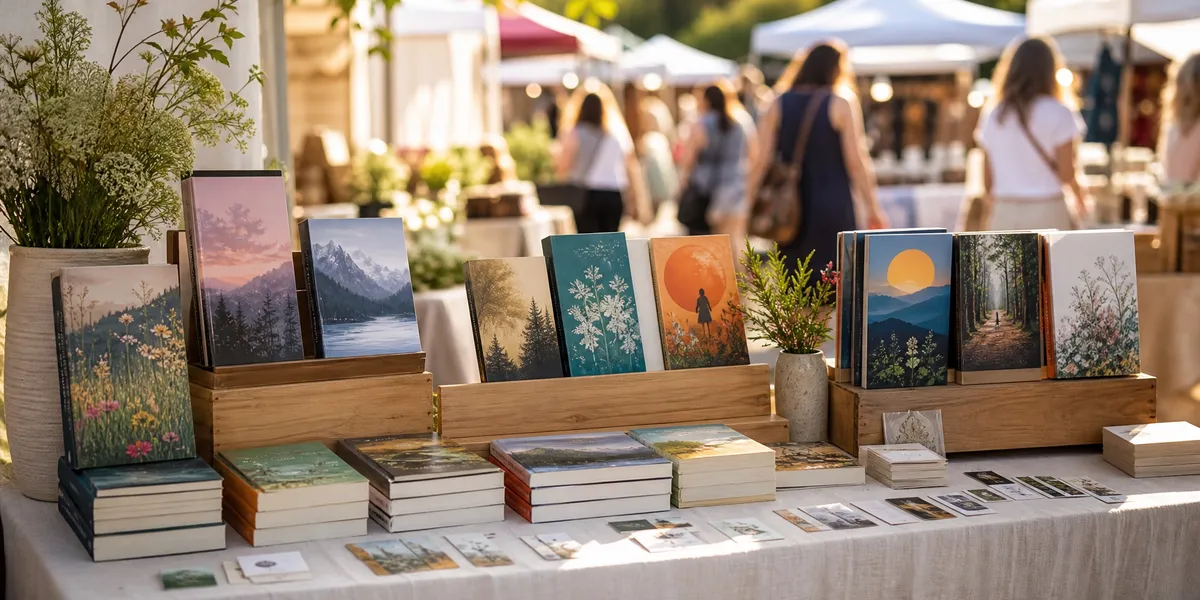
- Book stands: Small acrylic or wooden easels to display covers face-out
- Vertical banner: A retractable banner with your book covers, author name, and genre
- Square reader: A card reader like Square or SumUp — many shoppers don’t carry cash
- Price signs: Clear, visible pricing so shoppers don’t have to ask
- Business cards or bookmarks: Your giveaway item with a QR code to your website
- Author sign: A small sign saying “Meet the Author” or “Local Author — Signed Copies Available”
Display layout that sells
Stand your bestseller face-out at eye level in the center of your table. Stack additional copies flat behind it. If you have multiple titles, arrange them in a logical reading order or by series.
Keep your table uncluttered. Three to five titles displayed prominently outsells a table crammed with twenty books piled flat. Shoppers need to instantly understand what you write.
Place bookmarks and business cards at the front edge of your table — these are low-commitment items people grab even if they don’t buy today. That bookmark goes in their purse and reminds them of you later.
If you’re working on your book cover design ideas before your first fair, make sure your covers are designed for visibility at a distance. Bold titles and high-contrast imagery catch eyes from across an aisle.
How to Price Your Books at Craft Fairs
Pricing at in-person events is different from Amazon pricing. You have no algorithm to compete with and no comparison shopping happening in real time.
The craft fair pricing sweet spot
Price your paperbacks at $15-$20 for standard novels and $10-$15 for novellas or short story collections. This falls within the impulse-buy range ($10-$40) that moves best at craft fairs.
Don’t undercharge. A $7.99 price tag (matching your Amazon price) signals cheap rather than valuable. Craft fair shoppers expect handmade and artisan pricing. Your signed book is a premium product.
Create bundles and deals
- “Buy 2, get $5 off” encourages multiple purchases
- Series bundles at a discount (e.g., all 3 books for $40 instead of $45)
- Book + bookmark set as a gift-ready package
Know your margins
Calculate your break-even before every event:
| Item | Cost |
|---|---|
| Booth fee | $50-$150 |
| Printing (per book) | $3-$5 |
| Travel and parking | $10-$30 |
| Supplies (one-time, amortized) | $5-$10 per event |
If your total costs are $100 and you sell each book for $15 with a $4 print cost, you need to sell 10 books just to break even. Anything beyond that is profit. Most experienced craft fair authors report selling 15-40 books per event once they’ve refined their approach.
Understanding the cost to self-publish a book helps you set prices that ensure every event is profitable from the start.
How to Engage Shoppers Without Being Pushy
The biggest mistake authors make at craft fairs is sitting behind their table, nose in a book, waiting for someone to approach. The second biggest mistake is jumping on every passerby with a hard sell.
The sweet spot is somewhere in between.
The 3-second hook
When someone’s eyes linger on your display for more than a moment, offer a simple greeting: “Hi! I write [genre] — those are all signed copies if anything catches your eye.”
That’s it. You’ve identified yourself as the author (which is exciting to shoppers), named your genre (which helps them self-select), and mentioned the signing (which adds value). Then step back.
The elevator pitch
If they engage, have a 15-second pitch ready for each book. Not a synopsis — a hook.
Bad: “It’s about a woman named Sarah who moves to a small town and discovers her grandmother’s house has a secret room that leads to…”
Good: “It’s a cozy mystery set in a bookshop — think Murder She Wrote meets Gilmore Girls. Every chapter ends on a cliffhanger.”
Practice your pitch until it feels natural. You should be able to deliver it while making eye contact and smiling.
Let them hold the book
Once someone picks up your book, they’re 80% of the way to buying it. Don’t interrupt. Let them flip through it, read the back cover, and make their decision. Only add information if they ask a question.
If you’re new to pitching your work in person, our guide to book signing tips for new authors covers the psychology of in-person selling in depth.
How to Accept Payments at Your Booth
Cash-only booths lose sales. Period. Many shoppers under 40 don’t carry cash at all, and even those who do prefer the convenience of tapping a card.
Set up a mobile payment system
Square is the most popular option for craft fair vendors. The basic card reader is free, and you pay 2.6% + $0.10 per transaction. For a $15 book, that’s about $0.49 — well worth the sale you’d otherwise lose.
Other options include SumUp, PayPal Zettle, and Shopify POS. Choose whichever integrates best with your existing setup.
Also accept these
- Venmo and Zelle (display your QR code)
- Apple Pay and Google Pay (works through Square)
- Cash (bring a small cash box with change for $20 bills)
Track every sale
Use your payment system’s built-in tracking or a simple tally sheet. Knowing exactly how many books you sell at each event tells you which fairs are worth repeating and which aren’t.
How to Get Inventory for Craft Fairs
You need physical books to sell in person. Here are your options for getting print copies at the lowest per-unit cost.
Print-on-demand bulk orders
If you publish through Amazon KDP, you can order author copies at printing cost (typically $3-$5 per paperback). Order 30-50 copies before your first event.
IngramSpark also offers author copies and is preferred if you want wider distribution and better paper quality options.
Local printing
For specialty formats (hardcovers, illustrated books, or children’s picture books), a local printer may offer competitive bulk pricing at quantities of 100+.
How many books to bring
Bring more than you think you’ll sell. Running out signals demand and feels good — but it’s lost revenue. For your first event, bring 30-40 copies of your lead title and 15-20 of any secondary titles.
If you haven’t yet published your book, Chapter.pub helps you go from manuscript to publication-ready in weeks rather than months. The AI-assisted writing and formatting tools handle the technical side so you can focus on getting your book into readers’ hands.
How to Market Before and After the Event
The craft fair itself is just one piece of the puzzle. Smart pre-event and post-event marketing multiplies your results.
Before the event
- Post on social media 1-2 weeks before with the event name, date, and your booth number
- Email your subscriber list with event details
- Create a countdown on Instagram Stories
- Share a behind-the-scenes look at your booth prep
During the event
- Post Stories and Reels showing your booth in action
- Collect email addresses with a sign-up sheet (offer a free chapter or short story as incentive)
- Hand out bookmarks to every single person who walks past — even if they don’t buy
After the event
- Thank attendees on social media
- Email new sign-ups within 48 hours
- Follow up with anyone who took a business card but didn’t buy
- Write notes about what worked and what didn’t for next time
Your book launch strategy should include craft fairs as a key in-person channel, especially in the first 90 days after publication.
Common Mistakes to Avoid
- Sitting behind your table looking bored — Stand up, make eye contact, and greet people warmly
- Overloading your table — Less is more. Feature 3-5 titles prominently rather than 20 stacked flat
- Forgetting a card reader — You will lose sales if you’re cash-only
- Not having a pitch ready — Practice your 15-second hook until it’s second nature
- Choosing the wrong event — A romance author at a hunting and fishing expo won’t sell books
- Underpricing — Craft fair shoppers expect artisan pricing. $15-$20 per book is normal and expected
- Skipping follow-up — The event isn’t over when you pack up. Those email sign-ups and business card exchanges are future sales
How Much Can You Make Selling Books at Craft Fairs?
Most authors earn $100-$500 per craft fair event once they’ve dialed in their booth and pitch. Your earnings depend on event size, book pricing, and how well your genre matches the audience.
Here’s a realistic breakdown:
| Event Type | Booth Cost | Expected Sales | Profit |
|---|---|---|---|
| Small community fair | $50 | 10-15 books | $60-$115 |
| Medium holiday market | $100 | 20-30 books | $120-$230 |
| Large craft show (2-day) | $200 | 40-60 books | $240-$460 |
The real value extends beyond book sales. Every person who takes a bookmark, signs up for your email list, or hears your pitch becomes a potential reader. Many craft fair authors report that their online sales spike in the days following an event.
Some authors build craft fairs into their ongoing book marketing strategy, attending 2-3 events per month during peak seasons (holiday season, spring, and summer markets).
Do You Need an ISBN for Craft Fair Sales?
Yes, you need an ISBN if you’re selling physical books, but if you already publish through KDP or IngramSpark, your paperback already has one. The ISBN is printed on your back cover with the barcode — you don’t need to do anything extra for craft fair sales.
If you’re producing books independently through a local printer, you’ll need to purchase your own ISBN. Check our guide on whether you need an ISBN for Kindle for the full breakdown of when ISBNs are required.
What About Sales Tax at Craft Fairs?
Most states require you to collect sales tax on physical book sales. Check your state’s Department of Revenue website for specific requirements.
In many states, you’ll need:
- A sales tax permit (usually free)
- To collect tax at the point of sale
- To remit collected tax quarterly or annually
Some states exempt books from sales tax entirely (check yours). Square and other POS systems can automatically calculate and add sales tax to each transaction if you configure them correctly.
How to Stand Out Among Other Vendors
At a craft fair, you’re competing with jewelry makers, candle sellers, and pottery artists — not other authors. Use that to your advantage.
Make your booth interactive
- Offer to sign books with a personal message right there (“To Sarah, Happy Birthday!”)
- Let people flip through a sample copy
- Display a poster-sized version of your most eye-catching book cover
Build a visual identity
Your banner, tablecloth, and signage should match your book’s genre aesthetics. A romance author’s booth should feel warm and inviting. A thriller writer’s booth should feel dark and intriguing.
Consistency signals professionalism. It tells shoppers this isn’t your first rodeo.
Connect your author brand
Make sure your booth connects to your broader author website and online presence. QR codes on your banner, bookmarks, and business cards should link directly to your site or email sign-up page.
FAQ
How many books should I bring to a craft fair?
Bring 30-50 copies of your lead title and 15-20 of secondary titles to your first craft fair. Experienced authors adjust based on event size — large holiday markets with 5,000+ attendees may warrant 75-100 copies. Running out means lost sales, so err on the side of bringing more.
What is the best table setup for selling books at a craft fair?
The best table setup for selling books uses a solid dark tablecloth, face-out book stands at eye level, a vertical banner with your covers, clear pricing signs, and a card reader. Keep the display uncluttered with 3-5 featured titles rather than stacking dozens of books flat.
How do I find craft fairs that allow book vendors?
Find craft fairs accepting book vendors through local Facebook groups, community event calendars, Eventbrite, and craft fair directories. Contact event organizers directly to ask if authors are welcome — many fairs actively seek book vendors because they add variety. Churches, schools, and civic organizations often host affordable seasonal markets.
Is it worth selling books at craft fairs?
Selling books at craft fairs is worth it for most self-published authors. You keep 100% of the cover price minus printing costs (compared to 40-60% through retailers), build direct reader relationships, and collect email sign-ups. Most authors earn $100-$500 profit per event once they refine their setup and pitch.
Do I need a business license to sell books at a craft fair?
Requirements vary by state and municipality. Most craft fairs require vendors to have a basic business license or seller’s permit. Check your local government’s website for vendor requirements, and ask the event organizer what documentation they need during the application process.