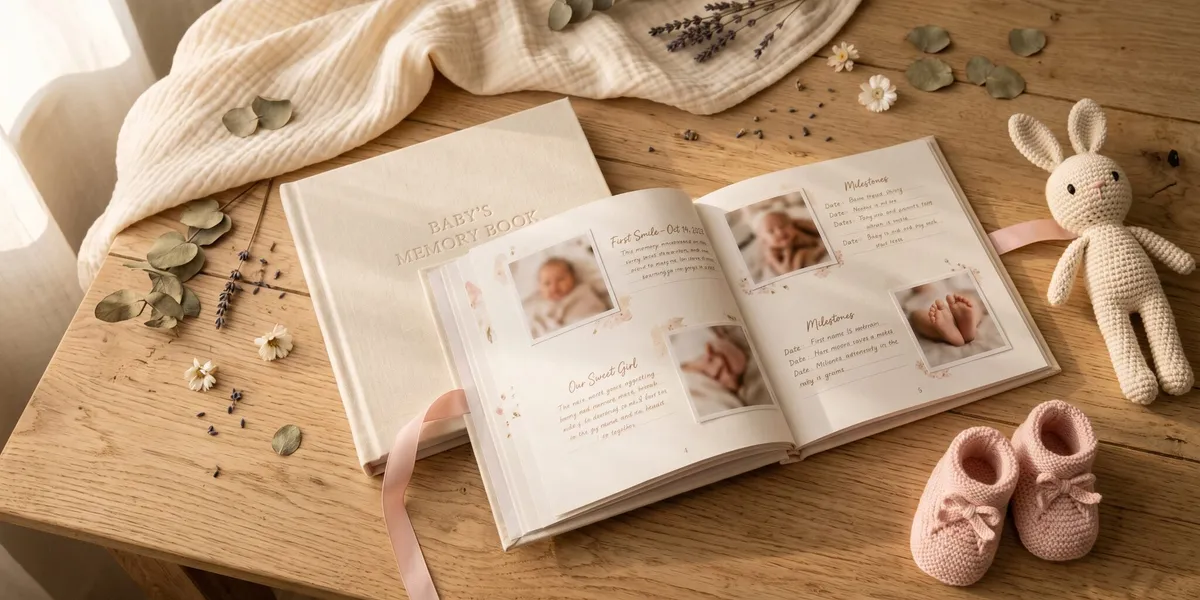
You can write a baby book that your family treasures for generations — whether you want a personal memory journal or a published book for other parents. The process is simpler than you think, and you do not need to be a professional writer to create something beautiful.
In this guide, you’ll learn:
- How to choose between a memory book, milestone journal, or published baby book
- What to include in each section so nothing gets forgotten
- How to organize and write your content even when sleep-deprived
- Options for printing, publishing, and sharing your finished book
Here is how to create a baby book worth keeping forever.
What Kind of Baby Book Are You Writing?
A baby book is any book that documents a child’s early life — from pregnancy through the first few years. Before you start writing, you need to decide which format fits your goal.
There are three main types:
Memory book or keepsake journal. This is the classic baby book. You fill it with milestones, photos, letters, and personal reflections about your child’s first years. It stays in your family as a treasured keepsake.
Guided journal for other parents. This is a baby book you design with prompts, templates, and fill-in sections — then publish it so other parents can use it to document their own baby’s milestones. These sell well on Amazon KDP and make great guided journal projects.
Children’s board book for babies. This is a picture book written for babies to look at and interact with. It has minimal text, bright illustrations, and sensory elements. If this is your goal, check out our guide on how to write a children’s book.
Most people searching for “how to write a baby book” want the first or second type. This guide covers both, with extra sections on publishing if you want to share your work beyond your family.
How to Write a Baby Memory Book (Personal Keepsake)
A baby memory book captures your child’s story from pregnancy through their early years. The key is creating a structure you can actually maintain — because new parents are exhausted and time is scarce.
Choose Your Format First
You have several format options for a personal baby memory book:
| Format | Best For | Effort Level |
|---|---|---|
| Physical scrapbook | Hands-on parents who love crafting | High |
| Printed photo book | Parents who take lots of photos | Medium |
| Digital journal app | Busy parents who write on their phone | Low |
| Written journal/notebook | Parents who prefer handwriting | Medium |
| AI-assisted book | Parents who want polished, publishable quality | Medium |
If you want a polished final product without spending months on layout, AI writing tools can help you organize scattered notes and photos into a cohesive narrative. Chapter works well for parents who want to turn raw memories into structured, readable prose — you provide the moments and details, and the AI helps you shape them into something your child will actually want to read someday.
Set Up Your Sections
Every good baby memory book needs a logical structure. Here are the essential sections to include:
Before baby arrived. Document the pregnancy journey — how you found out, your feelings, cravings, the name selection process, and preparation for baby’s arrival. Include ultrasound details and any letters you wrote to your unborn child.
Birth story. Record the full birth experience while it is still fresh. Include the date, time, weight, length, location, who was present, and the emotional details that matter most. This is often the most treasured section of any baby book.
Firsts and milestones. Track first smile, first laugh, first words, first steps, first foods, first tooth, and first haircut. But go beyond the obvious — document the first time your baby reached for you, their first friend, or their first attempt at a joke.
Monthly or quarterly updates. Record what your baby is doing, eating, and loving at regular intervals. These snapshots become fascinating as your child grows.
Family and relationships. Document who your baby’s people are — grandparents, siblings, aunts, uncles, close friends. Include how your baby interacts with each person and any special bonds that form.
Favorites and personality. Note favorite toys, songs, books, foods, and activities. Capture quirks, habits, and emerging personality traits that you will forget if you do not write them down.
Letters to your child. Write periodic letters addressed directly to your baby. Share your hopes, observations about their personality, what the world looks like right now, and what being their parent feels like. These become incredibly meaningful later.
Write in Real Time (Even If It Is Messy)
The biggest mistake new parents make with baby books is waiting until they have time to “do it properly.” That time never comes.
Instead, capture moments as they happen. Use voice memos on your phone. Text yourself one-line notes. Take a photo and add a caption. Jot down three words in a notebook at bedtime.
You can polish and organize later. The raw material is what matters, and raw material disappears from memory faster than you expect. Research on autobiographical memory shows that specific details fade within weeks — so capture the small moments now and shape them later.
A weekly 15-minute writing session works well for most parents. Pick a consistent time — Sunday evening after bedtime, Monday morning during a nap — and turn your scattered notes into a few paragraphs.
Organize Chronologically or by Theme
Most baby memory books follow a chronological structure — pregnancy, birth, month one through month twelve, year two, year three. This is intuitive and easy to maintain.
An alternative is organizing by theme — one section for milestones, one for family stories, one for letters, one for funny moments. This works well if you are writing the book after the fact rather than in real time.
Either approach works. Pick the one that feels natural and stick with it. A finished baby book with imperfect organization beats a perfect system you never complete.
How to Create a Baby Book for Publishing
If you want to create a baby journal or milestone book that other parents can buy and use, you are entering the guided journal market — and it is a profitable one. Baby memory books consistently sell on Amazon, Etsy, and through independent bookstores.
Research What Sells
Before designing your baby book, study what already exists. Search Amazon for “baby memory book” and “baby milestone journal.” Note what the bestsellers include, what reviewers praise, and what they say is missing.
Common gaps you can fill:
- Books for nontraditional families (single parents, same-sex parents, adoptive parents, blended families)
- Cultural-specific baby books that reflect particular traditions and milestones
- Minimalist designs for parents who find traditional baby books overwhelming
- Extended baby books that cover pregnancy through age five instead of just year one
- Baby books with guided prompts instead of blank pages
Finding an underserved angle is the same strategy that works for writing a parenting book — the more specific your audience, the easier it is to stand out.
Design Your Page Layout
A publishable baby book needs a clear, consistent page structure. Each section should include:
Prompts and questions. Instead of blank space, give parents specific questions to answer. “What was the first food you tried?” is easier to fill in than a blank page labeled “First Foods.”
Space for photos. Include designated photo areas with captions. Even if the book is primarily a journal, photo spots make it more engaging.
Milestone trackers. Simple checkboxes or fill-in-the-blank fields for recording dates of key milestones.
Reflection space. Open-ended sections where parents can write freely about their experience.
Design elements. Subtle illustrations, decorative borders, or thematic graphics that give the book personality without overwhelming the content.
If you are publishing on Amazon KDP, you will need to format your interior as a PDF. Tools like Canva, Adobe InDesign, or Book Bolt work well for designing journal-style interiors. For the written content and prompts, Chapter can help you generate thoughtful, varied prompts that go beyond generic baby book questions.
Write Prompts That Actually Help
The quality of your prompts determines whether parents fill in the book or abandon it after three pages. Good baby book prompts are specific, emotionally engaging, and easy to answer in a few sentences.
Weak prompts:
- “Baby’s first year” (too broad)
- “Memories” (too vague)
- “Notes” (unhelpful)
Strong prompts:
- “The first time you smiled at me, I was doing _____ and my reaction was _____”
- “Your favorite way to be held is _____ and you always _____”
- “The song that calms you down every time is _____”
- “Something you did this month that surprised me: _____”
- “If I could freeze one moment from this week, it would be _____”
Strong prompts trigger specific memories. They give parents a starting point instead of a blank page. Write 50-100 prompts, organize them by age or theme, and test them with a few parent friends before finalizing.
Choose Your Publishing Path
You have several options for publishing a baby book:
Amazon KDP is the most accessible route. You can publish a paperback baby journal with no upfront costs. The trade-off is that KDP does not support board books or spiral binding — formats that many parents prefer for baby books.
IngramSpark gives you wider distribution and more format options, but requires an upfront setup fee and ISBN purchase.
Print-on-demand services like Lulu or Blurb offer premium printing options including lay-flat binding, which is popular for memory books.
Local printing works well if you want a small batch of high-quality books for gifts or a niche audience.
For a deeper look at the publishing process, our guide on self-publishing a children’s book covers many of the same production steps — formatting, ISBNs, cover design, and distribution.
What to Include in a Baby Book (Complete Checklist)
Whether you are writing a personal memory book or designing one for publishing, here is a comprehensive checklist of content to include:
Pregnancy and Birth
- How you found out about the pregnancy
- Gender reveal or discovery moment
- Pregnancy cravings and symptoms
- Baby shower details
- Nursery preparation
- Birth plan vs. what actually happened
- Birth story with date, time, weight, length
- First family photo
- Baby’s name meaning and selection story
- Hospital or birth center memories
First Year Milestones
- First smile, laugh, and giggle
- Rolling over, sitting up, crawling, standing, walking
- First words and babbling sounds
- First tooth
- First solid food and reactions
- First bath
- First haircut
- First holiday celebrations
- First trip or outing
- First illness and how you handled it
Personality and Daily Life
- Sleep patterns and bedtime routines
- Favorite toys, books, and songs at each stage
- Funny moments and unexpected behaviors
- Relationship with siblings, pets, or regular caregivers
- Temperament observations
- Food preferences and mealtime habits
Family Context
- Family tree or key family members
- Cultural traditions observed
- World events happening during baby’s early life
- The home you lived in
- Your daily routine as a new parent
- Advice from grandparents or elders
This list works as a personal narrative structure — you are documenting a true story with specific details, sensory moments, and emotional honesty.
How to Write a Baby Book Years Later
Maybe your baby is now a toddler, a preschooler, or even older — and you never got around to starting a baby book. You are not too late. Many parents write baby books retrospectively, and the result can be even richer because you have perspective on which moments truly mattered.
Gather Your Raw Materials
Start by collecting everything you have:
- Phone photos and videos. Scroll through your camera roll from pregnancy onward. Photos are the single best memory trigger. Pay attention to the background details — what your home looked like, what season it was, what you were wearing.
- Text messages and social media posts. Search your messages for announcements, funny stories, and milestone updates you shared with family and friends.
- Medical records. Your pediatrician’s records have exact dates for weight checks, vaccinations, and developmental milestones.
- Calendar entries. Check old calendars for appointments, events, and activities that jog your memory.
- Other people’s memories. Ask your partner, parents, siblings, and close friends what they remember. They will recall moments you have forgotten entirely.
Use Memory Mapping to Fill Gaps
Memory mapping is a technique from memoir writing that works perfectly for baby books. Start with a milestone you remember clearly — your baby’s first steps, for example. Then map outward from that memory.
Where were you? Who was there? What time of day was it? What had happened earlier that day? What did your baby do right before taking those steps? What did you do after?
Each anchor memory pulls related details back to the surface. Work through five or six anchor memories and you will have enough material for a substantial baby book.
This is the same approach used in memoir writing — starting with vivid moments and building the narrative outward from there.
Write Without Chronological Pressure
When writing a baby book after the fact, do not force yourself to start at the beginning and write straight through. Instead, write whatever memory comes most vividly first. Write the birth story one day, the first Christmas the next, and the crawling phase the day after that.
You can arrange everything chronologically later. The goal right now is to get memories onto the page before they fade any further.
AI writing tools are especially helpful for retrospective baby books. You can dump raw notes, photo descriptions, and scattered memories into Chapter, and it helps you weave them into a coherent, readable narrative. Over 10,000 authors have used Chapter to turn raw material into polished books — and baby books are one of the most common personal projects on the platform.
Common Mistakes to Avoid
- Waiting for perfection. A messy, incomplete baby book is infinitely more valuable than a perfect one you never start. Done beats beautiful.
- Including only milestones. The everyday moments — the 3 AM feedings, the way your baby grabs your finger, the sound of their laugh — matter more than milestone dates.
- Writing in generalities. “Baby loved bath time” is forgettable. “You splashed so hard during your 6-month bath that the dog ran out of the room” is a story your child will love reading.
- Forgetting your own experience. A baby book is not just about the baby. Your emotions, struggles, growth, and love are part of the story. Include yourself.
- Comparing to other baby books. Your baby book does not need to look like the ones on Pinterest. It needs to sound like you and capture your family’s real experience.
How Long Does It Take to Write a Baby Book?
How long it takes to write a baby book depends on the type you are creating. A personal memory book written in real time takes 15-30 minutes per week over one to three years. A retrospective baby book written after the fact takes two to four weeks of focused writing sessions. A publishable baby journal with designed prompts and layouts takes four to eight weeks from concept to print-ready file.
The writing itself is not the time-consuming part. Gathering photos, organizing memories, and making design decisions take longer than the actual writing. Starting with a clear structure — like the section list in this guide — cuts your timeline significantly.
Can You Use AI to Write a Baby Book?
You can absolutely use AI to help write a baby book, and it is one of the best use cases for AI writing tools. AI will not replace your memories or your voice — but it can help you organize, expand, and polish your raw material into something publishable.
Here is how AI fits into the baby book process:
- Organizing scattered notes into chronological or thematic sections
- Expanding brief memories into full paragraphs with sensory details
- Generating prompts for sections where you are stuck
- Polishing your writing while keeping your natural voice
- Formatting for publishing if you want to print or sell your book
The key is giving the AI your real memories as input. The more specific and personal your raw material, the better the output. “Write about a baby’s first steps” produces generic content. “My daughter Ellie took her first steps on March 3rd in the kitchen, reaching for the cat” produces something worth keeping.
If you want to write a book about your experience as a new parent, AI tools can also help you expand a baby book into a full parenting memoir or advice book.
How to Turn a Baby Book Into a Family Heirloom
A baby book becomes a true heirloom when you think beyond the first draft. Here are ways to elevate your book:
Print a physical copy. Digital files get lost. Hard drives fail. Cloud services shut down. A printed book survives decades on a bookshelf. Services like Blurb, Shutterfly, and Artifact Uprising specialize in high-quality photo books.
Make multiple copies. Print one for your child, one for grandparents, and one backup. The cost of an extra copy is negligible compared to the value of the content.
Include a letter for future reading. Write a final letter addressed to your child at age 18, 21, or on their wedding day. Seal it in an envelope tucked into the back cover.
Add context about the world. Future generations will be fascinated by details that feel ordinary now — what things cost, what technology you used, what your neighborhood looked like, what you worried about as a new parent in 2026.
Update it. The best baby books grow over time. Add a page on each birthday. Include your child’s reactions when they read the book for the first time. Let the book become a living document rather than a finished project.
If you want to create something for grandchildren specifically, our guide on writing a book for your grandchildren covers legacy writing in more depth.
FAQ
What Is a Baby Book?
A baby book is a keepsake journal or memory book that documents a child’s milestones, firsts, and family memories from pregnancy through the early years. Baby books typically include birth details, monthly updates, milestone trackers, photos, and personal reflections from parents. They serve as treasured family heirlooms that preserve memories you would otherwise forget.
How Many Pages Should a Baby Book Have?
A baby book should have 40 to 80 pages for a personal memory book or publishable guided journal. A simple first-year milestone book works well at 40-50 pages. A comprehensive book covering pregnancy through age three needs 60-80 pages. The right length depends on how much detail you want to capture and whether you include photo pages.
What Should I Write on the First Page of a Baby Book?
The first page of a baby book should include a welcome letter or dedication addressed directly to your child. Write why you are creating this book, what your hopes are for their life, and how you felt when you learned they were coming. Keep it personal and heartfelt — this page sets the tone for the entire book and becomes one of the most meaningful pages your child will read later.
Can I Make Money Selling Baby Books?
You can make money selling baby books by creating a guided baby journal with prompts and milestone trackers, then publishing it on Amazon KDP or Etsy. Baby memory books are a consistent-selling category in the low-content book market. Success depends on finding a specific niche — books for adoptive parents, minimalist designs, or culturally specific milestones tend to outperform generic options.
Is It Too Late to Start a Baby Book?
It is never too late to start a baby book. Many parents begin writing months or even years after their child is born and still create meaningful keepsakes. Use photos, text messages, social media posts, and medical records to reconstruct your timeline. Ask family members for their memories. A retrospective baby book often has richer perspective because you know which moments truly mattered.