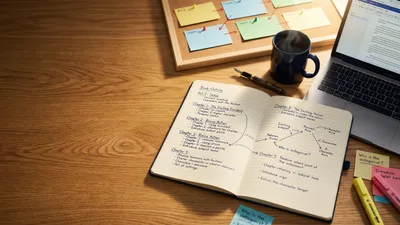
You can write your first book in as little as 30 days — even if you have never written more than an email. The trick is not talent. It is having a repeatable process that takes you from blank page to finished manuscript without burning out.
In this beginner’s guide, you’ll learn:
- The 7 steps every first-time author uses to finish a book
- How to pick an idea that is actually worth writing
- A daily writing routine that fits into a busy life
- The free and paid tools that make writing 10x faster
- How to edit, publish, and sell your book on Amazon
Here is the exact step-by-step process thousands of beginners have used to go from “I want to write a book” to holding a copy of their own finished book.
What Does It Take to Write a Book as a Beginner?
Writing a book as a beginner takes three things: a clear idea, a daily writing routine, and a finishing mindset. You do not need an MFA, a publisher, or years of experience. The average beginner book takes 3 to 6 months to draft when you write 500 to 1,000 words per day, five days a week.
The biggest myth about writing a book is that you need to be “a writer” first. You don’t. According to a 2023 study in the New York Times, 81% of Americans say they want to write a book someday — but only about 3% ever finish one. The difference is not skill. It is process.
This guide gives you that process.
Step 1: Pick the Right Book Idea for Your First Book
Your first book idea should be small enough to finish and specific enough to matter. New writers kill their momentum by trying to write epic fantasy trilogies or sweeping memoirs. Pick a contained idea you can hold in your head.
Ask yourself three questions:
- What do people ask me for advice about? (nonfiction gold)
- What story have I been telling friends for years? (memoir / fiction gold)
- What would I want to read that does not exist yet? (market gap)
For fiction, aim for a single character with a single problem across a single setting. Think The Old Man and the Sea, not Game of Thrones.
For nonfiction, narrow your topic until it could only be written by you. “How to be productive” is too broad. “How remote nurses can batch their charting in 15 minutes a day” is a book. The narrower your topic, the easier it is to write — and sell.
Concrete example: First-time author James Clear built Atomic Habits around one narrow idea: tiny habit changes compound. He did not try to write a book about all of self-improvement. The niche won him 20 million copies sold.
Step 2: Decide Whether You’re Writing Fiction or Nonfiction
This one choice changes your entire workflow. Fiction requires plot, character, and scenes. Nonfiction requires research, outline, and argument. Pick your lane before you write a single word.
Fiction checklist for beginners:
- Choose a genre (romance, mystery, fantasy, thriller, literary)
- Pick one protagonist, one main conflict, one core setting
- Target 60,000 to 80,000 words for a standard novel
- Outline a simple three-act structure before drafting
Nonfiction checklist for beginners:
- Define your reader (who is this for in one sentence?)
- Pick your transformation (what will they know or do after?)
- Target 30,000 to 60,000 words for a focused how-to or memoir
- Outline chapter by chapter before drafting
If you cannot decide, start with nonfiction. It is easier to finish because the structure is clearer and most beginners already have expertise they can mine. You can always write fiction next.
Step 3: Outline Your Book Before You Write a Single Chapter
A book outline is a chapter-by-chapter map of what happens in your book. It is the single most important predictor of whether you finish your book or abandon it at chapter three. Writers who outline are 3x more likely to finish their manuscripts than writers who “pants” it.
For a 60,000-word book, aim for 10 to 15 chapters of roughly 4,000 to 6,000 words each. Write one or two sentences describing what each chapter covers. That is it. You do not need a 30-page outline.
Here is a simple fiction outline template:
- Chapter 1 — Introduce the protagonist in their ordinary world
- Chapter 2 — The inciting incident that disrupts everything
- Chapter 3 — The protagonist refuses the call to action
- Chapter 4 — They commit and enter the new world
- Chapters 5 to 9 — Rising stakes and complications
- Chapter 10 — The midpoint twist
- Chapters 11 to 13 — The dark night of the soul
- Chapter 14 — The climax
- Chapter 15 — The resolution and new normal
For nonfiction, outline by reader transformation: where do they start, what do they learn in each chapter, where do they end up? Each chapter should move them one step closer to the outcome promised on the cover.
If outlining feels impossible, use an AI tool like Chapter to generate a full chapter-by-chapter outline from a one-paragraph book description. Most beginners finish outlines 10x faster with AI assistance.
Step 4: Build a Daily Writing Routine You Can Actually Keep
The secret to finishing a book is not writing more on your good days. It is writing a little on every day — including the bad ones. A beginner who writes 500 words per weekday finishes a 60,000-word first draft in about six months. That is pacing most people can live with.
Here is a realistic first-timer routine:
- Time: 30 to 60 minutes per day, same time every day
- Location: One spot your brain associates with writing (desk, library, coffee shop)
- Target: 500 to 1,000 words or 1 hour, whichever comes first
- Days off: Take weekends off guilt-free
According to a 2022 Psychology Today article, the most successful writers build habits around triggers, not willpower. That means attaching your writing session to an existing routine: after your morning coffee, after the kids go to bed, during your lunch break.
Track your daily word count on a calendar or spreadsheet. The visible streak becomes its own motivator. Stephen King writes 2,000 words every day, including his birthday. You do not need to match him — but you do need to show up.
Step 5: Write the Ugly First Draft
The first draft of every book is allowed to be terrible. Anne Lamott calls this the “shitty first draft” — the permission slip that unlocks actual writing. Your job in the first draft is not to write well. It is to finish.
Follow these first-draft rules:
- No editing as you go. Do not go back to fix typos, rewrite paragraphs, or polish dialogue. Keep moving forward.
- Skip scenes you are stuck on. Write “[SCENE WHERE THEY ARGUE]” and keep going. Fill it in later.
- Do not reread more than yesterday’s work. Momentum dies the moment you start editing from chapter one.
- Celebrate word count, not quality. You can fix bad writing. You cannot fix a blank page.
Hemingway famously said the first draft of anything is garbage. That is supposed to be comforting. It means every published author you admire wrote something worse than what you are writing right now — and they fixed it in revision.
A 60,000-word first draft at 500 words per day takes 120 writing days. If you write Monday through Friday, that is about 24 weeks — six months. That is a realistic timeline for a beginner with a full-time job.
Step 6: Edit, Revise, and Polish Your Manuscript
Editing happens in three passes: structural, line, and proofread. Mixing them up is how beginners waste months on pointless rewrites. Do them in order, one at a time.
Pass 1 — Structural edit (big picture): Read the whole manuscript in one sitting. Does the plot make sense? Are there chapters that should be cut or moved? Is the argument clear? Fix only big-picture issues. Do not touch sentences.
Pass 2 — Line edit (sentence level): Now rewrite sentences for clarity, rhythm, and voice. Cut filler. Tighten dialogue. Replace weak verbs with strong ones. This is where your book starts to sound like a real book.
Pass 3 — Proofread (typos and errors): Hunt for typos, grammar mistakes, and inconsistencies. Tools like Grammarly and ProWritingAid catch most errors. Read your manuscript aloud to catch anything they miss.
After your own three passes, get outside eyes on your draft. Beta readers (friends, writing groups, or paid services) will catch things you cannot see. According to Reedsy, most self-published authors invest somewhere between $500 and $2,000 in professional editing before publication. It is the single best money you will spend on your book.
Step 7: Publish Your Book on Amazon or Traditional Publishers
You have two publishing paths: self-publish on Amazon KDP or query traditional publishers. Most beginners choose self-publishing because it is faster, keeps 60 to 70% royalties, and does not require an agent.
Self-publishing route (fast, full control):
- Format your manuscript for Kindle (Word or Vellum)
- Design a professional cover (hire a designer on Reedsy or use Canva)
- Upload to Amazon KDP — it is free
- Set your price ($2.99 to $9.99 for Kindle earns 70% royalty)
- Publish and promote
Traditional publishing route (slow, prestigious):
- Write a query letter and book proposal
- Research and query literary agents (12 at a time)
- Wait 2 to 6 months per round
- If an agent signs you, they pitch to publishers
- Publication typically comes 12 to 18 months after signing
For first-time beginners, self-publishing on Amazon is almost always the better choice. You learn faster, earn faster, and keep control of your book. You can always pursue traditional publishing with your second or third book.
Best Tools for Beginner Writers in 2026
You do not need expensive software to write your first book, but the right tools make the process dramatically faster and less painful. Here are the tools most beginner authors use:
Our Pick — Chapter
Chapter is an all-in-one AI book writing platform built for first-time authors. You describe your book idea, and Chapter generates a full outline, drafts chapters alongside you, and helps you edit — all in one place. It is the fastest way for a complete beginner to go from idea to finished manuscript.
Best for: Beginners who want a guided, AI-assisted path to a finished book Pricing: $97 one-time (nonfiction) | Fiction tool available separately Why we built it: Because 81% of people want to write a book, but only 3% finish one. Chapter exists to fix that ratio.
Chapter has helped more than 2,147 authors create over 5,000 books. It has been featured in USA Today and the New York Times, and Chapter authors have reported earning $13,200 from a single book and landing speaking gigs in front of 20,000 people — all from their first-ever published work.
Other useful tools:
| Tool | Best For | Price |
|---|---|---|
| Chapter | AI-assisted drafting and outlining | $97 one-time |
| Scrivener | Organizing long manuscripts | $59.99 |
| Google Docs | Free drafting and backup | Free |
| Grammarly | Grammar and proofreading | $12/mo |
| Vellum | Formatting for Kindle and print | $249 |
| Canva | DIY cover design | Free |
You do not need all of these. Most beginners only need a writing tool (Chapter or Google Docs), a grammar checker, and a formatter. Keep your stack small so you can focus on writing, not tool management.
Common Mistakes First-Time Authors Make
Beginners tend to make the same handful of mistakes that stall or sink their first book. Avoid these and your odds of finishing shoot up dramatically:
- Starting too big. Epic trilogies and sweeping memoirs are graveyards for first books. Start small.
- Editing while drafting. This is the #1 momentum killer. Draft first, edit later. Always.
- Waiting for inspiration. Professional writers do not wait for the muse. They show up on schedule.
- Skipping the outline. Pantsers can finish books, but beginners who outline finish 3x more often.
- Comparing yourself to published authors. You are comparing your first draft to their final draft. Stop.
- Not finishing. A bad finished book is infinitely more valuable than a brilliant unfinished one.
The single biggest predictor of whether someone finishes their first book is simply whether they keep writing after the excitement wears off. That usually happens around chapter three. Push through.
How Long Does It Take to Write a Book as a Beginner?
Writing a book as a beginner typically takes 3 to 12 months, depending on your word count goal and daily writing pace. A 60,000-word novel at 500 words per day takes about 6 months. A 30,000-word nonfiction book at the same pace takes 3 months. Speed matters less than finishing.
Some beginners finish in 30 days using intense sprints like NaNoWriMo (50,000 words in November). Others take a full year writing slowly around family and work. Both are valid. The only wrong pace is stopping.
Can a Complete Beginner Really Write a Good Book?
Yes — a complete beginner can absolutely write a good book. Most bestselling authors were complete beginners once. The difference between published authors and aspiring ones is finishing and editing, not innate talent. Every writer learns their craft by writing a book they are proud of.
Andy Weir wrote The Martian as a complete beginner. Delia Owens wrote Where the Crawdads Sing as her first novel at age 69. Paula Hawkins wrote The Girl on the Train after years of failed attempts. All of them were beginners until they weren’t.
Your first book will not be your best book. That is fine. The goal of a first book is to teach you how to finish a book. Everything after that gets easier.
How Much Money Can You Make from Your First Book?
Beginner authors typically earn $0 to $5,000 from their first book in the first year, with a few outliers earning much more. Self-published Kindle books at $4.99 earn about $3.43 per sale (70% royalty), so 1,000 sales equals $3,430. Most first books sell 50 to 200 copies without marketing, or 500 to 2,000+ with promotion.
According to Written Word Media’s 2023 author income report, the median self-published author earns under $1,000 per year per book — but authors with a backlist of five or more books often earn full-time incomes. The money comes from consistency, not a single hit.
Some Chapter authors have dramatically exceeded these averages. One first-time Chapter author reported earning $13,200 from their debut book. Another landed a paid speaking engagement in front of 20,000 people as a direct result of their first-ever publication. These are outliers, but they happen — and they start with finishing.
FAQ
How do I start writing a book for the first time?
Start writing a book for the first time by picking one small, specific idea, outlining 10 to 15 chapters, and writing 500 words per day, five days a week. You do not need to start at chapter one — start at whichever scene or idea feels most alive. Momentum matters more than order.
How long should a beginner’s first book be?
A beginner’s first book should be 30,000 to 60,000 words for nonfiction and 60,000 to 80,000 words for fiction. Shorter is almost always better for a first book because you are more likely to finish it. A finished 40,000-word book beats an unfinished 100,000-word book every time.
Do I need a degree to write a book?
No, you do not need a degree to write a book. Most published authors have no formal writing education. Publishers, agents, and readers care about whether your book is good — not about your credentials. The only qualification required to write a book is finishing one.
What is the hardest part of writing a book?
The hardest part of writing a book is finishing the first draft, specifically the messy middle between chapters 3 and 10. This is where most beginners quit because the initial excitement has worn off and the ending feels too far away. Push through the middle and the rest gets easier.
Can AI really help me write my first book?
Yes — AI tools like Chapter can dramatically accelerate your first book, especially the outlining, drafting, and editing stages. Most beginner authors using AI assistance finish their first draft in 30 to 60 days instead of 6 months. AI does not replace your voice — it helps you get the words out of your head and onto the page faster.
Should I self-publish or look for a traditional publisher?
Self-publishing is almost always the better choice for a first-time beginner author. You can publish in weeks instead of years, keep 60 to 70% royalties, and retain full creative control. Traditional publishing makes more sense for your second or third book, once you have a platform and a track record.
Your first book will not be perfect. It will be yours — finished, published, and in the hands of readers. That is worth more than any amount of planning. Pick your idea, outline it this week, and write your first 500 words tomorrow morning. Six months from now, you will be holding your book.
Ready to skip the hardest parts of your first book? Try Chapter — our AI book writing platform that has helped 2,147+ first-time authors finish and publish their books in as little as 30 days.