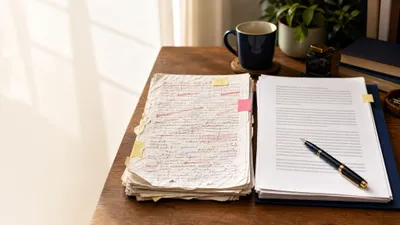
Yes, you can write a book in a weekend — a real, finished first draft you can edit and publish. It works best for short nonfiction (15,000–25,000 words), and the secret is not typing faster. It is removing every decision from the actual writing days.
In this guide, you’ll learn:
- The hour-by-hour weekend schedule that gets a draft done in two days
- How to pick a topic narrow enough to finish (and wide enough to matter)
- The word-count math that makes a weekend book realistic, not magical
- How AI tools like Chapter compress drafting from days to hours
Here’s the step-by-step process.
Can You Really Write a Book in a Weekend?
You can write a book in a weekend if you plan before the weekend and keep the scope small. A focused, single-topic nonfiction book of 15,000–25,000 words is achievable in two days — that is roughly 60–100 published pages, enough for a lead magnet, a how-to guide, or an authority-building book.
What you cannot do in a weekend is write and polish a 90,000-word literary novel. The weekend produces a rough draft, not a print-ready file. Editing comes after — and that is true of every book, regardless of how fast you write it.
The authors who pull this off treat it like a project, not a burst of inspiration. They decide the topic, the outline, and the audience in advance. By Saturday morning, the only job left is to fill in words. If you want the same approach over a slightly longer runway, our guide on how to write a book in 30 days walks through a less compressed version.
Step 1: Choose a Topic You Can Finish
Pick one topic you already know well, narrow enough to cover completely in 20,000 words. The biggest reason weekend books fail is scope: “marketing” is a five-year project, but “the 7 emails every new coach should send their first 100 subscribers” is a weekend.
Use this filter. A weekend topic should be:
- Something you already know — no research rabbit holes on day one
- Solving one specific problem for one specific reader
- Answerable in 8–12 chapters of 1,500–2,000 words each
Coaches, consultants, and service professionals have the easiest path here, because their book is usually their existing expertise reorganized. According to Donna Kozik’s weekend-book method, the winning move is choosing a topic you could teach out loud right now without notes.
If you are torn between ideas, ask which one you could write a confident table of contents for in ten minutes. That is your weekend book.
Step 2: Reframe the Book as a Word Count
Stop thinking “book” and start thinking “word count.” A book is an intimidating, unmeasurable goal. A word count is a finish line you can see.
Here is the math that makes a weekend realistic:
| Book type | Target words | Published pages | Weekend feasible? |
|---|---|---|---|
| Lead magnet / mini-book | 8,000–12,000 | 30–50 | Easily |
| Short nonfiction guide | 15,000–25,000 | 60–100 | Yes |
| Standard nonfiction | 40,000–50,000 | 160–200 | Only the draft, with AI |
| Novel | 70,000–90,000 | 280–360 | Draft only, very aggressive |
Most people type 30–40 words per minute. At a steady 1,000 words per hour of actual writing, 20,000 words is 20 hours — exactly two focused weekend days. The trick is that those 20 hours have to be writing, not deciding what to write next. That is what Step 3 fixes.
For reference, Reedsy notes that the average nonfiction book runs 50,000–75,000 words, while novellas sit around 20,000–50,000. A weekend book deliberately lives at the short end — and that is a feature, not a compromise. Readers finish short books, and short books still build authority.
Step 3: Outline Everything Before the Weekend Starts
Build your full chapter-by-chapter outline before Saturday — this is the single most important step. Writing coach Chandler Bolt argues that you run your structure once at the macro level for the whole book, then repeat it at the micro level for each chapter. Do that planning in advance and the draft itself becomes mechanical.
A weekend-ready outline includes:
- A one-sentence promise for the whole book
- 8–12 chapter titles, each phrased as a problem or question
- 3–5 bullet talking points under every chapter
- The single example or story that anchors each chapter
When every chapter is already broken into bullets, you never face a blank page — you face a list to expand. Tools like Chapter’s outline builder can generate this structure from a topic in minutes, or you can use a free book outline template and fill it in by hand on Friday night.
Spend Friday evening here. A finished outline is the difference between a productive weekend and a frustrated one.
Step 4: Set Up a Distraction-Free Environment
Protect your weekend before it starts — your environment does more for your output than willpower does. The goal is to make writing the only available option for two days.
Set this up on Friday night:
- Phone in another room, notifications off, social apps logged out
- A single document open — close the browser tabs, email, and chat
- Snacks and water within reach so you never leave the desk for logistics
- A clear “do not disturb” agreement with anyone you live with
Research on attention backs this up. A widely cited University of California, Irvine study found it takes an average of 23 minutes to fully refocus after an interruption. Over a two-day sprint, three interruptions can quietly cost you an entire chapter. Treat the weekend like a personal writing retreat — because that focused, uninterrupted block is exactly what makes the timeline work. If you struggle with mid-session momentum, our piece on how to write faster covers the flow techniques that matter most here.
Step 5: The Hour-by-Hour Weekend Schedule
Here is the realistic two-day plan. It assumes you outlined on Friday and protected both days from interruptions.
Saturday — Draft the first half
- 8:00–9:00 — Review outline, set up workspace, no email
- 9:00–12:00 — Write chapters 1–3 (aim for 1,000 words/hour)
- 12:00–1:00 — Lunch, walk away from the screen
- 1:00–5:00 — Write chapters 4–6
- 5:00–6:00 — Loose review, note gaps, stop
Sunday — Finish the draft
- 8:00–9:00 — Re-read yesterday’s last chapter only (do not edit)
- 9:00–12:00 — Write chapters 7–9
- 1:00–4:00 — Write remaining chapters plus intro and conclusion
- 4:00–6:00 — Read it end to end, flag fixes for later
Notice you write the introduction last. Intros are easier once the book exists. For the writing hours themselves, our guide on how to write faster without losing quality has techniques for staying in flow across long sessions.
Step 6: Don’t Write — Talk, Record, or Prompt
The fastest weekend drafts are not typed at all. You can speak 130 words per minute, which means you can dictate 50,000 words of raw material in about six and a half hours. There are three speed paths:
Dictation. Talk through each chapter’s bullet points out loud and record on your phone, then transcribe. You generate content at speaking speed, not typing speed. Many bestselling authors draft this way — and a Stanford study found speech-to-text input is roughly three times faster than typing, with fewer errors.
Q&A capture. Ask your email list or social followers for questions on your topic, then answer each one. Your answers become chapters. This is one of the oldest fast-drafting tricks and it sidesteps writer’s block entirely.
AI-assisted drafting. Feed your outline and talking points into an AI writing tool and let it produce a first-pass draft of each chapter in your voice, which you then edit. This is the modern version of dictation, and it is what makes a 40,000-word weekend book genuinely possible. See our AI writing workflow for authors for the full process.
Our Pick — Chapter
Chapter is built for exactly this use case: you give it your topic and outline, and it drafts full chapters in your voice that you guide and edit, rather than starting from a blank page. Over 10,000 authors, which has been featured in USA Today and the New York Times.
Best for: Nonfiction authors who want a finished draft in a weekend, not a month Pricing: $97 one time, 2 books included (fiction or nonfiction), 30-day money-back guarantee Why we built it: Because the bottleneck in fast drafting was never your ideas — it was the hours of typing, and AI removes them.
How AI Makes a Weekend Book Realistic
AI tools collapse the slowest part of writing — turning your outline into prose. Instead of typing 1,000 words an hour, you guide and edit AI-generated chapters at 3,000–5,000 words an hour. That is the difference between a 12,000-word mini-book and a full 40,000-word guide in the same two days.
The workflow is simple. You provide the outline and talking points. The AI drafts each chapter. You read, correct, cut, and add your own stories and voice. The result is yours — you directed every chapter — but you skipped the hours of staring at a blank screen.
This is not “AI writes your book.” It is closer to having a fast first-draft writer you direct. If you are weighing whether the output is good enough to publish, read our honest take on AI writing quality and whether AI can help you write a book.
What You’ll Need: A Simple Weekend Toolkit
You need surprisingly little to write a book in a weekend. The toolkit is about removing friction, not adding features.
| Need | Option | Why it matters |
|---|---|---|
| Outline | AI builder or free template | Done Friday, removes all in-the-moment decisions |
| Drafting | Chapter, or any writing app | AI drafting triples your output per hour |
| Dictation | Phone voice memo + transcription | Captures content at speaking speed |
| Focus | A timer and a closed door | Protects the deep-work blocks |
The one upgrade that genuinely changes the timeline is an AI drafting tool. Everything else — the timer, the template, the voice recorder — you likely already own. If you want a free starting point, our roundup of the best websites to write a book for free and how to write a book with AI for free cover no-cost options.
Whatever tool you choose, the rule is the same: pick it before the weekend, learn it Friday night, and never tool-shop mid-sprint. Switching tools on Saturday is just another way to avoid writing.
Common Mistakes to Avoid
- Choosing too broad a topic — “leadership” is a career; “how to run your first one-on-one” is a weekend
- Editing while you draft — the fastest way to miss your word count is to polish chapter one for three hours
- Skipping the Friday outline — without it, you spend Saturday deciding instead of writing
- Expecting a finished book — the weekend gives you a draft; editing is a separate week
- Writing the intro first — it is the hardest chapter and you do not know your book yet
How Long Does It Take to Edit a Weekend Book?
Editing a weekend draft takes longer than writing it — typically one to three weeks of part-time work for a short nonfiction book. You will need a structural pass, a line edit, and a proofread. As KN Literary Arts notes, we do not talk the way we write, so dictated or AI-drafted material always needs revision.
Budget your time honestly: the weekend gets you a complete manuscript, but a publishable book is draft plus editing. Our guide on how to finish writing a book covers the editing and completion stretch.
A useful mental model is “fast draft, slow polish.” The drafting weekend works precisely because it is fast and imperfect — you are not allowed to stop and fix. Editing is where craft lives, and it deserves its own unhurried sessions. Trying to do both at once is what turns a two-day project into a two-year one. Tools like an AI developmental editor can compress the editing phase too, but the principle holds: keep drafting and editing in separate boxes.
Should You Write Fiction in a Weekend?
You can draft a novella in a weekend, but a full novel is harder because fiction needs scene-level invention you cannot fully outline in advance. A 20,000–30,000-word novella draft is weekend-feasible; a 80,000-word novel is not.
If fiction is your goal, treat the weekend as a sprint to draft your first act or a complete novella, then continue. Our guides on writing a novella and writing a novel cover the longer arc. For pure speed, writing a book in a week is a more realistic fiction timeline.
The reason fiction resists a weekend is invention. Nonfiction draws on what you already know — you are organizing existing knowledge. Fiction asks you to invent characters, conflict, and scene-by-scene cause and effect in real time, and that creative load is hard to front-load into an outline. A beat-sheet helps, but the prose itself still has to be discovered as you write. If you do want to fiction-sprint, keep the scope to a single complete story rather than a chapter of a sprawling saga — a finished 25,000-word novella beats a half-finished novel every time.
FAQ
Can you actually write a book in a weekend?
Yes, you can write a book in a weekend if it is short nonfiction (15,000–25,000 words) and you outline beforehand. The weekend produces a complete first draft, not a polished final book — editing is a separate step that takes one to three weeks afterward.
How many words can you write in a weekend?
In a weekend you can write 15,000–25,000 words by typing, or 40,000+ words using dictation or AI assistance. At a steady 1,000 words per hour of focused typing across two full days, 20,000 words is realistic. Speaking or AI drafting roughly triples that output.
What kind of book is best for a weekend?
The best weekend book is a focused, single-topic nonfiction guide — a how-to book, a lead magnet, or an authority builder based on expertise you already have. Coaches, consultants, and entrepreneurs have the easiest path because their book is existing knowledge reorganized into chapters.
Do you need AI to write a book in a weekend?
You do not need AI, but it makes a weekend book far more realistic. AI tools like Chapter draft chapters from your outline at 3,000–5,000 words per hour, versus 1,000 words typing by hand. That speed is the difference between a mini-book and a full-length draft in two days.
Is a weekend book good enough to publish?
A weekend draft is good enough to publish only after editing — a structural pass, a line edit, and a proofread. The draft itself is rarely publication-ready, the same as any first draft. Plan a weekend to write and one to three weeks to edit before you self-publish.
Ready to draft your book this weekend? Chapter turns your outline into full chapters in your voice, so you spend the weekend directing and editing instead of staring at a blank page.