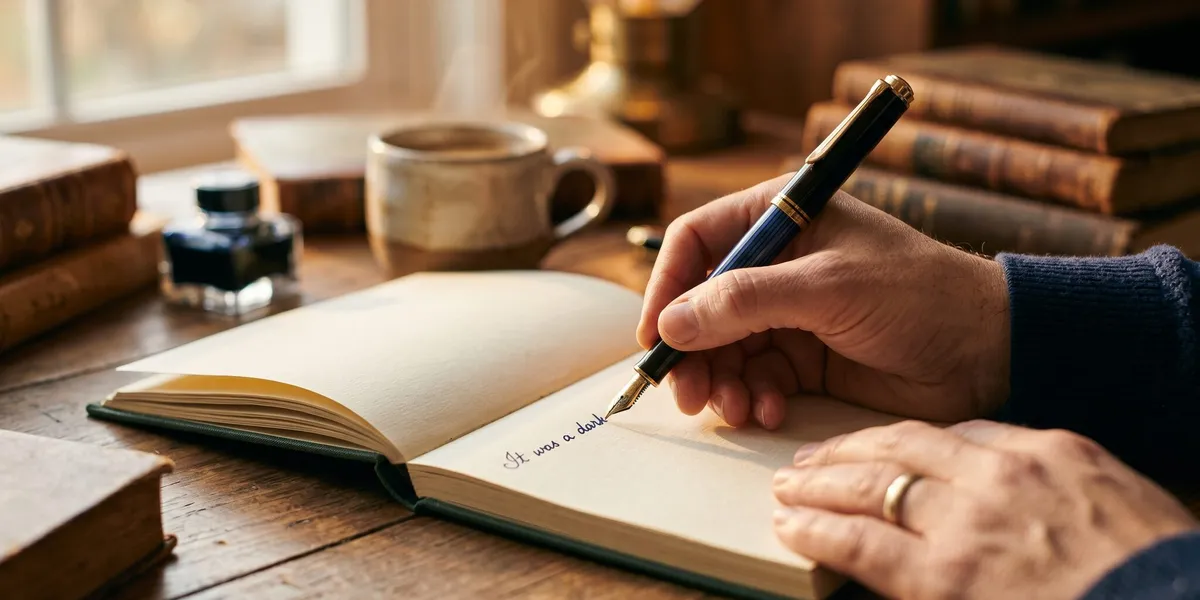
Your opening line decides whether someone reads your book or puts it back on the shelf. One sentence. That’s all you get.
In this guide, you’ll learn:
- Eight proven techniques for writing opening lines that grab readers instantly
- Real examples from bestselling books you can study and adapt
- The most common first-sentence mistakes that kill reader interest
- How to test whether your opening line actually works
Here’s how to write a first sentence readers can’t ignore.
What Makes a Compelling Opening Line?
A compelling opening line is a first sentence that creates an immediate emotional or intellectual response, forcing the reader to continue to the second sentence. The best opening lines raise a question, set a mood, or introduce a conflict that demands resolution.
Your opening line doesn’t need to be clever. It needs to be magnetic.
The difference between a forgettable opener and a compelling one comes down to a simple test: does your reader need to know what comes next? If the answer is yes, your opening line works.
Think about it from the reader’s perspective. They’re standing in a bookstore, scanning the first page. They’re scrolling through a preview on Amazon. You have roughly five seconds before they decide.
That first sentence carries all the weight.
How to Write a Hook That Works as an Opening Line
A strong hook and a compelling opening line are closely related, but they’re not identical. Your hook is the broader mechanism that pulls readers in. Your opening line is the sharpest point of that hook.
The best opening lines accomplish one of three things:
- Introduce a character you immediately want to know more about
- Establish a situation that feels urgent or unusual
- Create a question the reader can’t leave unanswered
Every technique below serves at least one of these goals. Pick the one that fits your book’s tone, genre, and opening scene.
Technique 1: Start With a Bold, Surprising Claim
Make a statement so unexpected that your reader has to keep going to find out if it’s true.
This technique works because it creates cognitive tension. You’ve presented something that conflicts with what the reader expects, and their brain needs resolution.
How to do it: Write a declarative sentence that contradicts common knowledge, reveals something shocking, or states an uncomfortable truth. Don’t explain it yet. Let it sit.
Works best for: Memoirs, literary fiction, thrillers, nonfiction books with a contrarian angle.
Example approach: A memoir might open with a single, stark confession that reframes everything the reader thinks they know about the author. A thriller might state an outcome that seems impossible given what a normal day should look like.
Technique 2: Drop the Reader Into the Middle of Action
Skip the setup. Start with something happening right now.
This is the in medias res approach, and it’s one of the most reliable ways to write a compelling opening line. You bypass all the throat-clearing and drop the reader directly into a moment of tension or motion.
How to do it: Identify the first moment of conflict, movement, or change in your story. Write it as if the camera is already rolling. No establishing shots. No context yet.
Works best for: Thrillers, action, adventure, fantasy, and any genre where pacing matters from page one.
The key is choosing the right moment. Not the biggest explosion, but the moment where something shifts — where the status quo breaks.
Technique 3: Introduce a Character With a Defining Detail
Give the reader one vivid, specific detail about your protagonist that reveals who they are.
Not a physical description. Not their name, age, and hair color. One behavioral or situational detail that makes the reader think, ‘I need to know this person.’
How to do it: Choose the single most revealing thing about your character — their obsession, their flaw, their habit under stress — and lead with it. Make it specific enough that it could only belong to this character.
Works best for: Literary fiction, character-driven stories, memoirs, and books about your life.
When you develop a character for your opening line, you’re doing double duty. You’re hooking the reader and establishing voice in a single sentence.
Technique 4: Create Immediate Mystery or Tension
Withhold just enough information to make the reader desperate to fill the gap.
This is the information-gap technique. You give the reader a piece of a puzzle — enough to see the shape but not the full picture. Their curiosity does the rest.
How to do it: Present a situation, detail, or observation that raises an obvious question. Don’t answer it. The answer is what keeps them reading through the first chapter, the second chapter, and beyond.
Works best for: Mystery, suspense, thriller, horror, speculative fiction.
The trap here is being too vague. If the reader can’t even form a question because your opener is too abstract, you’ve lost them. Specificity creates mystery. Vagueness creates confusion.
Technique 5: Set an Unmistakable Mood or Atmosphere
Transport the reader into a specific emotional state with your very first sentence.
Some opening lines don’t present action or character. They create a feeling — dread, wonder, loneliness, warmth — so vivid that the reader is already living inside the story before the plot begins.
How to do it: Choose one sensory detail (sight, sound, texture, smell) that embodies the mood you want. Write it with precision. One perfectly chosen image beats three paragraphs of atmospheric description.
Works best for: Literary fiction, horror, gothic, romance, atmospheric fantasy.
This technique pairs especially well with showing rather than telling. Don’t say ‘it was a creepy house.’ Describe the one detail that makes the reader’s skin crawl.
Technique 6: Use a Conversational, Direct Address
Speak directly to the reader. Pull them in as a confidant.
This technique breaks the fourth wall immediately. It creates intimacy. The reader isn’t observing a story — they’re being told one, directly, by a narrator who has chosen them specifically.
How to do it: Write as if you’re telling the story to one person sitting across from you. Use ‘you,’ or use a first-person voice that assumes the reader is already leaning in.
Works best for: Memoir, creative nonfiction, literary fiction, YA, humor.
The conversational opening works because it establishes trust and voice simultaneously. The reader immediately knows what kind of narrator they’re spending time with.
Technique 7: Start With a Contradiction or Paradox
Present two things that shouldn’t coexist — but do.
Contradictions arrest attention because your brain automatically tries to resolve them. When your opening line presents a paradox, the reader has to keep going to understand how both things can be true.
How to do it: Juxtapose two contrasting ideas, emotions, or situations in a single sentence. The more unexpected the pairing, the stronger the pull.
Works best for: Literary fiction, memoir, philosophical nonfiction, coming-of-age stories.
A paradox opening works particularly well for stories about transformation or conflict, because the contradiction in the first line often mirrors the central tension of the entire book.
Technique 8: Lead With a Universal Truth (Then Subvert It)
State something everyone agrees with — then twist it into something personal, unexpected, or slightly off.
This technique uses the reader’s existing knowledge as a launchpad. You start on common ground, then shift the floor beneath their feet.
How to do it: Begin with an observation or principle that feels true and familiar. In the same sentence or the very next one, pivot to something surprising. The contrast between the expected and the unexpected creates the hook.
Works best for: Nonfiction, memoir, satire, literary fiction, essays.
The key is choosing a truth your specific audience will recognize. If you’re writing about the publishing industry, lead with something every author has experienced. If you’re writing a memoir about parenthood, start with what every parent knows — then reveal what they don’t.
How to Write a Strong Opening Line for Different Genres
Your genre shapes what kind of opening line will resonate most. Readers bring expectations based on the type of book they’re picking up.
| Genre | Best Technique | Why It Works |
|---|---|---|
| Thriller/Suspense | Action or Mystery | Readers expect immediate tension |
| Literary Fiction | Character Detail or Mood | Voice and atmosphere signal quality |
| Memoir | Bold Claim or Direct Address | Personal stakes hook readers fast |
| Romance | Character or Contradiction | Emotional tension drives the genre |
| Fantasy/Sci-Fi | Mood or Bold Claim | Worldbuilding starts in sentence one |
| Nonfiction | Universal Truth or Bold Claim | Readers need to trust your expertise |
When you’re starting your novel, pick the technique that matches both your genre’s conventions and your book’s specific tone. A cozy mystery and a psychological thriller are both ‘mystery,’ but they demand very different opening energies.
How to Write an Opening Line for Nonfiction Books
Nonfiction opening lines follow slightly different rules. Your reader isn’t looking for a character to fall in love with — they’re looking for proof that you can solve their problem.
The nonfiction opening line formula:
- State the problem your reader is facing (the reason they picked up the book)
- Signal your credibility through specificity, data, or earned authority
- Promise the transformation they’ll experience by reading
If you’re writing a book introduction, your opening line needs to accomplish even more — it sets the tone for the entire book and tells the reader whether your voice is one they want to spend hours with.
For nonfiction, the Technique 6 (direct address) and Technique 8 (universal truth subversion) approaches tend to perform best. They establish authority while creating a connection with the reader.
Common Opening Line Mistakes to Avoid
Even experienced writers make these errors in their first sentences:
- Starting with weather or scenery — Unless the weather IS the story (a hurricane, a drought), skip it. It signals a slow start.
- Opening with a character waking up — This is the most common amateur opening. It tells the reader nothing about what makes your story unique.
- Leading with backstory — Don’t explain before you engage. Hook first, context second.
- Being deliberately confusing — Mystery is good. Confusion is not. The reader should have a question, not a headache.
- Trying too hard to be literary — Overwritten opening lines feel performative. Simplicity often hits harder than complexity.
The fix for all of these? Ask yourself one question: would I keep reading? Be honest. If your opening line doesn’t pass your own test, rewrite it until it does.
Should You Write Your Opening Line First or Last?
Here’s a truth many writing teachers won’t tell you: you don’t have to write your opening line first.
Many published authors write their opening line last. They draft the entire book, discover what the story is actually about, and then craft a first sentence that perfectly sets up everything that follows.
If you’re struggling with writer’s block because you can’t get the first line right, give yourself permission to skip it. Write a placeholder. Start with Chapter 2. Come back to the opening after you’ve found your story’s voice.
The opening line you write in your first draft is almost never the one that gets published. What matters is that you start writing at all.
That said, if a great opening line comes to you — write it down immediately. Sometimes the first sentence arrives fully formed, and when it does, it can fuel the momentum for everything that follows.
How to Test Whether Your Opening Line Works
You’ve written your opening line. Now test it.
The five-second test: Show your first sentence to someone unfamiliar with your book. After five seconds, ask them one question: ‘Do you want to know what happens next?’ If they hesitate, rewrite.
The genre test: Read the opening lines of the last five bestsellers in your genre. Does your opening line feel like it belongs in that company? Not identical — but at the same level of quality and engagement.
The context-free test: Read your opening line with no title, no cover, no blurb. Does it still hook you? A great opening line should work even without any surrounding context.
The AI-assisted test: If you’re using an AI writing tool like Chapter, you can generate multiple variations of your opening line and compare them. AI excels at producing alternatives you might not have considered, giving you more options to test against your readers.
Over 10,000 authors have used Chapter to write their books, and many of them use the platform to brainstorm and refine their opening lines before committing to a final version.
How Long Should an Opening Line Be?
The length of your opening line matters less than its impact. One-word openers can work. Twenty-word openers can work. What doesn’t work is an opening line that tries to do too much in too little space — or too little in too much space.
Short opening lines (under 10 words) feel punchy and immediate. They work best for thrillers, horror, and stories that need instant energy.
Medium opening lines (10-25 words) give you room for a vivid image, a character detail, or a surprising claim. This is the sweet spot for most genres.
Long opening lines (25+ words) can work for literary fiction where the voice and rhythm of the prose are part of the hook. But they need to earn every word.
When you’re writing your first chapter, consider how the length of your opening line sets the pacing for the paragraphs that follow. A short, sharp opener followed by longer paragraphs creates a specific rhythm. A flowing first sentence that leads into short, clipped paragraphs creates a different one.
Can You Rewrite Your Opening Line After Drafting?
You absolutely should rewrite your opening line after drafting. Most authors revise their first sentence more than any other sentence in the book.
Here’s a practical revision process:
- Draft your book first — Don’t get stuck perfecting line one when you don’t know what the book is yet
- Identify your book’s core tension — What’s the central question, conflict, or promise?
- Write 10 variations — Give yourself options using different techniques from this guide
- Test with readers — Use the five-second test from the section above
- Choose the one that fits your voice — The best opening line sounds like you, not like a writing exercise
If you’re starting to write a book for the first time, don’t let the opening line become a roadblock. Get words on the page first. Polish them later.
FAQ
What is a compelling opening line in a book?
A compelling opening line is the first sentence of a book that immediately engages the reader and compels them to read the second sentence. The best opening lines create curiosity, establish voice, or introduce conflict. They work by raising a question the reader needs answered, whether through a bold claim, vivid image, or unexpected situation.
How many words should an opening line be?
An opening line should be as long as it needs to be to create a hook — typically between 5 and 25 words. Short openers (under 10 words) create urgency and work well for thrillers. Medium-length openers (10-25 words) suit most genres. Longer openers can work for literary fiction where voice and rhythm are the draw.
Can AI help you write a better opening line?
Yes, AI can help you write a better opening line by generating multiple variations you can test and refine. Tools like Chapter let you brainstorm dozens of opening line options, compare different techniques, and find angles you might not have considered. Over 10,000 authors have written books using Chapter’s AI writing platform.
Should you write the opening line first or last?
You can write your opening line first or last — both approaches work. Many bestselling authors write a placeholder first sentence, draft the entire book, then return to craft the opening line once they understand the story’s true core. The important thing is not to let the opening line become a barrier to starting your book.
What makes a bad opening line?
A bad opening line fails to give the reader a reason to continue reading. Common mistakes include starting with weather descriptions, opening with a character waking up, leading with backstory or exposition, being deliberately obscure, or trying too hard to sound literary. The fix is always the same: ask yourself whether you would keep reading based on that sentence alone.