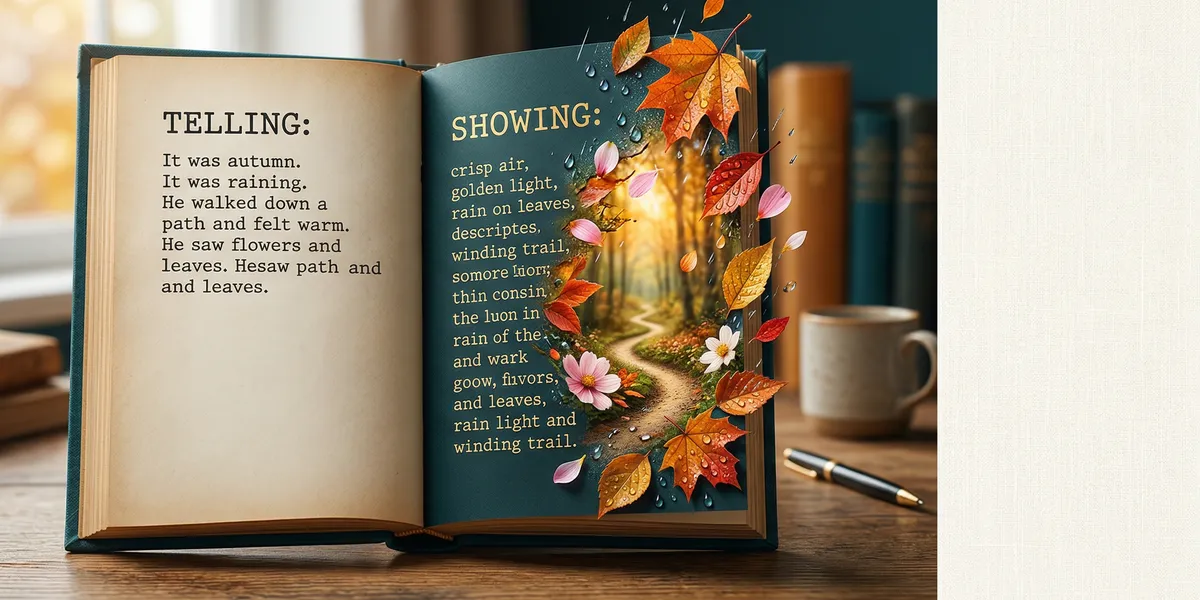
Show don’t tell is a writing technique where you use sensory details, actions, and dialogue to let readers experience a scene rather than stating emotions or facts directly. Instead of writing “she was nervous,” you show the nervousness through her fidgeting hands, dry throat, and darting eyes.
What Does Show Don’t Tell Mean?
Show don’t tell is the difference between reporting what happens and making readers feel like they are inside the scene. When you tell, you give readers a summary. When you show, you give them an experience.
Telling uses abstract statements and adjectives to describe a character’s state. Showing uses concrete, specific details that let readers draw their own conclusions. The reader becomes an active participant instead of a passive receiver.
Anton Chekhov captured the principle in a letter to his brother: instead of simply stating that the moon is shining, describe the glint of light on broken glass. The factual statement is forgettable. The image stays.
This technique applies beyond fiction. Memoir writers, essayists, and even nonfiction authors strengthen their prose when they replace vague claims with vivid specifics. Any time you catch yourself summarizing what a person felt, you have an opportunity to show it instead.
Show Don’t Tell Examples
The fastest way to internalize this technique is to see telling sentences transformed into showing passages.
Emotions
Telling: He was angry.
Showing: He slammed his fist on the table. The coffee mug jumped, sloshing dark liquid across the stack of bills. He didn’t wipe it up.
The telling version labels the emotion. The showing version lets you see and hear it. You conclude he’s angry without being instructed to.
Character Traits
Telling: She was generous.
Showing: She pressed a twenty into the barista’s tip jar, then doubled back to add another. She did this every Tuesday, always when she thought no one was watching.
A single adjective becomes a revealing action. You understand generosity through behavior, not a label.
Setting and Atmosphere
Telling: The house was creepy.
Showing: The porch light flickered twice, then died. Somewhere inside, a floorboard groaned under weight that shouldn’t be there. The front door stood open six inches, swinging on a hinge that needed oil.
“Creepy” is an opinion. The flickering light, groaning floorboard, and open door are evidence. Your reader’s skin prickles because they assembled the feeling themselves.
Physical Sensations
Telling: It was a hot day.
Showing: Sweat pooled at the base of her neck and slid between her shoulder blades. The asphalt shimmered in waves, and her water bottle was warm to the touch before she even opened it.
Heat becomes something you feel on your own skin, not something you are told about.
5 Techniques to Show Instead of Tell
Knowing the principle is one thing. Applying it consistently is another. These five techniques give you concrete methods to catch telling in your drafts and convert it to showing.
1. Use the Camera Test
Imagine your scene is being filmed by a camera. A camera can’t record emotions, thoughts, or personality traits — it can only capture what is visible and audible. If a camera couldn’t pick it up, you are telling instead of showing.
Write down what the camera would see: facial expressions, body language, objects in the room, sounds in the background. That’s your showing material.
2. Replace Adjectives With Actions
Adjectives like “nervous,” “happy,” “old,” and “wealthy” are telling words. They label a quality without demonstrating it.
Find these adjectives in your draft and ask: what does this quality look like in practice? A “wealthy” character drives a specific car, wears a specific watch, lives at a specific address. A “nervous” character does specific things with their hands, voice, or posture.
The action is always more convincing than the label.
3. Use Dialogue to Reveal Character
Dialogue is one of the most powerful showing tools. How a character speaks — their word choice, rhythm, what they avoid saying — reveals personality, education, emotional state, and relationships without a single line of narration.
Telling: Mark was dismissive of her idea.
Showing: “Sure, that could work,” Mark said, already looking at his phone. “Send me a deck or something.”
You hear his disinterest. The phone and the vague “or something” do the work that “dismissive” tried to do alone.
4. Engage All Five Senses
Most writers default to visual description. But smell, taste, touch, and sound are often more evocative and less expected.
The smell of diesel and old carpet immediately places you in a specific kind of bus. The taste of chalk dust in the air puts you in a schoolroom without saying “she was in a classroom.”
When you draft a scene, ask yourself which senses are missing. Adding even one non-visual detail can transform a flat passage into a lived experience.
5. Resist the Urge to Explain
This is the hardest habit to break. You write a perfectly vivid showing passage — then immediately follow it with a telling sentence that explains what you just showed. Writers sometimes call this the R.U.E. principle: Resist the Urge to Explain.
Over-explained: She slammed the door so hard the frame shook. She was clearly furious.
Better: She slammed the door so hard the frame shook.
The second sentence kills the impact of the first. Trust your reader. If you showed it well, they don’t need you to spell it out.
When Telling Is Actually Better Than Showing
Here is the part most “show don’t tell” advice leaves out: you should not show everything.
Showing is slower than telling. It takes more words and more page space. If you show every minor detail — the character getting dressed, driving to work, ordering coffee — your story grinds to a halt.
Use telling for:
- Transitions between scenes. “Three weeks passed” is perfectly fine. You don’t need to show all 21 days.
- Information that isn’t emotionally important. If the fact that a character ate lunch has no bearing on the plot or their emotional state, tell it and move on.
- Pacing control. Telling speeds things up. Showing slows things down. A thriller that shows every single moment loses its urgency. A literary novel that tells every emotion loses its depth. The skill is knowing which scenes deserve the slow, immersive treatment and which ones need to move.
- Backstory in small doses. A quick told summary of a character’s past can set up the context needed for a showing scene to land.
The goal is not to eliminate telling. The goal is to show the moments that matter most — the scenes where emotion, tension, or character development are at stake — and tell the rest efficiently.
Show Don’t Tell vs Other Writing Techniques
Show don’t tell is closely related to several other craft concepts. Understanding the connections helps you apply each one more precisely.
Imagery is a primary tool for showing. When you write sensory details that create pictures in a reader’s mind, you are using imagery to show instead of tell.
Dialogue is another showing vehicle. Strong dialogue reveals character, advances plot, and establishes tone — all without narration explaining what is happening.
Narrative techniques like deep POV take showing even further. In deep point of view, you eliminate the narrator’s commentary entirely and filter everything through the character’s direct experience. It is showing at its most immersive.
Literary devices like metaphor and simile are showing tools. Saying someone’s voice “cut through the room like a saw blade” shows its quality more vividly than saying “she spoke loudly.”
Common Mistakes When Trying to Show
Even writers who understand the principle make these errors:
- Overwriting. Showing a character’s sadness with a full page of tears, rain, and grey skies is just as heavy-handed as telling. One or two precise details carry more weight than a dozen generic ones.
- Showing the wrong things. Spending 200 words showing a character making breakfast when breakfast has no plot or emotional significance is a pacing mistake, not good showing.
- Filtering through the narrator. Phrases like “she noticed,” “he felt,” and “she could see” are telling in disguise. “She noticed the broken window” is weaker than “The window was broken.” Cut the filter and let the reader notice directly.
- Forgetting subtext. The best showing is indirect. A character who says “I’m fine” while shredding a napkin is showing two things at once — the words tell one story, the hands tell another. That gap is where meaning lives.
FAQ
What Is Show Don’t Tell in Simple Terms?
Show don’t tell means using specific details, actions, and dialogue to let readers experience your story instead of summarizing it for them. Rather than writing “the room was messy,” you describe the pizza boxes on the floor, the clothes draped over chairs, and the stack of unopened mail. The reader sees the mess and draws their own conclusion.
What Is the Difference Between Showing and Telling in Writing?
The difference between showing and telling is that telling states facts or emotions directly while showing uses concrete details that let readers infer those facts and emotions. Telling says “he was tired.” Showing describes his heavy eyelids, the coffee stain on his sleeve, and the way he kept losing his place mid-sentence. Both communicate the same information, but showing makes the reader feel it.
Can You Use Show Don’t Tell in Nonfiction?
You can absolutely use show don’t tell in nonfiction. Memoir, narrative nonfiction, and creative essays all benefit from showing techniques. Instead of writing “my childhood was difficult,” describe a specific moment that captures that difficulty. Business writing and academic writing lean more on telling by nature, but even there, a concrete example or case study is a form of showing that strengthens your argument.