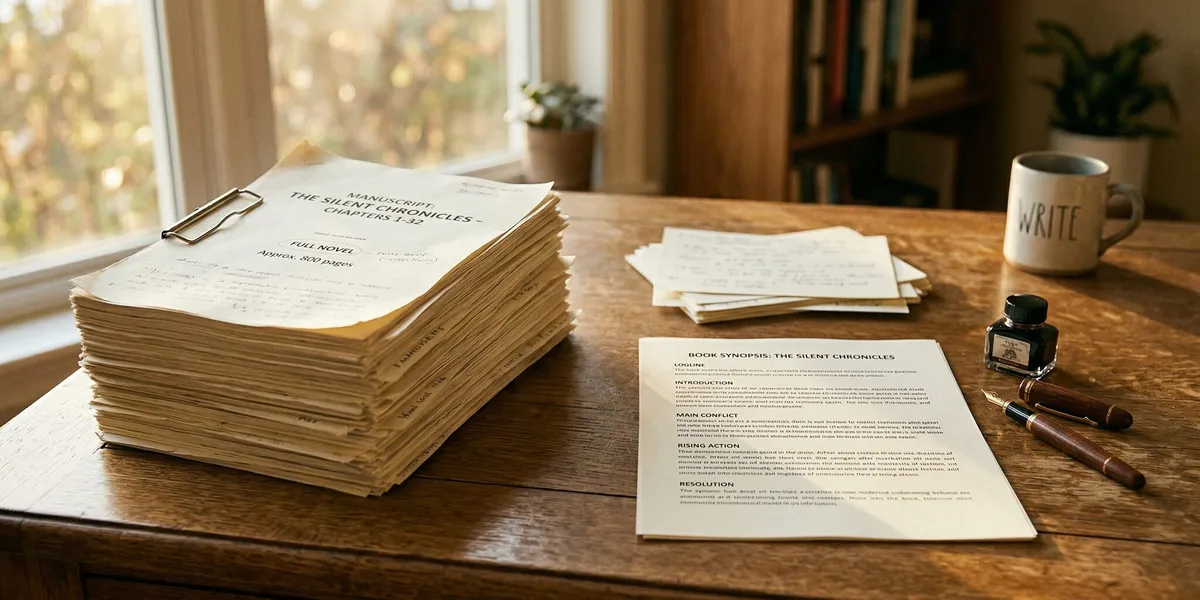
A synopsis is a concise, complete summary of your book that covers every major plot point — including the ending. You write one when submitting to literary agents, entering contests, or pitching to publishers. Unlike a blurb or back-cover copy, a synopsis reveals everything.
In this guide, you’ll learn:
- What a synopsis actually is (and what it isn’t)
- The exact format and length agents expect
- A step-by-step process to write yours from scratch
- Real mistakes that get synopses rejected
Here’s how to write a synopsis that does your book justice.
What Is a Synopsis?
A synopsis is a narrative summary of your entire book written in present tense, third person. It condenses your story’s beginning, middle, and end into one to three pages. Agents and editors use it to evaluate whether your plot holds together before committing to reading your full manuscript.
The word comes from the Greek sunopsis, meaning “a seeing all together.” That’s exactly what your synopsis should deliver — the complete picture of your story in miniature.
A synopsis is not marketing copy. You’re not teasing the reader or building suspense. You’re showing a publishing professional that you can tell a coherent, compelling story.
Synopsis vs. Blurb vs. Summary
These three terms confuse a lot of writers. Here’s the difference:
| Document | Purpose | Reveals ending? | Length | Audience |
|---|---|---|---|---|
| Synopsis | Show agents/editors the full story arc | Yes — always | 1-3 pages | Publishing professionals |
| Blurb | Sell the book to readers | No — creates suspense | 150-200 words | Readers/buyers |
| Summary | General overview for any context | Sometimes | Varies | Anyone |
Your synopsis is an industry document. Your blurb is a sales tool. Don’t mix them up.
How Long Should a Synopsis Be?
Most literary agents want a one-page synopsis (roughly 500 words, single-spaced) or a two-page synopsis (about 1,000 words). Some request up to five pages for complex narratives.
The safest approach: prepare three versions.
- Short synopsis — 1 page, 500 words. Your elevator pitch on paper.
- Standard synopsis — 2 pages, 1,000 words. The most commonly requested length.
- Extended synopsis — 3-5 pages. For agents who want more detail or complex multi-POV stories.
Always check the specific agent’s submission guidelines. If they say “one-page synopsis,” they mean one page — not one-and-a-half.
Formatting basics:
- Single-spaced (unless the agent specifies double-spaced)
- 12-point Times New Roman or similar serif font
- 1-inch margins
- Your name and book title in the header
- Present tense, third person (even for first-person novels)
What to Include in Your Synopsis
Every effective synopsis hits five elements:
- Your protagonist and their world — Who is the main character? What’s their status quo before the story starts?
- The inciting incident — What event disrupts their world and launches the plot?
- Rising conflict and stakes — What obstacles stand in their way? What do they stand to lose?
- The climax — What’s the turning point where everything comes to a head?
- The resolution — How does the story end? What has changed for the protagonist?
That’s it. You don’t need subplots, minor characters, or scene-by-scene breakdowns. Focus on the main character’s emotional journey and the central conflict that drives it.
What to Leave Out
Strip these from your synopsis:
- Minor characters — Only name characters who directly impact the protagonist’s journey. Everyone else gets a descriptor (“her best friend,” “the detective”).
- Subplots — Unless a subplot directly feeds into the main conflict, cut it.
- Dialogue — Use sparingly, if at all. One iconic line can work. Five lines of conversation won’t.
- Backstory — Only include what’s essential to understanding the present conflict.
- Rhetorical questions — Don’t write “Will she find the courage to fight back?” Just tell us what happens.
How to Write a Synopsis: Step-by-Step
Step 1: Outline Your Major Plot Points
Before you write a single sentence, list your story’s key beats. Use this framework:
- Setup — Who is the protagonist? What do they want?
- Catalyst — What happens to force them into action?
- Midpoint shift — What changes the direction of the story halfway through?
- Dark moment — What’s the lowest point for the protagonist?
- Climax — How does the protagonist confront the central conflict?
- Resolution — What’s the new normal?
Write each beat as a single sentence. You now have the skeleton of your synopsis.
Step 2: Write the First Draft in Present Tense
Expand each beat into a short paragraph. Write in present tense, third person — even if your novel is written in first person or past tense.
Wrong: “Sarah decided she had to leave town.” Right: “Sarah decides she has to leave town.”
Don’t worry about word count yet. Get the story down first, then trim.
Step 3: Focus on Emotional Arc, Not Just Plot
The most common synopsis mistake is writing a plot summary with no emotional throughline. Agents don’t just want to know what happens — they want to see how your character changes.
For every major plot beat, include the character’s emotional response or internal shift. What do they feel? What do they realize? How does this event change them?
A synopsis that reads “this happens, then this happens, then this happens” is a dead synopsis. A synopsis that shows a character transforming through conflict is alive.
Step 4: Name Only Essential Characters
Introduce your protagonist by full name in CAPS the first time they appear (e.g., “SARAH CHEN is a…”). After that, use their first name normally.
For secondary characters, capitalize their name on first mention too. But keep the named character count to a maximum of five or six. If your synopsis has more than six named characters, the agent will struggle to track them all.
Step 5: Cut to Your Target Length
Now trim. Here’s what to cut first:
- Adjectives and adverbs that don’t change meaning
- Transitions between scenes (“Meanwhile,” “Later that day”)
- Any sentence that describes setting without advancing plot
- Repetitive emotional beats
Read it aloud. If you stumble over a sentence, it’s too long. Rewrite it.
Step 6: Reveal the Ending
This is where most writers resist — and where most synopses fail. You must reveal how your story ends.
Agents need to see that your plot resolves satisfactorily. A synopsis that ends with a cliffhanger or “you’ll have to read to find out” signals that you either don’t trust your ending or don’t understand how the publishing industry works.
The ending is often the strongest part of a good synopsis. It shows the agent that you can land the plane.
Synopsis Examples by Genre
The approach shifts slightly depending on your genre:
For literary fiction: Emphasize the character’s internal transformation. The emotional arc matters more than plot mechanics. Show how themes develop and resolve.
For thrillers and mysteries: Hit the major twists and reveals. Name the antagonist and their motivation. The plot mechanics are the selling point — make sure the tension escalates clearly.
For romance: Both protagonists need equal presence. Show the “meet cute,” the central conflict keeping them apart, and what ultimately brings them together. Include the happily-ever-after.
For fantasy and sci-fi: Resist the urge to explain worldbuilding. Only include world details that are essential to understanding the plot. The synopsis is about your characters, not your magic system.
For memoir and nonfiction: Focus on the narrative arc — what happened, how it affected you, and what insight or transformation resulted. Even nonfiction synopses need a clear beginning, middle, and end.
Common Synopsis Mistakes
Avoid these pitfalls:
- Writing marketing copy instead of a summary — Your synopsis isn’t a teaser. Tell the whole story.
- Including too many characters — More than six named characters makes your synopsis unreadable.
- Skipping the ending — Agents always want to know how it ends. Always.
- Using past tense — Write in present tense unless specifically told otherwise.
- Cramming in subplots — One main storyline. That’s what the synopsis tracks.
- Making it boring — A synopsis should still have voice. Flat, mechanical writing signals a flat book.
Do You Need a Synopsis for Self-Publishing?
If you’re self-publishing, you don’t need a traditional synopsis for agent submissions. But writing one is still valuable.
A synopsis forces you to see the shape of your story clearly. If you can’t summarize your book in two pages, you might have structural problems — missing plot points, unclear character motivation, or a saggy middle.
Many authors at Chapter write a synopsis as part of their planning process. It works as a high-level outline before you start drafting, and as a diagnostic tool after you’ve finished.
For self-published authors, you’ll also need a book description (blurb) for your sales page. That’s a different document with different rules — check out our guide on how to write a book blurb for that process.
How to Write a Synopsis for Nonfiction
Nonfiction synopses work differently from fiction. Instead of a plot arc, you’re showing the argument structure and reader transformation.
Your nonfiction synopsis should cover:
- The problem your book addresses
- Your unique angle or framework for solving it
- Chapter-by-chapter breakdown (brief — one to two sentences per chapter)
- The reader’s takeaway — What will they know, believe, or do differently after reading?
If you’re writing a book proposal for traditional publishing, the synopsis is typically part of a larger package that includes sample chapters, market analysis, and your author platform.
How Long Does It Take to Write a Synopsis?
Most authors spend three to five hours writing a good synopsis — longer than you’d expect for a one-page document. That’s normal.
The difficulty isn’t the writing itself. It’s the compression. You’re making hard choices about what stays and what goes. Every sentence has to earn its place.
Here’s a realistic timeline:
- 30 minutes — List your major plot beats
- 1 hour — Write the rough draft
- 1-2 hours — Revise and cut to length
- 30 minutes — Polish the opening and closing paragraphs
- 30 minutes — Proofread and format
If you’re struggling to get started, try writing a book outline first. An outline gives you the structural clarity that makes synopsis-writing significantly easier.
Can AI Help You Write a Synopsis?
AI tools can help you draft and refine a synopsis — but they can’t replace your judgment about what matters most in your story.
Here’s where AI genuinely helps:
- Compression — Feed your chapter summaries to AI and ask it to condense them into one paragraph per act
- Identifying the emotional arc — Ask AI to analyze which character moments carry the most weight
- Tense and POV consistency — AI catches present-tense slips faster than most human editors
Where AI falls short: knowing which details your specific target agent cares about, capturing the voice that makes your story unique, and making the creative decisions about what to cut.
If you’re writing a book with Chapter, you can use the AI assistant to help draft your synopsis directly from your manuscript — it already knows your characters, plot, and themes.
FAQ
What is a synopsis in writing?
A synopsis in writing is a complete narrative summary of your book that covers every major plot point, including the ending. Written in present tense and third person, it typically runs one to three pages and is used to pitch your book to literary agents and publishers.
How is a synopsis different from a summary?
A synopsis is specifically an industry document for publishing professionals that always reveals the ending. A summary is a general-purpose overview that can be any length and may or may not reveal the conclusion. Synopses follow strict formatting conventions — summaries don’t.
Should a synopsis reveal the ending?
Yes — a synopsis should always reveal the ending. Literary agents and editors need to see that your plot resolves satisfactorily before they request the full manuscript. Withholding the ending signals inexperience with the submission process.
How many characters should be in a synopsis?
Keep your synopsis to five or six named characters maximum. Introduce your protagonist and key secondary characters by full name in caps on first mention. Refer to minor characters by role (e.g., “her mentor” or “the detective”) rather than adding more names.
What tense should a synopsis be written in?
Write your synopsis in present tense, third person — even if your book is written in first person or past tense. This is the standard convention for synopses in the publishing industry. Example: “Sarah discovers the letter” rather than “Sarah discovered the letter.”