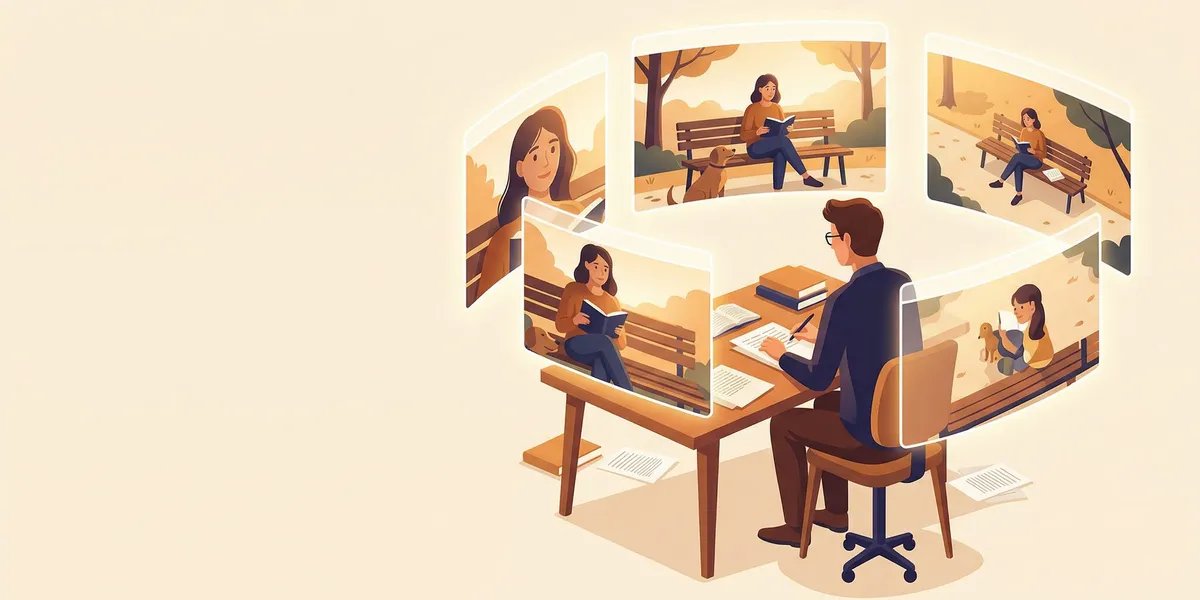
There are six main types of point of view in writing: first person, second person, third person limited, third person omniscient, third person objective, and multiple POV. Each one controls what your reader sees, feels, and understands about your story.
In this guide, you’ll learn:
- What each type of point of view is and how it works
- Published examples of every POV type
- How to choose the right point of view for your book
- The biggest POV mistakes writers make (and how to fix them)
Here’s everything you need to know about narrative perspective.
What Is Point of View in Writing?
Point of view (POV) is the narrative lens through which your reader experiences a story. It determines who tells the story, what information is available, and how close the reader feels to the characters.
Your POV choice affects three things simultaneously. It controls the pronouns you use (“I” vs. “she” vs. “you”). It sets the boundaries on what the narrator can know or reveal. And it shapes the emotional distance between reader and character.
The Purdue OWL categorizes POV by pronoun usage, but the real differences go far deeper than grammar. Two stories can both use “she” and feel completely different depending on whether the narrator is limited to one mind or can access every character’s thoughts.
Point of View vs. Perspective
These terms get confused constantly, but they mean different things.
Point of view is the structural, grammatical choice — first person, third person limited, and so on. It’s a technique you select before you start writing.
Perspective is the worldview, beliefs, and biases of the character through whose eyes the story is filtered. A bitter divorcee and a wide-eyed child can both narrate in first person (same POV), but their perspectives will make the same event feel like two entirely different stories.
You choose POV once. Perspective emerges from character development, and it’s what makes your narrator feel like a real person rather than a camera pointed at events.
The 6 Types of Point of View (Complete Breakdown)
| POV Type | Pronouns | What the Narrator Knows | Best For |
|---|---|---|---|
| First person | I, me, my, we | Only their own thoughts and experiences | Memoir, YA, literary fiction, voice-driven stories |
| Second person | You, your | Varies — often prescriptive or immersive | Experimental fiction, self-help, choose-your-own-adventure |
| Third person limited | He, she, they | One character’s inner world per scene | Most contemporary fiction, romance, thrillers |
| Third person omniscient | He, she, they | Everything — all minds, all timelines | Epic fantasy, classic literature, sagas |
| Third person objective | He, she, they | External actions only — no inner thoughts | Journalism-style fiction, Hemingway-inspired prose |
| Multiple POV | Varies by chapter | Shifts between characters’ viewpoints | Thrillers, epics, ensemble stories |
Let’s break each one down with examples.
First Person Point of View
First person uses “I” to tell the story from inside one character’s head. The reader sees, hears, and knows only what the narrator experiences directly.
Example: “I set the letter down on the table and stared at it for a long time. The handwriting was my mother’s, but the words didn’t sound like her at all.”
First person creates instant intimacy. Your reader lives inside the narrator’s skull — they feel every doubt, every flash of anger, every quiet realization. This is why it dominates memoir, coming-of-age fiction, and literary novels where voice is the main attraction.
When First Person Works Best
Choose first person when your narrator’s voice is as compelling as the plot itself. If stripping away the personality behind the “I” would make the story feel flat, you’re in the right POV.
First person also works beautifully for unreliable narrators. Since the reader has no external verification of events, you can layer deception, self-delusion, or selective memory into the narration without breaking the rules.
First Person Limitations
You can only show what the narrator directly witnesses or learns. If a critical scene happens across town, you need a workaround — a phone call, a letter, someone relaying the information. This constraint forces creative solutions, but it can also feel restrictive in stories with large casts or simultaneous plotlines.
First Person Subjective vs. First Person Objective
Most first person narration is subjective — the narrator shares their thoughts, feelings, and interpretations freely. But first person objective exists too. Here, the narrator reports what they see and do without revealing their inner emotional state. The reader must infer feelings from actions and dialogue alone.
This distinction, explored in depth by literary scholars at LitCharts, is subtle but powerful. A first person objective narrator creates tension through restraint — what they refuse to say becomes as important as what they tell you.
Second Person Point of View
Second person uses “you” to cast the reader as a character — usually the protagonist. It’s the rarest POV in published fiction and the hardest to sustain over a full-length book.
Example: “You walk into the bar and realize immediately that everyone already knows. The bartender won’t meet your eyes. The woman in the corner booth is pretending to read.”
Second person creates a strange, immersive quality that no other POV can match. It collapses the distance between reader and character entirely. You’re not observing someone’s life — you’re living it.
When Second Person Works
It shines in short fiction, experimental novels, and choose-your-own-adventure stories where the reader’s agency matters. Jay McInerney’s Bright Lights, Big City proved it could sustain a full novel, and Mohsin Hamid used it masterfully in How to Get Filthy Rich in Rising Asia.
Second person also dominates nonfiction. Every self-help book, how-to guide, and instructional article uses “you” naturally — including the one you’re reading right now.
Why Most Writers Avoid It
Over the length of a novel, second person can feel gimmicky or exhausting. Telling readers what “you” think and feel risks feeling presumptuous. The MasterClass guide on POV notes that agents and editors often view second person manuscripts with skepticism unless the technique serves a clear purpose.
If you’re drawn to second person, try it in a short story first. See whether the technique serves the story or just draws attention to itself.
Third Person Limited Point of View
Third person limited uses “he,” “she,” or “they” while staying anchored inside one character’s mind per scene or chapter. The narrator can access that character’s thoughts and feelings but has no window into anyone else’s head.
Example: “She heard the front door close and knew he was gone. The house felt different without him — not emptier, exactly, but more honest. She could finally breathe.”
This is the most popular POV in contemporary fiction, and for good reason. It gives you the intimacy of first person — you’re deep inside a character’s experience — with the flexibility of third person grammar. You can describe the character physically, zoom out for a wider view, or let the narrator’s voice carry subtle information the character wouldn’t consciously articulate.
Deep POV (Close Third)
Deep POV takes third person limited and strips away almost every trace of narrative distance. There are no “she thought” or “he realized” markers. The character’s thoughts become the prose itself.
Standard third limited: She thought the room was too quiet.
Deep POV: The room was too quiet.
Deep POV has become the industry standard for romance, thriller, and contemporary commercial fiction. Editors and agents increasingly expect it, according to Writer’s Digest. If you’re writing in third person limited today, learning deep POV technique is essential.
Third Person Limited Mistakes to Watch
The most common error is head-hopping — accidentally slipping into another character’s thoughts without a scene or chapter break. If your POV character is Sarah, the narrator cannot suddenly tell us what Jake is thinking in the same paragraph. That breaks the limited constraint and confuses readers.
Use scene breaks or chapter breaks to signal a POV shift. Your reader’s trust depends on consistency.
Third Person Omniscient Point of View
Third person omniscient uses the same pronouns as limited — “he,” “she,” “they” — but the omniscient narrator knows everything. Every character’s thoughts. Every hidden motive. Past, present, and future events. The narrator sits above the story like a god, choosing what to reveal and when.
Example: “She believed he would come back. He wouldn’t. The letter she’d slipped under his door that morning would sit unread for three years, until a new tenant found it wedged behind the radiator and threw it away without opening it.”
Omniscient narration dominated fiction for centuries. Tolstoy, Austen, Dickens — the great 19th-century novels relied on narrators who could move freely between minds and moments. Today it’s less common in commercial fiction, but it remains powerful for epic stories, literary fiction, and genres where scope matters more than intimacy.
Omniscient vs. Head-Hopping
Here’s the crucial distinction most writing guides get wrong: omniscient is not the same as uncontrolled head-hopping.
A skilled omniscient narrator has a consistent voice and makes deliberate choices about whose thoughts to reveal. The narrator is a character in their own right — wise, wry, detached, or opinionated. Head-hopping, by contrast, is accidental and voice-less. It reads like the writer forgot whose scene it was.
If you’re writing omniscient, develop the narrator’s voice as carefully as you’d develop a first-person narrator’s voice. That narrator personality is what holds the entire structure together.
When Omniscient Shines
Choose omniscient when your story needs panoramic scope — world-building across multiple storylines, large casts of characters, or a narrator who can comment on the action with thematic insight. Fantasy epics, historical sagas, and multigenerational family stories often benefit from the breadth only omniscient can provide.
Third Person Objective Point of View
Third person objective is the camera on the wall. The narrator reports external actions, dialogue, and physical descriptions — but never enters any character’s mind. No thoughts. No feelings. No interpretations.
Example: “He set down his coffee and looked at her. She looked back. Neither spoke for eleven seconds. Then he stood up, put on his coat, and walked out.”
This POV forces readers to interpret meaning from behavior alone — the way you do in real life. It creates tension through absence. What characters don’t say becomes electrically charged.
The Hemingway Connection
Ernest Hemingway is the master of third person objective. His “iceberg theory” — where the surface story only hints at deeper meaning — relies on objective narration. In stories like Hills Like White Elephants, you never get a single word of internal monologue. Everything meaningful lives in the dialogue, the pauses, and the physical details the narrator chooses to report.
Third person objective is difficult to sustain for novel-length fiction. Without internal access, character development depends entirely on showing — on action, dialogue, and subtext. But for short stories and specific scenes within longer works, it can be devastatingly effective.
Multiple Points of View
Multiple POV rotates between two or more viewpoint characters across chapters or sections. Each chapter is typically written in first person or third person limited, with the character’s name in the chapter heading.
Example structure:
- Chapter 1: Sarah (first person)
- Chapter 2: Jake (third person limited)
- Chapter 3: Sarah (first person)
- Chapter 4: Detective Morales (third person limited)
Thrillers love this structure. So do romance novels (dual POV between love interests), literary fiction with ensemble casts, and epic fantasy with parallel storylines.
Rules for Multiple POV
Give each POV character a distinct voice. If you swapped the chapter headings and a reader couldn’t tell whose section they were in, the voices aren’t differentiated enough.
Limit your POV characters. Two to four is manageable. Beyond five, you risk diluting every character’s story. George R.R. Martin’s A Song of Ice and Fire uses over a dozen, but that’s the exception that proves the rule — and even Martin’s readers sometimes struggle to track every thread.
For a deeper guide to balancing multiple viewpoints, see our complete walkthrough on writing multiple POV stories.
How to Choose the Right Point of View for Your Story
Choosing POV is one of the first decisions you’ll make, and it shapes everything downstream — voice, pacing, tension, and reader attachment. Here’s a framework.
Ask These Three Questions
1. Whose story is this? If it’s fundamentally about one person’s internal journey, first person or third limited is your best bet. If it’s about a world, a family, or an ensemble — consider omniscient or multiple POV.
2. How much does the reader need to know? If withholding information creates suspense (thrillers, mysteries), limited POV gives you natural constraints. If dramatic irony is your tool (the reader knows something the character doesn’t), omniscient lets you play that card.
3. What genre are you writing? Genre conventions matter. Romance readers expect dual POV or deep third limited. Literary fiction embraces experimentation. Memoir is almost always first person. Writing against convention is fine — but do it deliberately, not accidentally.
POV by Genre
| Genre | Most Common POV | Why |
|---|---|---|
| Literary fiction | First person or third limited | Voice and interiority matter most |
| Romance | Third person limited (dual POV) | Readers want both love interests’ inner worlds |
| Thriller / Mystery | Third limited or multiple POV | Controlled information creates suspense |
| Fantasy / Sci-fi | Third limited, omniscient, or multiple | Scope and world-building demand flexibility |
| Memoir | First person | It’s your story — “I” is the natural choice |
| YA | First person (present tense) | Immediacy and voice drive the genre |
| Horror | First or third limited | Isolation and limited knowledge amplify fear |
Common Point of View Mistakes to Avoid
Even experienced writers stumble on POV. Here are the five most common mistakes.
- Head-hopping without scene breaks. Slipping into another character’s thoughts mid-scene breaks your reader’s trust. If you need another perspective, start a new scene.
- Inconsistent narrative distance. Jumping between deep POV and distant narration in the same chapter creates a jarring, uneven reading experience. Pick a distance and hold it.
- Choosing POV for the wrong reasons. Writing in first person because “it’s easier” often backfires. First person is harder to execute well because every sentence must sound like a specific human being.
- Revealing too much in omniscient. Just because an omniscient narrator can tell the reader everything doesn’t mean they should. Selective revelation is what makes omniscient narration artful rather than clinical.
- Starting with the wrong POV. If your draft feels flat after three chapters, experiment with a different POV before assuming the story itself is the problem. Sometimes the wrong lens is the only thing standing between you and a breakthrough.
Can You Switch Point of View Mid-Story?
You can switch POV, but you need clear signals to avoid confusing your reader.
The most common method is a chapter break — each chapter uses a different character’s viewpoint. A scene break (signaled by a line of white space or asterisks) works for switches within a chapter.
What you should never do is switch POV mid-paragraph or mid-scene without any signal. That’s not a technique — it’s a mistake, and readers will lose their footing immediately.
Some writers even mix POV types across chapters (first person for one character, third limited for another). This can work brilliantly when each POV type reflects something about the character it’s attached to. But be intentional — mixing for variety alone confuses more than it illuminates.
What Is Fourth Person Point of View?
Fourth person is an emerging term for narration that uses a collective “we” to represent a group consciousness rather than an individual’s experience.
Example: “We watched the new family move in and decided, without discussing it, that we did not trust them. We had lived on this street for decades. We knew what belonged here.”
Joshua Ferris used this brilliantly in Then We Came to the End, narrating from the collective perspective of an entire office. It creates a sense of groupthink, shared identity, and the way communities can think and act as a single organism.
Fourth person is rare and experimental. If you’re considering it, make sure the collective voice serves a thematic purpose — isolation vs. belonging, conformity vs. individuality, or the way groups create their own version of truth.
How AI Can Help You Experiment With POV
One of the most powerful uses of AI writing tools is experimenting with point of view before committing to one for your entire manuscript.
Our Pick — Chapter
Chapter lets you draft scenes in multiple POVs quickly — write a chapter in first person, then regenerate it in third limited to see which version resonates more. Instead of manually rewriting thousands of words, you can test narrative perspectives in minutes.
Best for: Fiction and nonfiction writers who want to experiment with POV before committing to a full draft. Pricing: $97 one-time (nonfiction) | Varies (fiction) Why we built it: Choosing the wrong POV wastes weeks of revision. AI lets you test before you invest.
This approach works especially well for writers debating between first person and third limited — the two most common POVs in contemporary fiction. Draft your opening chapter both ways, read them aloud, and let your ear decide.
How Long Should You Stay in One POV?
For single-POV stories, the answer is simple: the entire book.
For multiple POV, chapter-length sections are the standard. Most published novels with alternating viewpoints give each character at least a full chapter before switching. Shorter rotations (scene-length) work in fast-paced thrillers but can feel choppy in literary fiction.
The key metric is whether the reader has enough time to settle into each character’s voice before being asked to shift. If your beta readers consistently say they feel “jerked around,” your rotations might be too short.
Is It Legal to Publish Books Written With AI in a Specific POV?
Yes. The point of view you choose has no impact on the legality of your book. Amazon KDP’s guidelines require disclosure of AI-assisted content, but the narrative perspective is a creative decision entirely within your control.
Whether you write in first person, third omniscient, or experiment with second person — the POV itself is never a legal concern. Focus on writing the best story you can, in whatever perspective serves it best.
FAQ
What Are the 4 Main Types of Point of View?
The four main types of point of view are first person (using “I/me”), second person (using “you”), third person limited (using “he/she/they” with access to one character’s mind), and third person omniscient (using “he/she/they” with access to all characters’ thoughts). Most published fiction uses either first person or third person limited.
What Is the Most Common Point of View in Fiction?
The most common point of view in fiction is third person limited. It dominates contemporary novels across nearly every genre — from romance and thrillers to literary fiction and fantasy. Third person limited offers the intimacy of first person with the grammatical flexibility of third person narration.
What Is the Difference Between Third Person Limited and Omniscient?
Third person limited restricts the narrator to one character’s thoughts and perceptions per scene. Third person omniscient gives the narrator access to every character’s inner world, plus knowledge of past and future events. Limited creates suspense through restricted information; omniscient creates dramatic irony through selective revelation.
Can You Mix First Person and Third Person in the Same Book?
You can mix first person and third person in the same book if you use clear structural signals — typically chapter breaks with labeled viewpoints. Some bestselling novels alternate between first-person chapters for the protagonist and third-person chapters for secondary characters. The key is consistency within each section.
Which Point of View Is Best for Beginners?
Third person limited is the best starting point of view for most beginning writers. It provides natural narrative distance (you can describe the character externally), avoids the voice demands of first person, and is the most forgiving of the common POV mistakes. Once you’re comfortable with third limited, experimenting with other POVs becomes much easier.