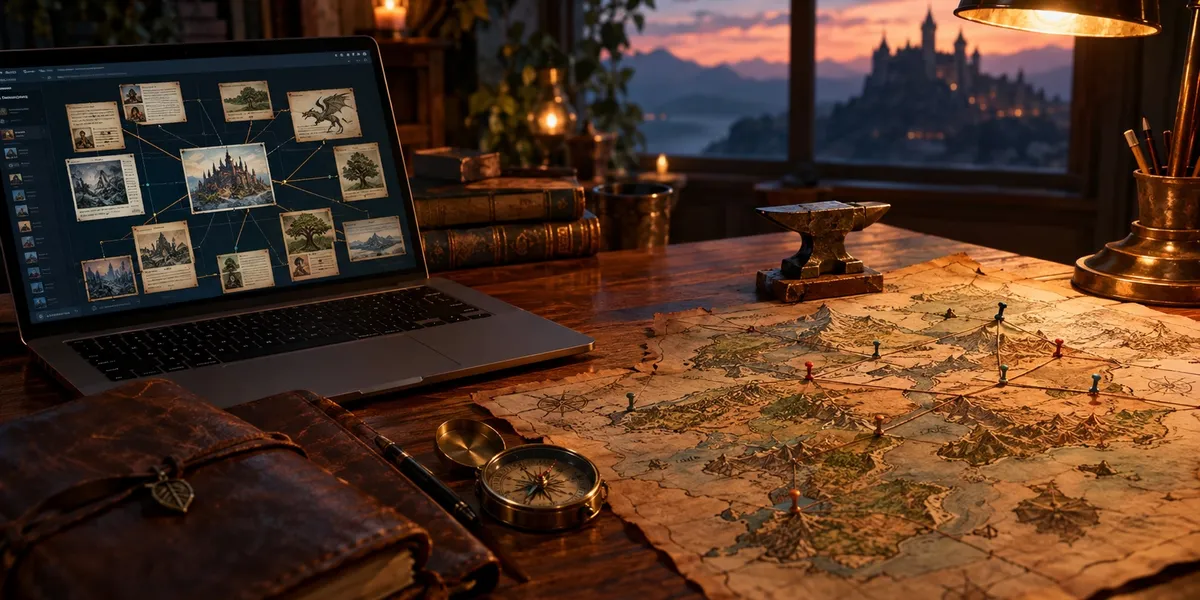
World Anvil is the deepest worldbuilding wiki you can buy, with a usable free plan and paid tiers from $7 a month. It is worth it if you are building a large fantasy or science fiction setting, or running a tabletop campaign. It is the wrong tool if what you actually need is a finished novel, because World Anvil organizes your world and leaves every word of the book to you.
In this World Anvil review, you’ll get:
- What the free plan really allows, and the privacy catch that comes with it
- Current 2026 pricing for every tier, checked on World Anvil’s own pricing page
- The real limitations, including the ones long-time users raise
- An honest look at where World Anvil beats our own product, and where it does not
Here is what you are actually signing up for.
What World Anvil Actually Is
World Anvil — A browser-based worldbuilding platform where you build your setting as a wiki of linked articles, maps and timelines, with a novel-writing editor and an RPG campaign manager attached.
It was founded by Janet Forbes, a writer, and Dimitris, a game master. World Anvil’s FAQ describes it as a worldbuilding toolkit, novel writing software and campaign manager in one, and its pricing page claims a community of 3,500,000+ worldbuilders.
The core unit is the article. You create an article for a city, a species, a religion, a war or a character, using templates that prompt you for the details that type usually needs. An auto-linker cross-references names as you type, so your world becomes a web you can click through.
Around that wiki sit the extras: interactive maps with pins, timelines, family trees, diplomacy webs, fantasy calendars, whiteboards for plotting, and Manuscripts, the built-in novel editor. There is no dedicated desktop app; everything runs in the browser.
What World Anvil Does Well
World Anvil wins on depth, connection and sharing. Few tools let you document a setting this thoroughly, link every piece of it together, and then publish the result as a polished site readers or players can explore.
Breadth no rival matches
If a worldbuilding element exists, World Anvil probably has a template for it. Species, organizations, magic systems, languages, technologies, ranks, conditions and vehicles all get their own structured prompts.
That matters most for big settings. If you are planning a multi-book epic, the templates push you to answer questions you would otherwise discover mid-draft, like who collects taxes in a border province. Our worldbuilding tips cover why those answers pay off later.
Everything links to everything
Mention a character inside a history article and World Anvil links it. Pin a city on a map and the pin opens the city’s full entry. A Trustpilot reviewer singles out exactly this: you can cross-link almost anything in the system.
For a sprawling world, that web is the product. It is what keeps a minor noble house from changing its sigil between book one and book three.
Maps and timelines that do real work
Interactive maps let you layer markers, labels and regions onto your own uploaded art. Paid tiers add parallel timelines (called Chronicles) and let you pin events to map locations.
If your plot depends on travel time, troop movements or a succession crisis, seeing it laid out beats a spreadsheet. Pair it with our guide to fantasy map making for writers if you still need the map itself.
Your world becomes something readers can visit
This is the feature most rivals lack, and World Anvil’s own comparison with Campfire leans on it. World Anvil lets you present your lore publicly as an illustrated site, with themes, custom CSS and, on the top tier, your own domain.
Some authors use it as a reader magnet: the war that happened before book one, the full royal family tree, the map with spoilers hidden. Game masters use the same features to reveal lore to players as a campaign unfolds.
Community and learning resources
World Anvil runs community worldbuilding challenges, a Discord help channel and a beginner course. In his Kindlepreneur review, Jason Hamilton lists the extensive tutorials and documentation among its main strengths, alongside reliable backups and collaboration with co-writers.
What World Anvil Does Not Do Well
World Anvil’s weaknesses are its learning curve, its privacy rules on the free plan, a no-refund policy, and the plain fact that it does not write your book. These are not edge cases; they are the reasons most writers who quit World Anvil give.
The learning curve is real
Almost every independent review says the same thing. Kindlepreneur lists a steep learning curve as its first con and warns that authors who only want simple notes may feel overwhelmed.
Dozens of templates, tiers and feature toggles mean many writers spend weeks learning the tool before they build much. If you lose momentum easily, that setup time is a cost.
It is built for game masters as much as writers
Statblocks, character sheet designers, session notes and support for over 100 RPG systems are excellent if you run a table. If you only write novels, a large share of the interface is for someone else.
You can switch feature groups off, which helps. Kindlepreneur still flags the RPG focus as a con for authors.
Free worlds are public
This is the catch on the free plan. World Anvil’s FAQ is explicit: private worlds and articles are a Guild (paid) feature, and the company frames this as its alternative to a time-limited free trial.
So your unpublished plot twists sit on a public page if you build them on the free tier. The FAQ also notes that if a paid membership lapses, your private content stays private, but you cannot edit it until you make it public or renew.
Subscriptions are non-refundable
The FAQ states that subscriptions are non-refundable, with refunds only for unauthorized transactions or at the company’s discretion. You can cancel any time and keep access until the period ends.
Several 1-star Trustpilot reviews complain about annual plans renewing without the refund they expected. Set a calendar reminder before your renewal date.
The interface has been changing
World Anvil has been rolling out a redesigned editor and dashboard through late 2025 and 2026. Recent Trustpilot complaints mention switching between the old and new edit views breaking page formatting, and some users describe the site as slow.
Updates may fix this. Right now, expect some friction.
It will not draft your novel
Manuscripts gives you a place to write chapters next to your wiki, with drag-and-drop scenes and linked reference articles. It is a writing environment, not a writing engine.
Nothing on the pricing page or FAQ describes AI drafting, and World Anvil states it does not train AI models on your work. If your world is finished and your manuscript is at chapter two, World Anvil cannot close that gap for you.
How Much Does World Anvil Cost in 2026?
World Anvil costs nothing to start, then $7 to $34 a month, $54 to $300 a year, or a one-time lifetime payment of $650 or $1,350. These figures come from World Anvil’s pricing page as of October 27, 2026, excluding tax.
| Tier | Monthly | Yearly | Lifetime | Key limits |
|---|---|---|---|---|
| Freeman (free) | $0 | $0 | n/a | 2 worlds, 42 articles (5 drafts), 100 MB storage, 2 maps, 2 timelines, public only |
| Master | $7 | $54 | n/a | 10 worlds, unlimited articles, 2 GB, privacy, Manuscripts, no ads |
| Grandmaster | $12 | $99 | $650 | Unlimited worlds, 5 GB, custom templates, content trees, API access |
| Sage | $34 | $300 | $1,350 | 15 GB, white labeling, custom domain, password-protected articles |
Older reviews mention a “Journeyman” tier around $50 a year. It no longer appears on the current pricing page, so treat any price quoted before 2026 as out of date.
Is World Anvil free?
World Anvil is free to start. The Freeman plan gives you 2 worlds, up to 42 articles and 100 MB of images, plus an interactive map and timeline. It excludes private content, Manuscripts, family trees and calendars, so it suits a public test world, not a secret novel.
What does a realistic setup cost?
For a novelist, the honest minimum is Master at $54 a year. That is the cheapest tier with private worlds and Manuscripts, and it is the tier Kindlepreneur recommends for most authors.
Over three years, that is $162. And at the end, you still have a world and a manuscript you wrote yourself, which is the right outcome if writing every sentence is the part you want.
Where World Anvil Beats Chapter
World Anvil beats Chapter at worldbuilding depth, sharing your world with an audience, tabletop campaigns, and price of entry. If any of those is your main goal, World Anvil is the better tool, and we would rather tell you that than sell you the wrong product.
- Worldbuilding depth. Chapter keeps a story bible that serves the manuscript. World Anvil is a full encyclopedia with dozens of templates, maps, family trees and timelines. For a ten-book setting, that depth is worth having.
- A public world for readers. Chapter has no browsable, shareable wiki. World Anvil turns your lore into a site readers can explore, which can become part of your author platform.
- Tabletop games. If you run D&D or another RPG, Chapter is simply the wrong tool. World Anvil was built for you.
- Free to start. Chapter costs $97 up front with no free tier or trial. World Anvil lets you try it for $0, and Master costs less per year than Chapter does once.
- You write every word. If drafting the prose yourself is the point, World Anvil’s Manuscripts keeps your writing and your world together without an AI in between.
Our roundup of the best worldbuilding tools puts World Anvil at the top of the dedicated wiki category for these reasons.
What Real Users Say About World Anvil
Real users praise World Anvil’s depth and cross-linking, and criticize its learning curve, renewals and recent interface changes. Sentiment is broadly positive among people who stick with it, and sharply negative among those who hit billing or editor problems.
On Trustpilot, World Anvil holds a 4.1 TrustScore from 265 reviews as of October 2026, with roughly 85% five-star and 7% one-star. Praise centers on linking characters, places and timelines, and on patient support staff.
The complaints cluster around auto-renewing annual plans, lost notes from errors, a slow site, reduced free-tier article limits, and the new edit view breaking formatting.
In the r/WorldAnvil community, “is World Anvil worth it” threads follow a pattern. Long-time users, especially game masters, call it invaluable once you go beyond basic worldbuilding, and value hiding secrets and map pins from players. Newer users say the templates overwhelm them, and some conclude a subscription only pays off if the tool feels natural to you.
Independent reviewers land in the same place. Kindlepreneur calls it one of the best worldbuilding platforms available, with the learning curve and RPG focus as the main drawbacks.
Who Should Buy World Anvil
World Anvil is the right purchase if your world is the project, not just the backdrop.
- Epic fantasy and science fiction series writers with multiple continents, magic systems and centuries of history to track. Our guide on how to create a magic system shows the kind of detail it handles well.
- Game masters running long campaigns who want lore, maps, statblocks and player-facing secrets in one place.
- Authors building a reader platform around their setting, who want fans to explore the lore between books.
- Collaborative worlds with co-authors, since only the world owner needs a paid membership.
Who Should Not Buy World Anvil
Skip World Anvil if any of these describe you.
- You want a finished book, not a better-organized world. If your notes are already good enough and the manuscript is what’s missing, more worldbuilding is procrastination with nicer maps.
- You write contemporary, romance or nonfiction. A wiki of 42 articles about a real city is overkill. A series bible in a simple document will do.
- You want a light, fast tool. If the learning curve sounds like a dealbreaker, Campfire is more modular, and Obsidian is free and minimal.
- You need private drafting for free. The free plan is public. If you cannot pay, do not put unpublished twists there.
- You dislike non-refundable subscriptions. Pay monthly first, not yearly, until you know you will stay.
The Alternative We Built
Our Pick — Chapter
Chapter is an AI book-writing platform that takes your premise, characters and world and drafts a complete, structured novel with you. It keeps a story bible so your setting stays consistent from chapter one to the final page, and you guide and edit every chapter.
Best for: Novelists whose world is planned but whose manuscript is not finished Pricing: $97 one time, 2 books included (fiction or nonfiction), 30-day money-back guarantee Why we built it: Most writers do not stall on worldbuilding; they stall on the 80,000 words after it.
Chapter and World Anvil solve different problems. World Anvil helps you build and share a world. Chapter helps you finish the book set in it.
That is why Chapter leads our recommendation for most writers reading a World Anvil review. The common story is not “I lack a wiki”; it is “I have spent two years worldbuilding and have three chapters.” World Anvil makes that loop more pleasant. Chapter breaks it.
More than 10,000 authors have used Chapter, and it has been featured in USA Today and the New York Times. It is a one-time payment, not a subscription, and you keep full rights to your book.
The honest limits: Chapter has no free tier or trial, no public wiki, and nothing for game masters. If your world is the product, keep World Anvil. Many writers use both: World Anvil for the encyclopedia, Chapter for the draft. Our Chapter review covers how the drafting works, and Chapter vs Campfire shows the same trade-off against another planning tool.
If you are ready to stop building and start finishing, see our guide on how to write a fantasy novel, then turn your world into a draft with Chapter’s fiction software for $97 one time, with 2 books included and a 30-day money-back guarantee.
FAQ
Is World Anvil worth it?
World Anvil is worth it if you are building a large fantasy or sci-fi setting or running a tabletop campaign and will use its maps, timelines and linked articles. It is not worth it if you need a finished manuscript, since it organizes your world but never drafts the book.
Is World Anvil free?
Yes, World Anvil has a free Freeman plan with 2 worlds, up to 42 articles and 100 MB of image storage. The catch is that free content is public, and features like Manuscripts, family trees and calendars require a paid Guild membership, starting at $7 a month.
How much does World Anvil cost?
World Anvil costs $7, $12 or $34 a month for its Master, Grandmaster and Sage tiers, or $54, $99 or $300 a year. Grandmaster and Sage also offer lifetime memberships at $650 and $1,350. Prices exclude tax and come from World Anvil’s pricing page in October 2026.
Can you write a novel in World Anvil?
Yes, you can write a novel in World Anvil using Manuscripts, its built-in editor, which links chapters to your worldbuilding articles. It requires at least the Master tier. You still write every word yourself; World Anvil does not generate prose for you.
Is World Anvil better than Campfire?
World Anvil is better than Campfire for depth, public world presentation and tabletop games. Campfire is generally easier to learn and its modular pricing suits novelists who want fewer tools. Neither drafts your book; for that, an AI book-writing platform like Chapter fills a different role.