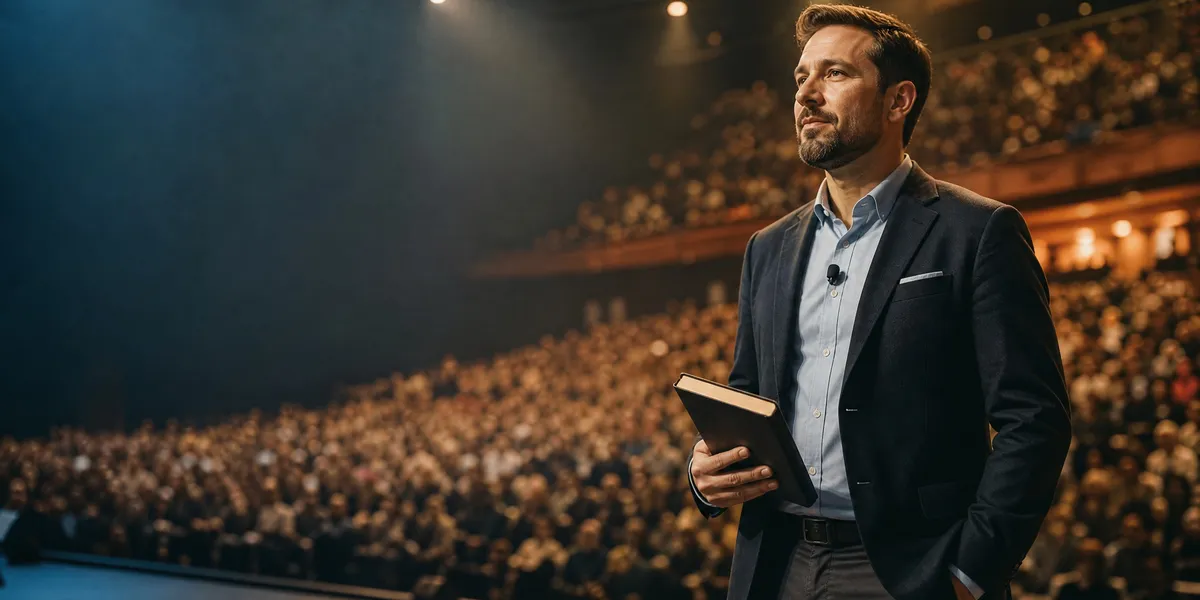
The best AI for writing a speaker book is Chapter, because a speaker book is not a drafting problem — it is a structure problem. You already have the content. It lives in a talk you have given forty times.
In this comparison, you will get:
- A ranked list of 7 AI tools, judged on how well each one turns an existing talk into book structure
- Honest notes on where every tool quietly fails a speaker
- A comparison table with real 2026 pricing
- The four-part structure that separates a speaker book from a generic business book
Here is how they stack up.
What Is a Speaker Book?
Speaker book — A short nonfiction book written primarily to win speaking engagements, built around one signature methodology rather than a broad topic survey.
A speaker book is a business card that happens to have a spine. Event organizers, bureaus, and corporate buyers use it as proof you can hold a room for sixty minutes, which is why it gets judged on clarity of framework, not on page count.
That changes what “best AI tool” means. Raw drafting speed is close to irrelevant. What matters is whether the tool can take a talk you already deliver and impose a chapter architecture on it.
Quick Comparison Table
| Tool | Best For | Turns a Talk Into Chapters | Full Book Output | Pricing |
|---|---|---|---|---|
| Chapter (Our Product) | Complete speaker books, start to finish | Yes — framework-first structuring | Yes, 80-250 pages in ~1 hour | $97 one-time |
| ChatGPT | Reshaping a signature talk into an outline | Partly — with heavy prompting | No — section by section | Free / $20 per month |
| Claude | Digesting long keynote transcripts | Partly — you supply the shape | No | Free / $20 per month |
| NotebookLM | Mining your old decks and transcripts | Source-grounded outlines only | No | Free |
| Descript | Converting recorded talks into text | No — produces raw material | No | Free / ~$24 per month |
| Jasper | Voice consistency across book and marketing | No — short-form engine | No | ~$49 per month |
| Perplexity | Adding citations that survive scrutiny | No | No | Free / $20 per month |
1. Chapter — Best AI for Writing a Speaker Book
Our Pick — Chapter
Chapter takes the methodology behind your talk and builds it into a complete, publish-ready manuscript of 80 to 250 pages in roughly an hour. You bring the framework. It handles architecture, drafting, and export.
Best for: Professional speakers, consultants, and executives who need a credible book on the table before their next bureau conversation Pricing: $97 one-time, no subscription Why we built it: Speakers do not lack material. They lack the six months it takes to convert a talk into a manuscript.
Every other tool on this list gives you text. Chapter gives you a book — table of contents, chapter arc, transitions, front matter, back matter, and a file you can upload to KDP the same week.
For a speaker book, the input stage is where it earns the price. You define your signature framework, the transformation you promise from stage, the audience that hires you, and the stories you already tell. Those become the spine of the manuscript instead of decoration sprinkled over generic advice.
What makes it work for speaker books specifically:
-
Framework-first structuring. Your three-part model becomes three sections, not three bullet points buried in chapter nine. Buyers who skim the contents page see your methodology immediately, which is exactly how a book gets you booked for speaking gigs.
-
Your stories, kept intact. The stories that land in the room are the ones that carry a chapter. Chapter builds around them rather than replacing them with invented anecdotes.
-
Right length by default. Speaker books work at 100 to 150 pages. Chapter targets that range instead of padding toward a page count nobody finishes on a flight.
-
Publish-ready export. Print files and ebook files, formatted. You can hand a box of books to an event organizer for the back table without hiring a formatter.
-
It doubles as a funnel. A speaker book is one of the strongest lead magnets a professional can own, because it proves competence before anyone sees a fee schedule.
Chapter has been used by 2,147+ authors to create over 5,000 books, and has been featured in USA Today and the New York Times. The speaking outcomes are specific:
“The book got me a speaking gig in front of 20,000 people.” — Chapter author
“A stranger read my book and reached out: I need your help. What does it cost? I said $13,200. He started the same day.” — Jim T.
“$60,000 in 48 hours from one lead magnet — and that was a book.” — Arek Z.
Honest limitations: Chapter writes the book. It does not pitch you to bureaus, build your speaker one-sheet, or design your interior graphics. If your talk depends on visual models, you will export and lay those out separately. And it will not invent a methodology for you — if your talk is a collection of tips rather than a system, fix that first.
2. ChatGPT — Best for Reshaping a Signature Talk Into an Outline
Best for: Speakers who want to interrogate their own framework before committing to a structure Pricing: Free tier available, $20 per month for Plus
ChatGPT is a strong thinking partner for the pre-writing stage. Paste your talk transcript, then ask it to name the underlying argument, find the three load-bearing ideas, and flag where you repeat yourself.
That last one is valuable. Talks tolerate repetition because audiences need reinforcement in real time. Books do not, and speakers rarely notice the redundancy in their own material.
Where it works well is the chapter-by-chapter conversation: draft one chapter, critique it, revise, move on. Many speakers get a serviceable book outline this way in an afternoon.
Where it falls short for speaker books: continuity. By chapter eight it has forgotten the terminology it invented in chapter two, and your framework quietly drifts. For a book whose entire job is making one methodology memorable, that drift is the most expensive failure mode there is. You become the continuity editor, which is most of the work.
3. Claude — Best for Digesting Long Keynote Transcripts
Best for: Speakers sitting on hours of recorded talks who need synthesis, not generation Pricing: Free tier available, $20 per month for Pro
Claude handles very long inputs without losing the thread, which suits a speaker with five years of conference recordings. Drop in three full transcripts and ask what argument you have actually been making across all of them.
The answers are often uncomfortable and useful. Speakers tend to discover their real thesis is narrower than the one on their website.
Its prose is also closer to publishable than most models produce out of the box — fewer stock transitions, less throat-clearing, which matters when a bureau reader opens to a random page.
Where it falls short for speaker books: it is a conversation, not a manuscript system. There is no project structure, no chapter management, no export. You will end up assembling the book by hand in a document, and the assembly is exactly the step that stalls most speakers for a year.
4. NotebookLM — Best Free Tool for Mining Your Existing Material
Best for: Speakers with a decade of decks, transcripts, and articles who do not know what is in them Pricing: Free
NotebookLM is the surprise on this list, and it is free. Upload your slide decks, transcripts, blog posts, and workshop handouts, and it answers questions grounded strictly in those sources with citations back to the file.
For a speaker book, this solves a real problem: you have said everything already, in fragments, across years. NotebookLM finds the fragments. Ask it which examples you use most often, or where you have explained step two of your model most clearly, and it will point you to the exact deck.
It also refuses to invent. Every claim traces back to a source you uploaded, which keeps the book in your voice rather than in a model’s default register.
Where it falls short for speaker books: it is a research surface, not a writing tool. It will not draft a chapter, will not hold a manuscript, and will not export anything resembling a book. Use it in week one, then move the findings somewhere else.
5. Descript — Best for Turning Recorded Talks Into Raw Text
Best for: Speakers whose best material only exists as video Pricing: Free tier available, roughly $24 per month for Hobbyist
Descript transcribes recorded keynotes accurately and lets you edit the audio by editing the text. For a speaker book, the value is simple: your strongest phrasing is the phrasing that worked live, and this is the fastest way to capture it verbatim.
Its filler-word removal is genuinely good, which matters because spoken transcripts are unreadable until the “ums” and false starts are gone.
Where it falls short for speaker books: transcription is not writing. A cleaned transcript is still spoken English — short clauses, callbacks to the room, jokes that need a live audience. Publishing it as a chapter is the single most common mistake in speaker books, and readers notice within a page. Descript gets you raw material and nothing further.
6. Jasper — Best for Voice Consistency Across Book and Marketing
Best for: Speakers with an established brand voice who also need launch copy Pricing: Roughly $49 per month
Jasper lets you define a brand voice once and apply it across outputs. For a speaker with an existing personal brand, that consistency has real value — the book, the speaker page, and the LinkedIn posts should sound like the same person.
It is also strong on the marketing layer around the launch, which is where many thought leadership books underperform.
Where it falls short for speaker books: it was built for marketing teams producing short-form content. Its templates cap out well below chapter length, and stitching a book together from marketing blocks produces exactly what it sounds like. At roughly $49 per month, six months of drafting costs three times what Chapter costs once.
7. Perplexity — Best for Citations That Survive Scrutiny
Best for: Speakers making claims a corporate buyer might check Pricing: Free tier available, $20 per month for Pro
Perplexity answers with live sources attached. If your keynote quotes a statistic you picked up at a conference in 2019, this is how you find out whether it was ever true.
That matters more for speaker books than for most nonfiction. Your book is a credibility document read by people deciding whether to put you in front of their staff. One fabricated statistic that a procurement lead finds does more damage than a mediocre chapter.
Where it falls short for speaker books: it is a research engine with no manuscript capability. Use it for fact-checking passes, not drafting.
How We Evaluated These Tools
Every tool was judged on four criteria specific to speaker books, not general writing:
- Talk-to-structure conversion. Can it take an existing keynote and produce a chapter architecture, not just paragraphs?
- Framework preservation. Does your methodology survive intact, with consistent terminology from chapter one to the end?
- Finished-book output. Does it produce a file you can print and sell, or a pile of text you still have to assemble?
- Total cost to a finished manuscript. Subscription tools were costed across a realistic six-month writing window.
What Structure Does a Speaker Book Need?
A speaker book needs four parts: a named problem, a named framework, one chapter per framework component, and a next step. That structure is what makes the book usable as a booking asset rather than a general-interest read.
Here is how each part earns its place:
- The named problem. One specific pain your audience already feels, stated in the first ten pages. Event organizers scan for this to check audience fit.
- The named framework. Your model, with a name you own. This is the single element that gets repeated when someone recommends you for a stage.
- One chapter per component. Each part of the model gets its own chapter, in the same order you deliver it live. Consistency between book and talk is what makes you feel rehearsed rather than improvised.
- The next step. An assessment, a workshop, or a conversation. A speaker book that ends without one leaves money on the table, which is the core argument in our guide to selling from the stage.
How Long Should a Speaker Book Be?
A speaker book should be 25,000 to 40,000 words, or roughly 100 to 150 pages. That length reads in one flight, costs little to print for back-of-room sales, and still carries enough substance to be taken seriously by a corporate buyer.
Longer is not better here. A 400-page book signals academic ambition. A 120-page book signals that you can compress a complex idea, which is exactly the skill an event organizer is hiring.
Can You Write a Speaker Book With AI and Still Be Credible?
Yes, you can write a speaker book with AI and remain credible, as long as the methodology, stories, and point of view are genuinely yours. AI handles structure and drafting. Credibility comes from the framework you built delivering the talk, which no tool can generate for you.
The failure case is not AI assistance. It is a book with no original system in it — the kind that summarizes what a reader could find in any airport bestseller. That book fails whether a human or a model wrote it.
Speakers who already have a proven talk are the ideal case for AI drafting, because the hard intellectual work happened years ago on stage. For a broader look at the tooling landscape, see our comparison of the best AI for nonfiction books.
What Should You Do After the Book Is Written?
Once the manuscript exists, the book becomes a booking tool. Add it to your speaker one-sheet, send copies to the three bureaus you want to work with, and reference a specific chapter in every pitch email.
Pricing follows credibility. Most speakers raise their fee within a year of publishing, and our speaking fees guide covers the ranges by market. Organizations like the National Speakers Association and Toastmasters are also where authored speakers get referred most often.
If your book is meant to bring in consulting work as well as stages, the mechanics overlap heavily with writing a business book and with building a book around a coaching practice.
FAQ
What is the best AI for writing a speaker book?
The best AI for writing a speaker book is Chapter, because it converts an existing talk into a complete manuscript with a framework-first chapter structure rather than loose text. It costs $97 one-time and outputs a print-ready file, while general chatbots leave you assembling the book yourself.
Can ChatGPT write a whole speaker book?
ChatGPT cannot write a whole speaker book in one pass. It drafts one section at a time and loses terminology consistency across long projects, so your framework drifts by the later chapters. It works best as an outlining and critique partner before you draft.
How much does it cost to write a speaker book with AI?
Writing a speaker book with AI costs between $0 and $300 depending on the tool. Chapter is $97 one-time, while subscription tools at $20 to $49 per month cost $120 to $294 across a realistic six-month writing window, plus your own assembly time.
Do speaker books need to be traditionally published?
Speaker books do not need to be traditionally published. Event organizers care about the framework and your authority, not the imprint. Self-publishing also keeps rights, pricing, and bulk-order margins with you, which matters for back-of-room and corporate bulk sales.
How long does it take to write a speaker book with AI?
Writing a speaker book with AI takes one to four weeks for most speakers with an existing talk. Drafting can happen in hours with a tool like Chapter, but revision, fact-checking, and formatting realistically take the remaining time before publication.