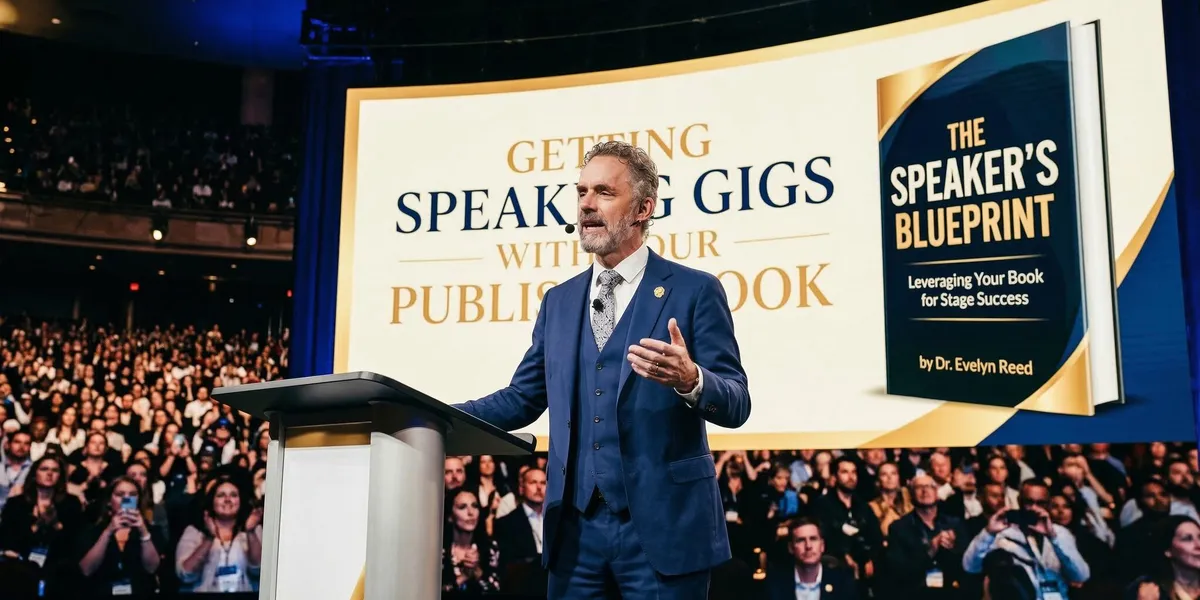
You can get speaking gigs from a book faster than from any other credential — often before the book has a single review. Event organizers need credible speakers, and “author of” is the two-word credential that opens more doors than a LinkedIn profile, a certification, or a media appearance.
In this guide, you’ll learn:
- How to turn one book into a signature talk organizers actually want
- The exact pitch structure that gets replies from event planners
- What to charge at every stage, from free local panels to $15,000 keynotes
- The 12-month path from published author to paid keynote speaker
One Chapter.pub author proved how fast this works. Kerri-Anne said: “A lady reached out and offered me a speaking engagement in Vegas — in front of 20,000 people. Just from saying my book was done.”
She had no speaker reel and no agent. She had a published book, and that was enough. Here’s how to do the same on purpose instead of by accident.
What this guide covers
- Why books open doors to stages
- Real authors who landed gigs from their books
- How to turn your book into a signature talk
- How to approach event organizers
- Building your speaker page and one-sheet
- Pricing your speaking engagements
- From free talks to paid keynotes
- How to get paid to speak as an author
- Common mistakes to avoid
- FAQ
Why does a book get you speaking gigs?
A book gets you speaking gigs because it solves an event organizer’s two hardest problems at once: finding a speaker credible enough to attract an audience and knowing in advance exactly what that speaker will say. A book is proof of both, and it exists before you ever pitch.
Speaker credential — Any verifiable asset that proves you can hold a room’s attention on a specific topic. A published book is the cheapest and most durable one you can create.
The “author of” effect
When your name appears next to a book title, three things happen in an event organizer’s mind:
- Credibility is established. Writing a book signals deep expertise. According to a 2024 survey by the National Speakers Association, 82% of event planners said a published book was the single most effective credibility marker when evaluating potential speakers.
- The topic writes itself. Your book title tells organizers exactly what you speak about. “Author of The Revenue Playbook” communicates your talk topic in four words.
- Promotion becomes easy. Organizers can point to your Amazon listing, use your book cover in marketing, and give attendees something tangible. Your book is marketing collateral that does double duty.
Why other credentials fall short
Certifications, degrees, and corporate titles are credibility markers, but they’re static. A book is living proof of expertise that people can hold, read, and share. It shows you know enough to fill 150 pages, not just a résumé line.
Social followings help, but they’re rented platforms. A podcast episode disappears into a feed. A book sits on a shelf permanently — the most durable credential you can create, which is why the authority book model works so reliably for consultants and coaches.
Real authors who landed speaking gigs from their books
The connection between publishing a book and landing speaking opportunities isn’t theoretical. It repeats across industries with almost boring consistency.
Kerri-Anne: from book to 20,000-person stage
Kerri-Anne, a Chapter.pub author, had barely announced her book was complete when the opportunity appeared. “A lady reached out and offered me a speaking engagement in Vegas — in front of 20,000 people. Just from saying my book was done.”
She didn’t pitch herself or cold-email conferences. The book’s existence was the pitch.
Jim T.: a $13,200 client and a conference circuit
Jim T., a business consultant, published a short book about his consulting methodology. A stranger read it, called him, and hired him for $13,200 on the spot. That same book led to speaking invitations at industry conferences, where he found more clients.
The pattern is consistent: a book creates gravitational pull. Organizers, podcast hosts, and conference chairs come to you instead of the reverse.
The industry data
According to the Global Speakers Federation, speakers with published books earn roughly 35% more per engagement than non-author speakers. SpeakerHub’s 2024 market report found speakers who published a book within the previous 12 months saw a 47% increase in inbound booking requests.
Across the 5,000+ books created on Chapter.pub by 2,147+ authors, the same effect shows up repeatedly — speaking invitations arrive during the launch window, not years later.
How do you turn your book into a signature talk?
You turn your book into a signature talk by picking one chapter, not summarizing the whole book. A 45-minute keynote holds roughly one idea with three supporting stories — about the content of a single strong chapter. Trying to cover the full book produces a shallow talk nobody remembers.
Call it the one-chapter rule. Here’s how to apply it:
| Step | What you do | Output |
|---|---|---|
| 1. Audit chapters | List every chapter and mark which ones readers email you about | Your 2-3 strongest ideas |
| 2. Pick the transformation | Choose the chapter with the clearest before/after for the audience | Your talk’s promise |
| 3. Build three proof stories | One client story, one personal story, one data point | Your talk’s spine |
| 4. Write the takeaway | A single framework attendees can use Monday morning | Your handout or slide |
| 5. Title it like a book | Specific, benefit-led, memorable | Your talk title |
Your talk title should never be your book title. “How to Turn Expertise Into Revenue With a Self-Published Book” gets booked. “Insights From The Revenue Playbook” doesn’t.
Build two or three of these from different chapters and you can pitch the same book to three different audiences. Authors who use their book to grow a business usually run one talk for prospects, one for peers, and one for the media.
How to approach event organizers
Having a book is the foundation. You still need to put yourself in front of the right people. Here’s the outreach that works.
Step 1: Identify the right events
Start where your book’s topic directly solves a problem the audience has. Don’t aim for TED first. Build the portfolio in order:
| Event type | How to find them | Difficulty |
|---|---|---|
| Local meetups and chambers | Meetup.com, local business groups | Easy — always looking for speakers |
| Industry associations | Google “[your industry] conference 2026” | Medium — submit 6-12 months ahead |
| Corporate events | LinkedIn outreach to L&D and HR leads | Medium — needs a clear ROI pitch |
| National conferences | AllConferences.com, trade publications | Hard — competitive, but a book gives you an edge |
| Keynotes and headliners | Speaker bureaus, referrals | Hard — requires a track record and a book |
Step 2: Craft a pitch that leads with the book
Keep outreach under 200 words and follow this structure:
- One sentence about their event — prove you did your homework.
- Your book as the credential — “I’m the author of [Book Title], which covers [relevant topic].”
- The talk you’d give — a specific title plus a 2-3 sentence description tied to their audience’s problem.
- Social proof — past engagements, audience sizes, testimonials.
- A link to your speaker page — make saying yes a single click.
Event organizers receive hundreds of pitches. Brevity signals professionalism.
Step 3: Follow up with value
If you don’t hear back, follow up once after 7-10 days. Attach a short article or resource tied to the event’s theme. That demonstrates expertise without nagging, and it’s the same principle behind a good book funnel — lead with something useful.
Step 4: Mine your existing network first
Before cold outreach, list every association, mastermind, alumni group, client company, and podcast you already belong to. Warm introductions convert several times better than cold pitches, and your first three gigs mostly determine how fast the rest arrive. The same relationship-first logic drives getting booked on podcasts as an author, which is often the shortest path to your first stage invitation.
Building your speaker page and one-sheet
Every author who wants speaking gigs needs a dedicated speaker page. It’s the page organizers land on when they Google you after reading your pitch.
What to include
- A professional headshot. Recent, high quality, not a selfie.
- Your book cover. Front and center. It’s your credential.
- 2-3 talk topics. Each with a title, a three-sentence description, and the ideal audience.
- Testimonials from past events. If you’re starting out, use reader, client, or colleague testimonials.
- A short bio (150 words max). Third person, leading with your book and expertise.
- A speaking reel. Even a two-minute webinar clip works. Content beats production value.
- A clear contact method. A booking form or direct email — never a hunt.
Your speaker page should live on the same site as the rest of your author website so the book, the talks, and the contact form reinforce each other.
The one-page speaker sheet
Organizers frequently ask for a one-sheet — a single PDF page they can forward to a committee. Include your headshot, book cover, talk titles, a three-line bio, three testimonials, past clients, and contact details. Export it as a PDF named firstname-lastname-speaker-sheet.pdf. This one asset closes more bookings than a speaker reel in the early stages, because it’s what actually gets circulated internally.
Where to list yourself
- SpeakerHub — free listing with event matching
- SpeakInc — bureau for professional speakers
- eSpeakers — widely used by event planners
- LinkedIn — add “Speaker” to your headline and featured section
Pricing your speaking engagements
Speaking fees vary wildly. A book lets you command higher fees, but you need to be strategic about when to charge and when to speak free.
The speaking fee spectrum
| Level | Fee range | Typical gig | Book requirement |
|---|---|---|---|
| Beginner | Free – $500 | Local meetups, panels, webinars | A completed book is enough |
| Emerging | $1,000 – $5,000 | Industry conferences, corporate lunch-and-learns | Book plus a few speaking clips |
| Established | $5,000 – $15,000 | National conferences, company all-hands | Book, reputation, testimonials |
| Expert | $15,000 – $50,000+ | Keynotes, high-profile summits | Bestselling book and a real platform |
According to the National Speakers Association, the median North American speaking fee is $7,500 per engagement. Authors typically command 25-40% above the non-author median. For a fuller breakdown by industry and format, see the author speaking fees guide.
What to charge when you’re starting out
Speak free at your first three to five events. Use them to collect testimonials, refine the talk, and build a reel. Then start charging.
The move from free to paid is easier than most authors expect. Organizers already expect to pay speakers — the question is how much, not whether.
The back-of-room model
Even at free events you can sell books. Many speakers earn $500-$2,000 per event in back-of-room sales alone, and some organizers buy a copy for every attendee — a bulk sale of 100-500+ books on their budget. Speaking to sell books and selling books at events both cover the table setup and the close.
From free talks to paid keynotes
The path from unpublished expert to paid keynote speaker is predictable. Your book accelerates every stage.
Stage 1: Publish your book
You need the credential before anything else. A short, focused book — 80 to 150 pages on your core expertise — is enough. It doesn’t need to be a bestseller. It needs to exist, look professional, and demonstrate real expertise.
Our Pick — Chapter
Chapter.pub helps you write and publish a professional nonfiction book in days instead of months. Over 2,147 authors have used it to create 5,000+ books — many, like Kerri-Anne, turning them into speaking opportunities.
Best for: Professionals who want a credibility-building book fast Pricing: $97 one-time Why we built it: Speaking opportunities don’t wait. The faster you publish, the sooner doors open.
If you’re still deciding what the book should be about, the authority book guide walks through choosing a topic that doubles as a talk topic.
Stage 2: Speak free locally (months 1-3)
Target three to five local events: chamber meetings, industry meetups, library talks, university guest lectures. Goals: practice the talk, get comfortable, and collect two or three video clips and testimonials.
Stage 3: Apply to industry conferences (months 3-6)
Most conferences run open calls for speakers. Submit to 10-15 in your niche. Your book puts you ahead of the roughly 90% of applicants with no published credential. Include your cover, Amazon link, and reader reviews in the proposal.
Stage 4: Start charging (months 6-12)
With five or more events behind you, quote fees. Begin at $1,000-$2,500 and raise by $500-$1,000 every three to five bookings. If you’re getting booked every time you quote, your fee is too low.
Stage 5: Pursue keynotes (year 2+)
By now you have a book, a reel, testimonials, and a track record. Approach speaker bureaus, apply to major conferences, and consider an agent. Your book and its speaking history are your portfolio.
Using your book as a business card for your expertise and a lead magnet for your services compounds the effect. Speaking generates clients, clients generate case studies, case studies strengthen the next edition, and the cycle repeats.
How do you get paid to speak as an author?
You get paid to speak as an author by charging a fee, selling books at the back of the room, and converting attendees into clients — usually all three at once. Most author-speakers earn more from the business the talk generates than from the speaking fee itself.
The four revenue streams from a single talk:
- Speaking fee — $1,000 to $50,000+ depending on your stage and the event’s budget.
- Back-of-room book sales — $500 to $2,000 per event, or a bulk purchase by the organizer.
- Client acquisition — the highest-value stream. Jim T.’s $13,200 engagement came from a reader, not a fee.
- Downstream bookings — audience members who run their own events and book you next.
Ask about a bulk book purchase in every negotiation. Organizers often have a materials budget separate from the speaker budget, which means you can be paid twice for one event.
How long does it take to get a speaking gig from a book?
It usually takes two weeks to six months from publication to your first speaking gig, depending on whether you pitch actively. Authors who email 10-15 local organizers during launch week often book something within a month. Authors who wait for inbound invitations typically wait three to six months.
Speed depends on outreach volume, not book sales. Kerri-Anne’s invitation arrived before her book had any sales history at all.
Common mistakes to avoid
- Waiting until the book is a bestseller. You need a professional published book, not a bestseller. Kerri-Anne’s was barely finished.
- Pitching without a speaker page. Organizers Google you before replying. No page, no booking.
- Summarizing the whole book on stage. One chapter, one idea, three stories. Depth beats coverage.
- Undervaluing your first paid gigs. If an event budgets for a venue, catering, and AV, it budgets for speakers.
- Giving the same talk everywhere. Keep the framework, swap the examples for each industry.
- Forgetting to sell books at events. Always bring copies. Signed copies sell, and they extend the relationship past the room.
Related Reading
- How to Use a Book to Grow Your Business
- Author Speaking Fees: What to Charge
- Speaking to Sell Books
- How to Get on Podcasts as an Author
- How to Build an Author Website in 2026 ✍️
- Book Marketing: The Complete Guide
FAQ
How do you get speaking gigs from a book?
You get speaking gigs from a book by turning one chapter into a signature talk, building a speaker page with your book cover and talk topics, then pitching 10-15 relevant events with a sub-200-word email that leads with your author credential. Most authors book their first gig within a month of pitching.
Do I need a traditionally published book, or does self-publishing count?
Self-published books work just as well for landing speaking gigs. Event organizers care about your expertise and the book’s quality, not your publisher’s name. Many of the most in-demand speaker-authors — including Chapter authors featured in USA Today and the New York Times — are self-published.
How soon after publishing can I start getting speaking gigs?
You can start immediately. Kerri-Anne received her 20,000-person invitation the moment she announced her book was complete. You don’t need reviews, sales numbers, or media coverage first. Once the book exists and looks professional, start pitching that week.
How much can an author charge for a speaking gig?
An author can typically charge $1,000-$5,000 early on and $5,000-$15,000 once established, against a North American median speaking fee of $7,500. Authors command roughly 25-40% more than non-author speakers because a published book removes the organizer’s risk.
What if I have stage fright?
Start small. A 15-person local meetup is a low-stakes place to build confidence. Join Toastmasters for structured practice, and record yourself presenting to a camera. Stage fright fades with repetition, and your book gives you something concrete to talk about — you’re the expert who wrote it.
Should I speak for free or charge from the beginning?
Speak free at your first three to five events to build a reel and testimonials, then transition to paid. The exception: if an event is clearly profitable — a corporate event or sponsored conference — quote a fee even for your first talk. Don’t leave money on the table when it’s obviously there.