You can create a believable fantasy language for your novel — even if you’ve never studied linguistics.
In this guide, you’ll learn:
- How to build a phonology that gives your language a distinct sound
- The step-by-step process for creating vocabulary, grammar, and writing systems
- How to weave your constructed language into your story without confusing readers
- Real examples from Tolkien, David Peterson, and other master conlangers
Here’s everything you need to know about creating fantasy languages.
What Is a Fantasy Language?
A fantasy language (or conlang) is a constructed language created for a fictional world, designed to feel authentic and deepen the reader’s immersion in the story. Unlike random made-up words, a well-built fantasy language follows internal rules for sound, structure, and meaning — just like a natural language does.
Tolkien’s Quenya and Sindarin. David Peterson’s Dothraki and High Valyrian. Suzette Haden Elgin’s Laadan. These languages weren’t slapped together. They were constructed with consistent phonologies, grammars, and cultural logic that made entire fictional civilizations feel real.
You don’t need to build something that comprehensive. For most novels, a naming language — a set of consistent sound rules, key vocabulary, and cultural phrases — is more than enough. The goal is to give the impression of a complete language without writing a 500-page grammar textbook.
Why Your Fantasy Novel Needs a Constructed Language
A well-crafted fantasy language does more than look cool on the page. It solves real storytelling problems.
Cultural depth. Language shapes how people think. A warrior culture might have twelve words for types of combat and none for surrender. A seafaring people might conjugate verbs differently based on whether something happened on land or at sea. When your language reflects your culture, your worldbuilding feels three-dimensional.
Character voice. Characters who speak or think in a constructed language sound fundamentally different from characters who don’t. Sprinkling in authentic-sounding words for greetings, oaths, and insults makes dialogue feel rooted in a specific place.
Reader immersion. According to research on constructed languages in fiction, readers report higher engagement with fantasy worlds that include consistent linguistic elements. The language doesn’t need to be complete — it just needs to feel real.
Naming consistency. Without a language system, your character names end up sounding random. One elf is named “Aelindra” and another is “Bob.” A naming language ensures every name, place, and artifact from the same culture shares a recognizable sound. If you’re using a fantasy name generator or character name generator, having phonological rules lets you filter results for consistency.
Step 1: Decide Your Scope
Before you build anything, decide how much language you actually need. Your scope determines how much work lies ahead.
Naming Language (Easiest)
A naming language gives you consistent-sounding names for characters, places, and objects. You define a set of sounds, some basic word-building rules, and a small vocabulary of 50-100 root words. This is enough for most fantasy novels.
Best for: Single-POV novels, stories where the constructed language isn’t spoken on-page, and writers who want authenticity without spending months on linguistics.
Partial Language (Moderate)
A partial language adds greetings, curses, proverbs, and short dialogue exchanges on top of a naming language. You’ll need basic grammar rules (word order, plurals, verb tenses) and a vocabulary of 200-500 words.
Best for: Multi-POV epics, stories featuring bilingual characters, and novels where cultural conflict drives the plot.
Full Language (Advanced)
A full language has complete grammar, extensive vocabulary, and the ability to express any thought. Tolkien spent decades on his. David Peterson builds these professionally for film and television.
Best for: Passion projects, series spanning multiple books, and writers who genuinely love linguistics. If this is your first conlang, start smaller.
Step 2: Build Your Phonology
Phonology is the sound system of your language — which sounds exist, which combinations are allowed, and how syllables are structured. This is the foundation everything else builds on.
Choose Your Sound Inventory
Every language uses a subset of possible human speech sounds. English uses about 44. Hawaiian uses 13. Your fantasy language needs its own set.
Start by picking consonants and vowels from the International Phonetic Alphabet (IPA). You don’t need to memorize the whole chart. Pick 15-25 consonants and 5-8 vowels that create the feeling you want.
For a flowing, melodic language (like Tolkien’s Elvish): Use lots of liquids (l, r), nasals (m, n), and vowels. Avoid harsh stops and clusters. Think Welsh or Finnish as inspiration.
For a harsh, guttural language (like Klingon or Black Speech): Use velar and uvular stops (k, g, q), fricatives (kh, gh), and consonant clusters. Think Arabic or Georgian as inspiration.
For an alien, unfamiliar language: Include sounds not found in English — clicks, ejectives, tonal distinctions, or unusual vowel combinations.
Set Syllable Rules
Define how sounds combine into syllables. Most languages follow patterns like:
- CV (consonant-vowel): ka, lo, mi — simple, open, flowing
- CVC (consonant-vowel-consonant): kal, lon, mit — balanced, versatile
- CCVC (consonant cluster + vowel + consonant): stral, grim, bren — heavier, more complex
Pick 2-3 patterns and stick with them. This single decision makes every word in your language sound like it belongs together.
Create Sound Rules
Natural languages have phonotactic rules — restrictions on which sounds can appear next to each other. English allows “str” at the start of a word but not “tsr.” Your language needs similar constraints.
Write down 3-5 rules. For example:
- No two vowels can appear next to each other
- Words always end in a vowel or nasal consonant
- The sound “kh” never appears at the beginning of a word
These rules create consistency. When you invent new words later, the rules ensure they all sound like they belong to the same language.
Step 3: Create Your Core Vocabulary
Don’t try to build a dictionary from scratch. Start with the words your story actually needs.
The Essential Word List
Create a list of 50-100 root words covering:
- Kinship terms: mother, father, child, elder, sibling
- Environment: sky, earth, water, fire, mountain, forest, sea
- Actions: go, come, fight, speak, build, die, love
- Descriptions: big, small, dark, bright, strong, sacred
- Cultural essentials: honor, oath, home, stranger, war, peace
- Greetings and farewells: hello, goodbye, welcome, safe travels
Tailor this list to your world’s culture. A desert civilization needs words for different types of sand and heat. A magical society needs words for types of power. A seafaring culture needs nautical vocabulary.
Build Words from Roots
Real languages build complex words from simpler roots. Your language should do the same.
If kal means “fire” and -an means “person,” then kalan means “fire-person” — perhaps a fire mage or a smith. If -eth marks a place, then kaleth is “place of fire” — a forge, a volcano, or a sacred site.
This root-and-affix system lets you generate hundreds of consistent words from a small set of building blocks. It also means readers can start guessing meanings, which creates a satisfying sense of discovery.
Example Root System
| Root | Meaning | Derived Words |
|---|---|---|
| kal | fire | kalan (fire-keeper), kaleth (forge), kalir (flame-blade) |
| mor | shadow | moran (shadow-walker), moreth (dark place), moril (hidden) |
| thal | stone | thalan (mason), thaleth (mountain), thalir (stone-carved) |
| vel | wind | velan (sailor), veleth (open plains), velir (swift) |
This table shows how four roots generate twelve words. Apply this pattern to your full root list, and you’ll have a rich vocabulary without inventing each word individually.
Step 4: Establish Basic Grammar
You don’t need a complete grammar. You need enough structure to write convincing phrases and short sentences.
Word Order
The three most common word orders in natural languages are:
- SVO (Subject-Verb-Object): “The warrior slays the dragon” — feels familiar to English speakers
- SOV (Subject-Object-Verb): “The warrior the dragon slays” — used by Japanese, Korean, Latin
- VSO (Verb-Subject-Object): “Slays the warrior the dragon” — used by Welsh, Arabic, Irish
Pick one. SOV and VSO create an immediate sense of foreignness for English-speaking readers without being incomprehensible.
Marking Nouns
Decide how your language handles:
- Plurals: Add a suffix (-i, -en, -ar), change a vowel, or don’t mark plurals at all
- Possession: Use a suffix (kalan-os = “the fire-keeper’s”), a separate word, or word order
- Cases: Simple languages use prepositions. Complex languages mark nouns directly for roles like subject, object, and location
For most fiction, a plural marker and a possessive marker are all you need.
Verb Basics
At minimum, decide:
- Tense: How do you mark past, present, and future? A suffix? A helper word?
- Negation: How do you say “not”? A prefix (un-), a separate word, or a changed vowel?
Keep it simple. You’re creating the illusion of depth, not writing a linguistics dissertation.
Step 5: Design a Writing System (Optional)
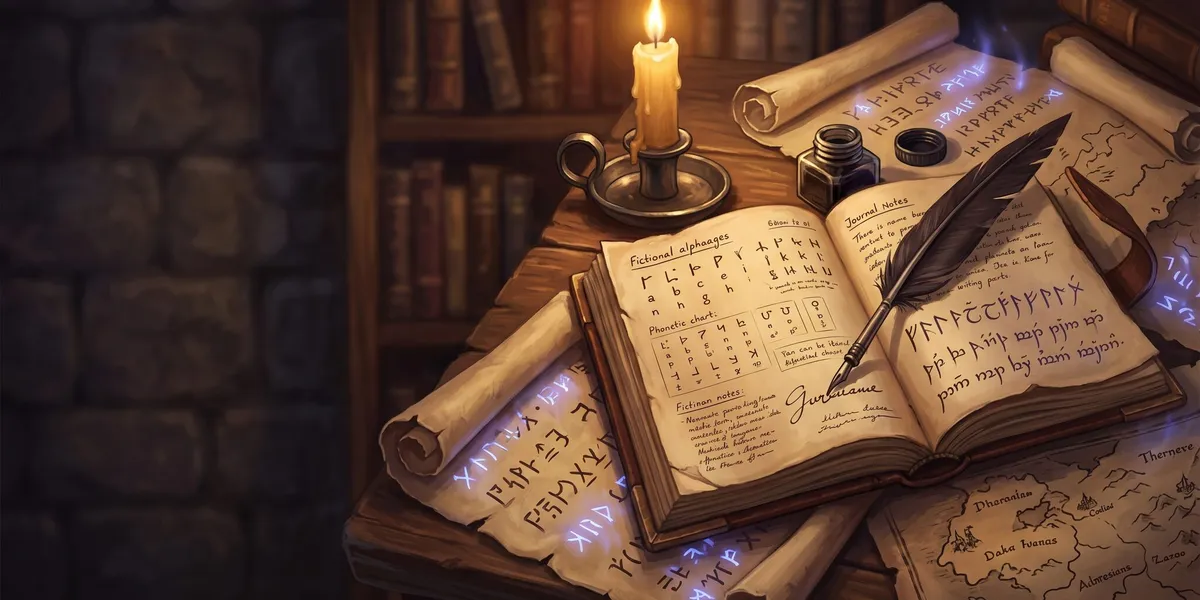
A writing system adds visual richness to your world, but it’s optional for most novels. If your story includes written messages, inscriptions, or maps, consider developing one.
Types of Writing Systems
- Alphabets — Each symbol represents a sound (like English or Greek)
- Syllabaries — Each symbol represents a syllable (like Japanese hiragana)
- Logographs — Each symbol represents a word or concept (like Chinese characters)
- Runes — Angular characters designed for carving into stone or wood (like Norse futhark)
For fantasy, runes and alphabets are the most common choices. Runes feel ancient and mystical. Alphabets are practical and easy to systematize.
If you’re developing a fantasy map, your writing system can appear on signposts, borders, and monuments — adding a layer of visual worldbuilding that readers love.
Design Principles
Keep your script visually consistent. If your culture carves into stone, the characters should be angular with straight lines. If they write with brushes on silk, the characters should be flowing and curved. The tools your people use should shape how their writing looks.
Step 6: Connect Language to Culture
This is where your language stops being a linguistic exercise and becomes a storytelling tool. The strongest fantasy languages reflect the culture that speaks them.
Language Reflects Values
A warrior culture might have complex verb forms for different types of combat but use simple, blunt terms for emotions. A scholarly culture might have precise vocabulary for abstract concepts but borrow practical words from neighboring languages. This is the same principle behind building a magic system — the system reflects the culture that created it.
Tolkien understood this deeply. His Elvish languages reflected the Elves’ love of beauty, nature, and ancient memory. The Black Speech of Mordor reflected Sauron’s desire for domination — it was harsh, efficient, and designed to command.
Untranslatable Words
Every language has words that don’t translate cleanly into other languages. These are gold for worldbuilding.
Maybe your desert culture has a word — sahleth — that means “the grief of watching a well run dry.” It captures an emotion so specific to their experience that no other language has a word for it. When a character uses sahleth in your story, readers feel the cultural weight behind it.
Create 3-5 untranslatable words for your language. They’ll become some of the most memorable elements of your world.
Dialects and Social Registers
Real languages have regional dialects and social registers — the way a peasant speaks differs from the way a noble speaks, even in the same language. Your constructed language can reflect this.
Maybe the mountain clans use older, more conservative forms of the language. Maybe the capital city has absorbed foreign loanwords that the rural villages haven’t. These linguistic layers make your world feel lived-in. For more depth on building cultural systems, see our worldbuilding tips guide.
How to Weave a Constructed Language Into Your Story
Creating the language is only half the challenge. Integrating it into your narrative without alienating readers is the other half.
The Drip-Feed Method
Never dump a paragraph of untranslated text on the reader. Instead, introduce words one at a time, in context, with meaning made clear through the surrounding text.
Bad: “Kal’ethan mor’suleth vel’irath,” he said. (Translation provided in a footnote)
Good: “Kal’ethan,” he whispered — the old word for oath-fire, the kind you can’t take back.
The second approach teaches the reader the word while keeping them in the story. Over the course of a novel, readers can absorb dozens of words this way without ever feeling lectured.
Context Clues Over Glossaries
Use action, reaction, and narrative context to convey meaning. A character who hears a foreign insult and reaches for their sword tells the reader everything they need to know about what was said.
Glossaries at the back of the book are fine as a reference, but your prose should never depend on them. Every constructed-language word in your text should be understandable from context alone.
Strategic Placement
Use your constructed language in moments of high emotion or cultural significance:
- Oaths and curses — Characters revert to their native tongue under stress
- Rituals and ceremonies — Formal language marks sacred moments
- Names and titles — Every name carries meaning the reader gradually learns
- Proverbs and sayings — Cultural wisdom expressed in the original language hits harder
Don’t use it for mundane dialogue. If two characters are ordering lunch, write it in English. Save the constructed language for moments that matter. When you do write dialogue in or around your conlang, strong dialogue tags help ground the reader in who’s speaking and how.
How to Create a Fantasy Language With AI
AI tools can accelerate the conlanging process — especially for writers who want linguistic consistency without spending months on construction.
Our Pick — Chapter
Chapter’s AI writing assistant helps you develop constructed languages alongside your novel. You can brainstorm phonologies, generate consistent vocabulary from root words, and test how your language sounds in dialogue — all within the same tool you’re using to write the book.
Best for: Fiction writers who want to build a language as part of their writing workflow, not as a separate project. Pricing: $97 one time, 2 books included (fiction or nonfiction), 30-day money-back guarantee Why we built it: Over 10,000 authors have used Chapter to write books, and many of them write fantasy that needs consistent worldbuilding — including language.
Beyond Chapter, you can use AI to:
- Generate word lists from phonological rules you define
- Check consistency — paste your language rules and ask AI to flag violations in your vocabulary
- Create etymologies — build word histories that add depth to your naming conventions
- Draft glossaries — organize your vocabulary into reader-friendly reference materials
AI works best as an accelerator, not a replacement. You set the rules — the sounds, the cultural logic, the emotional feel. AI helps you scale those rules across hundreds of words consistently. For more AI-powered worldbuilding ideas, check out our ChatGPT prompts for worldbuilding guide.
Famous Fantasy Languages to Study
Studying successful conlangs teaches you what works. Here are the most instructive examples.
Tolkien’s Elvish (Quenya and Sindarin)
Tolkien was a professional philologist, and it shows. Quenya draws from Finnish — vowel-heavy, musical, and agglutinative. Sindarin draws from Welsh — consonant mutations, flowing rhythm, and lyrical compounds. He built the languages first and wrote stories to give them a home.
What to learn: Root-based word derivation, sound change over time, and how language families can coexist in one world.
David Peterson’s Dothraki and High Valyrian
Created for Game of Thrones, these languages were built to feel like natural languages that had evolved over centuries. Peterson published his process in The Art of Language Invention — one of the best practical guides available.
What to learn: Building a language from a few existing words (the scraps George R.R. Martin provided), creating consistent grammar under deadline, and making a language sound natural in actors’ mouths.
Klingon (Marc Okrand)
Klingon was deliberately designed to sound alien — with Object-Verb-Subject word order (the rarest in natural languages), tlh consonant clusters, and a harsh phonology. It now has its own dictionary, translations of Shakespeare, and an active speaking community.
What to learn: How breaking linguistic expectations creates a strong sense of otherness.
Common Mistakes When Creating Fantasy Languages
Avoid these pitfalls that trip up first-time conlangers:
- Inconsistent sounds. If your Elven language uses soft, flowing sounds in one scene and harsh gutturals in another, readers notice — even subconsciously. Stick to your phonology.
- Too many apostrophes. Kal’eth’ir’an looks like someone attacked a keyboard. Use apostrophes sparingly and consistently — ideally to mark a specific linguistic feature like a glottal stop.
- Forgetting culture. A language that’s just random syllables with no cultural logic behind it feels hollow. Connect every linguistic choice to something about the people who speak it.
- Overloading the reader. If your first chapter contains fifty untranslated words, readers will give up. Introduce constructed-language elements gradually.
- Making it too regular. Real languages are messy. They have irregular verbs, exceptions to rules, and borrowed words from other languages. A perfectly regular language feels artificial. Add a few deliberate irregularities.
How Long Does It Take to Create a Fantasy Language?
Creating a fantasy language takes anywhere from a weekend to several years, depending on your scope. A basic naming language with 50-100 root words and simple phonological rules can be built in 2-3 days. A partial language with grammar and 200+ words typically takes 2-4 weeks of focused work. A complete language like Tolkien’s Quenya is a years-long project.
For most novelists, a naming language plus 20-30 key phrases is the sweet spot. You get 90% of the immersive benefit with 10% of the work.
Can You Create a Fantasy Language Without Knowing Linguistics?
Yes — you can create a fantasy language without any formal linguistics training. The core skill is consistency, not expertise. If you can decide on a set of sounds, write down rules for combining them, and stick to those rules throughout your novel, you’ll produce something that feels authentic.
Resources like David Peterson’s The Art of Language Invention and Mark Rosenfelder’s The Language Construction Kit explain linguistic concepts in plain language for non-specialists. The Language Creation Society also offers free guides and community support.
Start small. Build a naming language for your first novel. If you discover you love the process, go deeper with your next project.
Tools and Resources for Fantasy Language Creation
| Tool/Resource | What It Does | Best For |
|---|---|---|
| Chapter | AI writing assistant with worldbuilding support | Building languages inside your writing workflow |
| Vulgar Language Generator | Generates full languages from phonological inputs | Quick prototyping and inspiration |
| ConWorkShop | Online conlang management and community | Organizing and sharing your language |
| The Art of Language Invention | David Peterson’s guide to conlanging | Learning the craft from a professional |
| The Language Construction Kit | Mark Rosenfelder’s comprehensive guide | Deep linguistic foundations |
| IPA Chart | Complete inventory of human speech sounds | Choosing your phonology |
FAQ
What Is a Conlang?
A conlang (short for constructed language) is a language that has been deliberately created rather than evolving naturally over time. Conlangs include fictional languages like Tolkien’s Elvish and Dothraki, as well as auxiliary languages like Esperanto. Writers create conlangs to add depth and authenticity to their fictional worlds.
How Many Words Does a Fantasy Language Need?
A fantasy language needs 50-100 root words for a basic naming language and 200-500 words for a partial language with dialogue. Most published fantasy novels use fewer than 100 unique constructed-language words total. Focus on cultural keywords, names, greetings, and oaths rather than trying to build a complete dictionary.
What Makes a Fantasy Language Sound Realistic?
A fantasy language sounds realistic when it follows consistent phonological rules — the same set of sounds, syllable structures, and combination patterns throughout. Real languages have internal logic: certain sounds always appear together, words share recognizable roots, and grammar follows predictable patterns. Consistency is more important than complexity.
Should I Create a Writing System for My Fantasy Language?
You should create a writing system for your fantasy language only if written text appears in your story — inscriptions, letters, maps, or magical scripts. If your language is spoken but never seen on the page, a writing system adds worldbuilding depth for you but won’t reach your readers. Focus on sounds and vocabulary first, then add a script if your story needs it.
How Did Tolkien Create His Elvish Languages?
Tolkien created his Elvish languages by drawing on his expertise as a professional philologist who specialized in Old English and Finnish. He built Quenya (inspired by Finnish) and Sindarin (inspired by Welsh) with complete grammars, etymologies, and historical sound changes spanning thousands of years of fictional history. He famously said his stories existed to give his languages a world to live in.