Working with a ghostwriter is a collaboration, not a handoff. You supply the stories, expertise, and judgment; the ghostwriter supplies structure, craft, and momentum — and you should expect to spend 20 to 30 hours in interviews plus another 20 to 40 hours reviewing drafts.
In this guide, you’ll learn:
- What actually happens in each phase, from kickoff to final manuscript
- How to prepare for ghostwriter interviews so you get usable material
- The feedback method that produces a book in your voice instead of a generic one
- How to structure milestones, payments, credit, and royalties so nothing goes sideways
Here’s how the collaboration works, step by step.
What Does Working With a Ghostwriter Actually Involve?
Working with a ghostwriter involves six phases: kickoff, interviews, outline, drafting, revision rounds, and final polish. You stay involved throughout — supplying source material, answering follow-up questions, and approving each milestone before the next begins. Most book projects run four to twelve months.
The mistake that sinks projects isn’t a bad writer. It’s an author who signs the contract, disappears, and reappears six months later disappointed that the manuscript doesn’t sound like them.
Gotham Ghostwriters, one of the largest ghostwriting agencies, describes the relationship the same way: clearly defined roles on both sides, with the author responsible for input and approvals at every stage.
If you haven’t chosen a writer yet, start with our guide on how to hire a ghostwriter — this post picks up the day after you sign.
Phase 1: The Kickoff — Align Before Anyone Writes
The kickoff meeting exists to answer four questions before a single word gets drafted:
- Why are you writing this book? Lead generation, legacy, credibility, speaking fees, or straight book sales — each one produces a different book.
- Who is the reader? Not “business leaders.” A specific person with a specific problem.
- What does success look like? 5,000 copies? Ten enterprise clients? An authority book that gets you on stages?
- What’s the deadline that actually matters? A conference, a product launch, a birthday.
Write the answers down in one page and both sign it. That page becomes the tiebreaker for every disagreement later — when you and your ghostwriter argue about whether a chapter belongs, you check it against the goal, not against taste.
Book brief — A one-page document stating the book’s purpose, target reader, success metric, and hard deadline, agreed by author and ghostwriter before drafting begins.
Phase 2: Build a Voice Sample Kit in Week One
The single highest-leverage thing you can do in the first week is hand over raw material that shows how you actually sound. Ghostwriters can’t invent your voice — they reverse-engineer it from evidence.
Give your ghostwriter all of these in week one:
| Artifact | Why it matters |
|---|---|
| 5–10 emails you wrote to clients or your team | Shows unguarded sentence rhythm |
| 3 recorded talks, podcasts, or webinars | Captures spoken cadence and stock phrases |
| Any blog posts or LinkedIn posts you wrote yourself | Shows written voice under pressure |
| 3 books you’d want yours shelved beside | Signals tone and register targets |
| 1 book in your genre you actively dislike | Often more useful than the ones you like |
| Your slide decks and internal frameworks | Provides structure the book can inherit |
| A list of words and phrases you never use | Prevents the generic-consultant drift |
That last row does more work than authors expect. If you hate the word “leverage,” say so on day one — not on page 240.
This is the same problem AI writing tools solve with style samples. If you want to understand how voice capture works mechanically, see can AI maintain a consistent voice — the principles are identical whether the writer is human or not.
Phase 3: How to Prepare for Ghostwriter Interviews
Ghostwriter interviews are recorded conversations, typically 60 to 120 minutes each, where you talk and the ghostwriter mines your answers for stories, arguments, and structure. Most books need 10 to 20 sessions totalling 20 to 30 hours.
The interview stage is where books are won or lost. As professional ghostwriter Andrew Crofts notes, the early sessions are deliberately broad — the ghostwriter is looking for the shape of the whole project before narrowing in.
Come with stories, not summaries
The most common interview failure is answering in conclusions. “Delegation is critical for scaling” is a summary. “In 2019 I did payroll myself at 2am on Christmas Eve because I didn’t trust my ops lead” is a book.
Before each session, jot down three specific moments related to the topic: a time it went wrong, a time it went right, and a time you changed your mind.
Let them record everything
Recorded and transcribed interviews are standard practice and protect both sides. The transcript is your raw manuscript — a 90-minute session yields roughly 12,000 words of raw material.
Structure sessions by chapter, not chronology
After the broad opening interviews, agree in advance what each session covers: “next Tuesday we’re doing chapter four, the pricing chapter.” You prepare, they prepare, and the session produces usable material instead of wandering.
Be honest, especially about the failures
The parts of your story you’d rather skip are usually the parts readers connect with. If a topic is genuinely off-limits — litigation, a family member, a client under NDA — name it in the kickoff so your ghostwriter routes around it instead of building a chapter on it. For memoir specifically, see our guidance on how to write a memoir.
Phase 4: Approve the Outline Before Any Chapter Gets Written
After interviews, your ghostwriter turns transcripts into a chapter-by-chapter outline — usually 15 to 50 pages with chapter summaries and key points beneath each one.
This document is your last cheap opportunity to change the book. Restructuring an outline takes an afternoon. Restructuring a finished 70,000-word manuscript costs weeks and, in most contracts, extra money.
Read it three times, with a different question each time:
- Pass 1: Does the argument build? Could a reader skip a chapter without losing anything?
- Pass 2: Is every chapter carrying a story, not just a claim?
- Pass 3: Does the opening chapter earn the second one?
Expect two or three rounds of negotiation here. That’s healthy. If your ghostwriter accepts every note without pushback, you’ve hired a typist, not a collaborator.
For a sense of what a strong structure looks like, compare against our book outline template.
Phase 5: Ask for a Paid Sample Chapter Before Full Drafting
Before your ghostwriter disappears to write 70,000 words, commission one full chapter — paid, at the normal rate — and treat it as a voice test.
Pick a chapter that’s mid-book rather than the introduction. Introductions get polished to death and tell you nothing about sustainable voice.
Then read it out loud. If sentences make you stumble, they aren’t yours. Mark every phrase you’d never say and send the marked copy back. Fixing voice at chapter one is cheap; fixing it at chapter twenty is a rewrite.
Most experienced ghostwriters expect this and build it into their process. If yours resists a paid test chapter, that’s a signal worth taking seriously — Writer Beware documents plenty of cases where reluctance to show work early preceded bigger problems.
Phase 6: How to Give Feedback on a Ghostwritten Draft
Give feedback in three separate layers — structural, substantive, and line-level — and never mix them in the same pass. Mixed feedback produces a ghostwriter who rewrites sentences in a chapter you’re about to delete.
| Layer | What you’re checking | When to give it |
|---|---|---|
| Structural | Chapter order, what’s missing, what should be cut | First read of the full draft |
| Substantive | Accuracy, missing stories, weak arguments, wrong emphasis | Second read, chapter by chapter |
| Line-level | Word choice, rhythm, phrases you’d never say | Only after structure and content are locked |
Three more rules that keep revision rounds from spiraling:
- Diagnose, don’t prescribe. “This chapter feels flat” is useful. Rewriting the paragraph yourself usually isn’t — you’ll write it in a voice the ghostwriter then has to match.
- Batch your notes. One consolidated document per round beats forty Slack messages.
- Honor the 48-hour rule. Commit to returning approvals within two business days. Author delay, not writer delay, is the most common cause of missed book deadlines.
Most contracts include two to three revision rounds, each taking two to three weeks. Know your number before you start, because round four is billable.
If the draft needs bigger structural surgery than the rounds allow, that’s a developmental editing job — see developmental editing for what that involves.
What If the Draft Doesn’t Sound Like You?
If a ghostwritten draft doesn’t sound like you, identify the specific mismatch before asking for a rewrite — vocabulary, sentence length, humor, or authority level. “It doesn’t sound like me” is unactionable; “you’re writing 30-word sentences and I speak in 12-word sentences” is a fix.
Run this diagnostic on two pages:
- Vocabulary: Circle every word you wouldn’t use. If there are more than five per page, hand over a banned-words list.
- Sentence length: Read aloud. Long, subordinate-clause-heavy sentences are the most common tell of a writer defaulting to house style.
- Humor and warmth: If you’re funny in person and the page is solemn, your interviews were probably too formal. Ask for a looser session over coffee.
- Authority stance: Do you teach as a peer or as an expert on a stage? Mismatched stance reads as fake faster than anything else.
- Story density: If your voice lives in anecdotes and the draft argues abstractly, the fix is more raw material, not better prose.
Send the diagnostic, ask for one chapter revised against it, and re-test. Two failed voice revisions on a properly briefed chapter is the point to invoke your contract’s exit clause rather than hope round three lands.
How Should Payments and Milestones Be Structured?
Ghostwriting payments are structured as milestone installments tied to deliverables — typically 25–50% upfront, with the remainder released on outline approval, half-draft, full draft, and final manuscript. Never pay the full amount before delivery, and never expect a writer to work months without a deposit.
A typical schedule for a $40,000 book project:
| Milestone | % of fee | What you receive |
|---|---|---|
| Signing | 30% | Kickoff, interview scheduling, NDA in force |
| Outline approved | 20% | Full chapter-by-chapter outline |
| 50% of draft | 20% | Roughly half the manuscript |
| Full first draft | 20% | Complete manuscript |
| Final manuscript | 10% | Post-revision, delivered files and rights transfer |
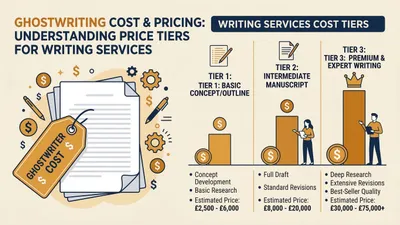
Rates vary widely by experience and book type. The Editorial Freelancers Association rate survey is the most reliable public benchmark, and our ghostwriter cost guide breaks down what different tiers actually charge.
Two contract clauses matter more than the price: copyright assignment on final payment and a kill fee defining what’s owed if either side walks. Both belong in writing before work starts — see our ghostwriter contract template and ghostwriter NDA template.
How Does a Ghostwriting Royalty Split Work?
A ghostwriting royalty split gives the writer a percentage of book earnings instead of, or in addition to, a flat fee — commonly 5% to 25% of net royalties, with lower flat fees attached to higher royalty shares. Pure royalty deals are rare and usually signal a writer who can’t fill their schedule.
Three structures you’ll encounter:
- Flat fee, no royalties (most common). You pay in full, you own everything, the writer walks away with no ongoing claim.
- Reduced fee plus royalty share. Lowers your upfront cost by 20–40% in exchange for 10–25% of net earnings. Sensible only if you have a real distribution platform.
- Pure royalty split. No money changes hands upfront. Attractive when cash is tight, but the writer has every incentive to prioritize paying clients.
If you agree to any royalty share, define net precisely — after which costs, on which formats, reported how often, auditable by whom. Vague royalty language is the single most litigated clause in ghostwriting agreements.
Credit works separately from money. “As told to,” “with,” a foreword acknowledgment, or complete anonymity are all normal; decide which before signing, because renegotiating credit after a book is written is unpleasant for everyone. Jane Friedman’s overview of hiring a ghostwriter covers the credit conventions across trade publishing.
How Long Does Working With a Ghostwriter Take?
Working with a ghostwriter takes four to twelve months for a full-length book, with 60,000–80,000-word nonfiction typically landing at six to nine months. Speed depends far more on your responsiveness than on the writer’s typing.
| Phase | Typical duration | Your time commitment |
|---|---|---|
| Kickoff and voice kit | 1–2 weeks | 4–6 hours |
| Interviews | 6–10 weeks | 20–30 hours |
| Outline and approval | 2–4 weeks | 5–8 hours |
| Drafting | 8–20 weeks | 5–10 hours (follow-ups) |
| Revision rounds | 6–12 weeks | 15–25 hours |
| Final polish | 2–4 weeks | 3–5 hours |
Budget 50 to 70 hours of your own time. Anyone promising a hands-off book in six weeks is selling you a template with your name on it.
For comparison with writing it yourself, see how long does it take to write a book.
Tools and Alternatives Worth Knowing About
Not every book needs a $40,000 collaborator. Here’s where each option fits.
Our Pick — Chapter
Chapter runs the same interview-outline-draft-revise workflow a ghostwriter uses, except you drive it. You answer structured prompts about your expertise and stories, and Chapter turns them into a full manuscript in your voice — with you making the editorial calls at every stage. Over **10,000 authors have used Chapter to create books, and the platform has been featured in USA Today and the New York Times. Client results include $13,200 from a single book and $60K in 48 hours from a launch.
Best for: Experts and business owners who have the material and the opinions but not $40,000 or 30 hours of interview time Pricing: $97 one time, 2 books included (fiction or nonfiction), 30-day money-back guarantee Why we built it: Because the ghostwriting bottleneck was never the writing — it was the cost of a human transcribing your thinking at $500 an hour
Other paths worth weighing honestly:
- Traditional ghostwriter ($20K–$150K). Still the best option for complex memoirs, sensitive material, and books where a human collaborator’s judgment about what to leave out is the whole value. Compare providers in best ghostwriting services.
- Hybrid: AI draft plus human editor ($3K–$8K). Draft with software, then hire a developmental editor to raise the ceiling. This is the fastest-growing middle path.
- Book coach ($2K–$10K). You write; they guide structure and accountability. Best when you want the authorship experience.
If you’re weighing the AI route specifically, AI ghostwriter covers what these tools do and don’t handle well, and ghostwriting a nonfiction book walks through the traditional process in more depth.
Common Mistakes to Avoid When Working With a Ghostwriter
- Going silent during drafting. Your ghostwriter will hit ambiguities in week three. If you answer in week nine, nine weeks of work were built on a guess.
- Giving feedback as rewrites. You’ll fracture the voice you’re paying to maintain.
- Changing the book’s purpose mid-project. Pivoting from lead-gen book to memoir after the outline is approved is a new project, and any reputable writer will price it as one.
- Skipping the paid sample chapter. It costs a fraction of the project and catches voice mismatch when it’s still cheap.
- Treating interviews as an interruption. Interview quality sets the ceiling on manuscript quality. Nothing downstream fixes thin source material.
- Leaving credit and copyright unwritten. Handshake terms turn into disputes exactly when a book starts succeeding.
Do You Still Own the Book if Someone Else Writes It?
You still own the book if someone else writes it, provided your contract includes a written copyright assignment or work-for-hire clause transferring all rights to you on final payment. Without that clause in writing, the ghostwriter is the default copyright holder under US law.
Confirm three things in the agreement: full assignment of copyright, the writer’s waiver of any claim to credit beyond what you’ve agreed, and their right (or lack of it) to name the project in a portfolio. The Association of Ghostwriters maintains standards its members work under, which is a useful reference point when reviewing terms.
FAQ
How involved do I need to be when working with a ghostwriter?
You need to be involved for 50 to 70 hours across the project — roughly 20–30 hours of recorded interviews, plus outline review, chapter feedback, and milestone approvals. Ghostwriting is a collaboration, and author responsiveness is the biggest single factor in whether a book ships on schedule.
What should I send my ghostwriter before we start?
Send your ghostwriter a voice sample kit: emails you’ve written, recordings of talks or podcasts, your own blog posts, slide decks, three books you admire, and a list of words you never use. These artifacts let the writer reverse-engineer your voice instead of guessing at it.
How many revision rounds should a ghostwriting contract include?
A ghostwriting contract should include two to three revision rounds, each taking two to three weeks. Rounds beyond that are usually billable at an hourly rate. Give feedback in separate structural, substantive, and line-level passes so each round produces maximum change.
Can I fire a ghostwriter mid-project?
You can fire a ghostwriter mid-project if your contract includes a kill fee or termination clause specifying what’s owed and who owns the partial work. Without one, you risk paying for material you can’t legally use. Settle copyright of partial drafts before signing, not after a dispute.
Is it cheaper to use AI instead of a ghostwriter?
Using AI is dramatically cheaper than a ghostwriter — $97 for a tool like Chapter versus $20,000 to $150,000 for a professional. The trade-off is your own time: AI removes the writing labor but not the thinking, the story selection, or the editorial judgment that make a book worth reading.
Sources: Gotham Ghostwriters, Jane Friedman, Professional Ghost, Trade Press Services, Editorial Freelancers Association, Association of Ghostwriters, Writer Beware.