You can write a best man speech that makes the room laugh, gets the bride’s mom crying, and ends with every glass raised — even if public speaking terrifies you.
In this guide, you’ll learn:
- The proven structure that keeps your speech focused and flowing
- How to balance humor with genuine emotion (without being cringe)
- Exactly how long your speech should be and why most people go too long
- Delivery tricks that calm your nerves and command the room
Here’s the step-by-step process.
What Makes a Best Man Speech Great?
A great best man speech is one that makes the groom feel seen, makes the couple feel celebrated, and makes the audience feel like they just witnessed something real. It balances humor with heart, stays under five minutes, and ends with a toast that puts a lump in every throat.
The secret? Great best man speeches follow a structure. They’re not improvised rambles fueled by champagne courage. Around 75% of people experience anxiety about public speaking, but the ones who nail it aren’t naturally gifted — they’re prepared.
Your speech doesn’t need to be perfect. It needs to be honest, organized, and practiced. That’s it.
Step 1: Start Writing Early (At Least 6 Weeks Out)
The biggest mistake best men make is waiting until the week before the wedding. Start writing at least six weeks out — ideally two months.
Keep a running note on your phone. When a memory surfaces, jot it down. When the groom says something funny, save it. The best material comes from everyday moments, not from staring at a blank page the night before.
Starting early also gives you time to test your speech. Read it to a trusted friend. Sleep on it. Cut what doesn’t work. The writing process rewards patience, not speed.
Step 2: Pick Your Core Message
Every great speech has one central idea. Not three. Not five. One.
Ask yourself: what’s the one thing you want the room to know about the groom — or about the groom and his partner together? Maybe it’s his loyalty. Maybe it’s how he completely changed when he met her. Maybe it’s that he’s the most stubborn person alive and she’s the only one who can get through to him. Public speaking coaches call this your “through-line” — the thread that ties every story and joke together.
Write that one sentence down. Everything else in your speech should support it. If a joke or story doesn’t connect back to your core message, cut it — no matter how funny it is.
Step 3: Use the Proven Best Man Speech Structure
The best speeches follow a simple four-part framework. You don’t need to reinvent anything — just fill in each section with your own stories.
Part 1: Introduction (30 seconds)
Tell the audience who you are and how you know the groom. Keep it brief. One or two sentences max.
Don’t open with “For those who don’t know me…” — everyone does that. Instead, try opening with a quick line that sets the right tone. A self-deprecating joke works well here, or a one-liner about how you got the job.
Part 2: Stories About the Groom (60–90 seconds)
Share one or two short stories that reveal the groom’s character. These should be entertaining but not humiliating. The goal is to paint a picture of who he is for the people in the room who may not know him well.
Good story formula: set the scene in one sentence, describe what happened in two or three sentences, land the punchline or emotional beat, then connect it to your core message.
The best personal narratives are specific. “He’s a great guy” means nothing. “He drove four hours in a snowstorm to help me move a couch” means everything.
Part 3: The Couple’s Story (60–90 seconds)
Transition from the groom to the couple. Talk about when you first noticed something was different. How did he talk about her? When did you realize this was serious?
If you can, share a specific moment when you saw the groom at his best because of his partner. This is where the emotional weight of your speech lives.
Mention the bride directly. Too many best man speeches are 100% about the groom. Acknowledge what she brings out in him. Welcome her into the circle.
Part 4: The Toast (15–30 seconds)
End with a genuine wish for their future. Keep it short — two or three sentences. Then raise your glass and ask the room to join you.
Don’t end with a quote you found on Google five minutes ago. End with something real. What do you genuinely hope for them?
How Long Should a Best Man Speech Be?
The ideal best man speech is 3 to 5 minutes long — roughly 500 to 750 words. Most people speak at about 140 words per minute, so a 600-word speech gives you right around four minutes with natural pauses.
Here’s why length matters: a survey from The Knot found that overly long speeches rank as one of the most awkward wedding moments for guests. Your audience is hungry, they want to dance, and they’ve already sat through a ceremony.
| Speech Length | Word Count | Verdict |
|---|---|---|
| Under 2 minutes | Under 300 words | Too short — feels like you phoned it in |
| 3–5 minutes | 400–750 words | Sweet spot — substantial but respectful |
| 5–7 minutes | 750–1,000 words | Pushing it — only if every word earns its place |
| Over 7 minutes | Over 1,000 words | Too long — you’ve lost the room |
When in doubt, cut. A tight three-minute speech always beats a rambling seven-minute one.
How to Be Funny Without Being Cringe
Humor is the hardest part of a best man speech. Here’s how to get it right.
Use specific details. “He did something embarrassing in college” isn’t funny. The specific, bizarre detail is what makes people laugh. Use vivid storytelling techniques to bring moments to life.
Alternate between funny and sincere. The best speeches oscillate. Get them laughing, then get them feeling. Get them laughing again, then hit them with something genuine. This rhythm keeps the audience engaged and gives each beat more impact.
Avoid these topics entirely:
- Exes (the groom’s or the bride’s)
- Anything sexual or explicit
- Inside jokes that only two people understand
- Anything the bride’s grandmother would find uncomfortable
- Stories that make the groom look genuinely bad (not endearingly flawed — actually bad)
Test your jokes. Tell them to two or three people before the wedding. If nobody laughs, the joke isn’t landing. Cut it.
The best humor in a best man speech comes from truth told with affection. Subtle rhetorical devices like callbacks, repetition, and the rule of three can sharpen your delivery. You’re not doing a stand-up set. You’re roasting someone you love in front of everyone who also loves him.
How to Handle Nerves and Deliver With Confidence
Nerves are normal. About 90% of speech anxiety comes from lack of preparation, not from some fundamental inability to speak in public. If you prepare well, the nerves become manageable.
Practice out loud at least five times. Not in your head — out loud, standing up, at full volume. Time yourself. Practicing this way builds muscle memory so your mouth knows where to go even when your brain is panicking. If you struggle to get started, the same strategies that help overcome writer’s block apply to speech prep.
Use note cards, not a phone. A phone screen goes dark. You lose your place scrolling. Note cards with bullet points (not full sentences) keep you on track while forcing you to speak naturally instead of reading.
Speak to individuals, not the crowd. Pick three or four friendly faces at different tables. Make eye contact with one person for a sentence or two, then move to the next. This makes you feel like you’re having a conversation instead of performing.
Slow down. Nerves make you speed up. Speech coaches at Gentleman’s Gazette recommend speaking consciously slower than feels natural. Pauses aren’t awkward — they’re powerful. A beat of silence after a punchline or emotional moment gives the audience time to react.
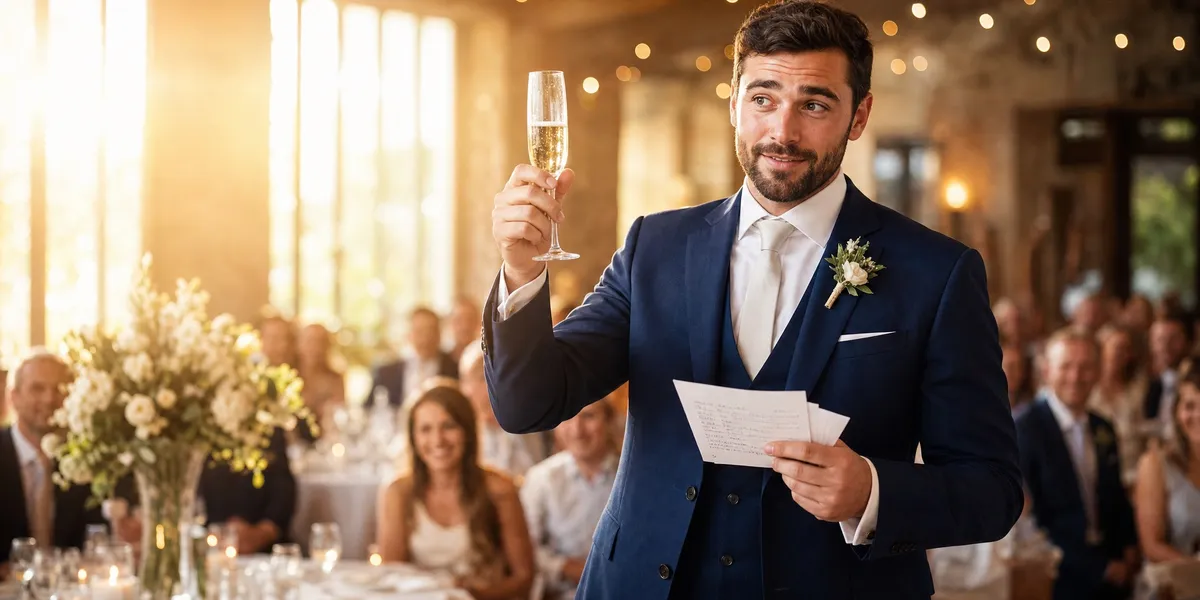
Hold something. A champagne glass in one hand and note cards in the other gives your hands a job. No fidgeting, no awkward pocket hands, no death grip on the microphone.
What to Do the Day Of
Your speech is written, practiced, and ready. Here’s how to handle the day itself.
Eat something. An empty stomach plus champagne plus adrenaline equals disaster. Wedding planners consistently recommend eating a real meal before the reception starts.
Limit your drinks. One drink to take the edge off is fine. Three drinks before your speech is a recipe for slurred words and forgotten stories. Save the celebration for after you’ve spoken.
Find out when you’re speaking. Talk to the wedding coordinator or DJ. Know exactly when your moment comes so you’re not blindsided. Usually it’s after the meal, before dancing starts.
Have a backup. Give a copy of your speech to a trusted friend or keep a photo of your note cards on your phone. If you lose your cards, you have a safety net.
Best Man Speech Opening Lines That Actually Work
Your opening line sets the tone for everything that follows. Skip the generic intros and try one of these approaches.
The honest admission: “I’ve been dreading this moment for six months, so if my voice shakes, just know it’s because I care too much, not too little.”
The callback: “When Jake asked me to be his best man, I said yes immediately. Then I Googled ‘how to write a best man speech’ and almost called him back.”
The quick story: “The first time I met Jake, he was wearing a Hawaiian shirt to a job interview. That tells you everything you need to know about him.”
The redirect: “I was told to keep this short and not embarrass the groom. So I’ll do one of those things.”
Each of these works because it’s specific, sets an expectation, and gets the audience leaning in. Avoid starting with “Hi, I’m [name], and I’ve known [groom] for [number] years.” It’s technically correct, but it’s the speech equivalent of a form letter.
Common Mistakes to Avoid
- Going too long. If you’re over five minutes, you’re probably over. Cut mercilessly.
- Making it about you. Your stories should reveal the groom’s character, not showcase your adventures.
- Reading word for word. A speech read from a phone screen sounds like a robot. Use bullet points and speak naturally.
- Forgetting the bride. This is a wedding speech, not a birthday toast. Mention her. Celebrate what she means to him.
- Winging it. “I’ll just speak from the heart” is code for “I didn’t prepare.” The heart speaks better when it’s rehearsed.
- Starting with apologies. “Sorry, I’m not great at speeches” makes the audience brace for something bad. Skip it.
Can AI Help You Write a Best Man Speech?
Yes — and it’s more useful than you might think. AI writing tools can help you brainstorm stories, organize your structure, find the right words for emotional moments, and tighten your language.
Our Pick — Chapter
Chapter helps you draft and refine personal writing projects — including speeches, memoirs, and personal essays. Feed it your notes and stories, and it helps you shape them into polished prose that still sounds like you.
Best for: Turning scattered notes and memories into a structured, polished speech draft
Why it works: The hardest part of writing a best man speech isn’t knowing what to say — it’s organizing your thoughts and finding the right words. AI writing tools handle the structural work so you can focus on the personal touches that make your speech yours.
That said, never deliver an AI-generated speech without heavy editing. Your speech needs to sound like you, not like a template. Use AI as a starting point, then rewrite every line until it feels authentic.
Best Man Speech Template (Copy and Customize)
If you want a ready-made framework, here’s one you can adapt:
Opening (2–3 sentences): Introduce yourself. Set the tone with a light joke or honest moment.
Groom story #1 (3–4 sentences): A funny or revealing story that shows who he is. Land a punchline or insight.
Groom story #2, optional (2–3 sentences): A second quick story or callback that reinforces the first.
The transition (1–2 sentences): Shift from humor to sincerity. “But seriously…” works if delivered naturally.
The couple (3–4 sentences): When you knew this was different. What she brings out in him. Welcome her.
The toast (2–3 sentences): A genuine wish. Raise your glass. Keep it real.
Total: roughly 500–700 words. Time it at about 3.5 to 5 minutes.
How to Write a Best Man Speech for Your Brother
Writing a best man speech for a sibling adds a layer of complexity. You share a history that goes back to childhood, and the temptation to over-share is real.
Focus on one or two stories that capture your relationship. Childhood memories work well here — but pick ones that show growth, not just embarrassment. The audience wants to see the arc from the kid you grew up with to the person standing at the altar.
Acknowledge the shift. Saying something like “I’ve gone from sharing a bedroom with him to sharing him with someone who actually chose to live with him” lands because it’s honest and affectionate.
Writing about people you’re close to is harder than writing about acquaintances. You know too much. The skill is in choosing what to include, not in finding things to say.
How to Write a Best Man Speech When You Don’t Know the Bride Well
You don’t need to know the bride deeply to give a great speech. You just need to pay attention.
Talk to the groom. Ask him: “What’s something about her that surprised you?” or “When did you know she was the one?” His answers become your material.
Talk to the bride’s friends or family if you can. Even a five-minute conversation gives you an anecdote or detail that makes your speech feel inclusive.
If you truly don’t know her well, be honest about it — then pivot to what you do know: how the groom talks about her, how he’s changed since meeting her, what you’ve observed from the outside looking in.
How to End a Best Man Speech
The ending of your best man speech is the moment everyone remembers. A weak ending deflates everything that came before. A strong one sends the whole room to their feet.
The best endings do three things: return to the core message, express a genuine wish, and invite the room to participate.
Return to your theme. If your speech was about the groom’s loyalty, end by saying you know he’ll bring that same loyalty to his marriage. If it was about how the bride transformed him, end by toasting the person she helped him become.
Keep the final wish specific. “I wish you both happiness” is generic. “I hope you build a home as loud and chaotic and full of love as the one you both grew up wanting” is specific and memorable.
Then raise your glass. Say “To [bride] and [groom].” That’s it. Don’t add more. Let the room do the rest.
FAQ
How long should a best man speech be?
A best man speech should be 3 to 5 minutes long, which is roughly 500 to 750 words. This length gives you enough time to share a meaningful story, acknowledge the couple, and deliver a toast without losing the audience’s attention. When in doubt, shorter is always better than longer.
What should you not say in a best man speech?
You should never mention exes, sexual stories, or anything that would embarrass the bride’s family. Avoid inside jokes that exclude the audience, excessive drinking stories, and anything that makes the groom look genuinely bad rather than endearingly flawed. Keep it clean enough for grandma.
Can you use AI to write a best man speech?
Yes, you can use AI writing tools like Chapter to help draft and structure a best man speech. AI is excellent for organizing your thoughts, suggesting transitions, and tightening your language. However, you should always rewrite the output in your own voice — authenticity is what makes a speech land.
Should you memorize a best man speech?
You don’t need to memorize your best man speech word for word. Instead, use note cards with bullet points that keep you on track while allowing natural delivery. Memorizing creates pressure to get every word right, which increases anxiety. Bullet points let you speak conversationally while hitting all your key moments.
When does the best man give his speech at a wedding?
The best man typically gives his speech during the reception, after the meal and before dancing begins. Check with the wedding coordinator or DJ for the exact timing. Being prepared for when your moment comes reduces anxiety and helps you deliver with confidence.