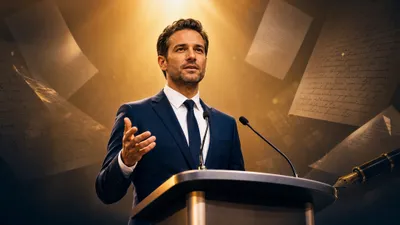
You can write a graduation speech that moves an entire auditorium — even if you’ve never spoken in front of more than five people.
In this guide, you’ll learn:
- The proven structure that keeps your speech focused and memorable
- How to open strong and close even stronger
- The storytelling techniques that turn a generic address into something people actually remember
- Exactly how long your speech should be and how to practice it
Here’s the step-by-step process.
What Makes a Graduation Speech Great?
A great graduation speech is one that makes your classmates feel seen, makes the audience feel something real, and gives everyone a single idea worth carrying forward. It balances honesty with optimism, stays under ten minutes, and ends with a line people repeat in the parking lot.
The best commencement addresses share three qualities. They reflect on shared experiences — not just the speaker’s resume. They offer one genuine insight instead of a dozen borrowed quotes. And they sound like a real person talking, not a term paper read aloud.
According to Carnegie Mellon University’s commencement speaker guide, the hardest part of a graduation speech is speaking to a diverse audience while keeping your own voice. The speakers who succeed don’t try to say everything — they say one thing well.
How to Write a Graduation Speech Step by Step
Step 1: Choose One Core Theme
Every memorable graduation speech has a single through-line — one idea that ties everything together. Not three lessons. Not five inspirational quotes. One honest truth you believe.
Ask yourself: what’s the one thing you want your classmates to remember five years from now? Maybe it’s that failure taught your class more than any textbook. Maybe it’s that the friends you made matter more than the GPA you earned. Maybe it’s that nobody actually knows what they’re doing after graduation — and that’s okay.
Write that one sentence down. This is your anchor. Every story, joke, and reflection in your speech should connect back to it. If something doesn’t support your theme — no matter how clever it is — cut it.
This is the same principle behind writing a strong hook for any piece of writing. You need a clear central idea before you write a single word.
Step 2: Brainstorm Your Best Material
Before you outline anything, spend a few days collecting raw material. Keep a note on your phone and jot down ideas as they come.
What to brainstorm:
- Shared memories your class would instantly recognize (the fire alarm during finals, the teacher everyone loved, the cafeteria incident nobody talks about)
- A personal story that changed how you see things
- One moment that captures what your school or class is really about
- A surprising lesson you didn’t expect to learn
- Something funny that actually happened — not a joke you found online
The best material comes from real life, not from googling famous graduation speeches. Research from the University of Arkansas confirms that audiences connect most with speeches grounded in specific, authentic experiences rather than generic inspirational language.
Talk to your classmates too. Ask what they’ll remember most. Ask what made this class different. Your speech represents everyone, not just you.
Step 3: Use the Proven Graduation Speech Structure
Most graduation speech anxiety comes from staring at a blank page with no framework. Use this tested three-part structure to organize everything you brainstormed.
Part 1: Opening (60-90 seconds) Open with something that earns attention. A specific story. A surprising observation. A moment of humor that’s real, not rehearsed. Your opening sets the tone for everything that follows.
What works: a brief personal anecdote, a unexpected question, a vivid detail from a shared experience.
What doesn’t: dictionary definitions, obvious observations like “today is a special day,” or opening with “when I was asked to give this speech.” These are graduation speech clichés that signal to your audience they’re about to hear something forgettable.
Part 2: Body — Reflection + Insight (4-6 minutes) This is where your theme comes alive. Share 2-3 stories or observations that build toward your central idea. Use the framework: gratitude, reflection, inspiration.
- Gratitude: Acknowledge the people who got everyone here — teachers, parents, friends, custodians, whoever genuinely mattered. Be specific, not generic.
- Reflection: Look back at the journey. What changed? What surprised you? What did your class survive together?
- Inspiration: Look forward. Connect your theme to what comes next. Not with empty platitudes — with honest acknowledgment that the future is uncertain and that’s part of the adventure.
Each story should be short (60-90 seconds when spoken) and concrete. One vivid detail beats three paragraphs of vague inspiration.
Part 3: Closing (60-90 seconds) Your closing is what people remember. Return to your theme. State it clearly. End with a line that lands — a callback to your opening story, a challenge to your classmates, or a simple truth delivered with conviction.
Don’t introduce new ideas in the closing. Don’t trail off with “so, yeah, congratulations everyone.” Build to your final sentence like it’s the last note of a song.
Step 4: Write Your First Draft
With your structure in place, write the full draft in one sitting. Don’t edit as you go — just get everything down. You’ll refine later.
Writing tips for speeches:
- Write how you talk, not how you write essays. Read every sentence aloud as you draft it. If it sounds stiff, rewrite it until it sounds like you.
- Use short sentences. They’re easier to deliver and easier to absorb.
- Use “we” and “us” more than “I.” You’re speaking for your class, not giving a TED talk about yourself.
- Avoid abstract language. Instead of “we overcame adversity,” say “we survived three principals in four years and still showed up every day.”
If you’re working on other writing projects alongside your speech — like a personal narrative or memoir — the same principle applies. Concrete details always beat abstract generalizations.
Step 5: Edit Ruthlessly
The difference between a good speech and a great one is editing. Your first draft will be too long, too scattered, and too safe. That’s normal.
Editing checklist:
- Does every section connect to your one core theme? If not, cut it.
- Is any section longer than 90 seconds? Trim it.
- Are you using filler phrases like “I think,” “kind of,” or “you know”? Remove them.
- Does your opening grab attention in the first 10 seconds?
- Does your closing land with impact?
- Is the total length between 750 and 1,500 words (5-10 minutes spoken)?
Cut anything that feels like padding. Strong narrative structure means every element serves the story. If a joke doesn’t support your theme, save it for the after-party.
Step 6: Practice Like You Mean It
Practicing your speech isn’t optional. It’s the difference between delivering a speech and reading one.
How to practice effectively:
- Read aloud at least five times. Time yourself each run. You’ll naturally speed up when nervous, so aim for a practice time slightly under your target.
- Practice in front of real people. Give the speech to a friend, a family member, or your dog. Get feedback on what lands and what doesn’t.
- Record yourself. Watch the recording. Notice where you rush, where you mumble, and where you lose energy.
- Practice on the actual stage if you can. Familiarity with the space reduces anxiety dramatically.
- Don’t memorize word-for-word. Memorize your structure and key phrases. You want to sound natural, not robotic. Bring note cards with bullet points as a safety net.
Research on public speaking consistently shows that preparation is the strongest predictor of speech quality — more than natural talent, charisma, or vocabulary.
How Long Should a Graduation Speech Be?
A graduation speech should be between 5 and 10 minutes long, which translates to roughly 750 to 1,500 words. Most expert sources and commencement guides recommend staying closer to the shorter end of that range.
Here’s a quick reference:
| Speech Type | Length | Word Count |
|---|---|---|
| Student speaker / Valedictorian | 5-7 minutes | 750-1,050 words |
| Guest commencement speaker | 8-15 minutes | 1,200-2,250 words |
| Class president / salutatorian | 3-5 minutes | 450-750 words |
Speak at roughly 150 words per minute and leave room for pauses, laughter, and applause. If your practice run hits 12 minutes, you need to cut — audiences remember short, punchy speeches far better than long, wandering ones.
Graduation Speech Opening Lines That Actually Work
Your opening line determines whether your audience leans in or checks their phones. Here are formats that work — adapt them to your own story.
The specific memory: Start with a vivid moment your class shares. Not “these four years went by fast” — instead, describe the exact moment something unforgettable happened.
The honest admission: Acknowledge the elephant in the room. “I’ve rewritten this speech eleven times, and I’m still not sure I have anything useful to say” is more engaging than any inspirational quote.
The unexpected question: Ask something that makes people think. “How many of you have any idea what you’re doing next year?” gets a bigger reaction than “today marks the beginning of the rest of our lives.”
The callback to a shared joke: If your class has an inside joke or a running bit, opening with a reference to it instantly creates connection. Just make sure it’s something the broader audience can follow.
Avoid opening with famous quotes. You’re the speaker — the audience wants to hear what you have to say. If you must reference someone else’s words, put it in the middle of a story, not at the very start.
For more on crafting openings that command attention, check out our guide on how to write a hook.
How to Write a Valedictorian Speech
A valedictorian speech follows the same structure as any graduation speech but carries an extra responsibility — you’re speaking as the academic representative of your entire class, not just as yourself.
The biggest mistake valedictorians make is turning the speech into a highlight reel of personal achievements. Your classmates don’t want to hear about your GPA. They want to hear about the experience you all shared.
Key differences for valedictorian speeches:
- Focus on “we” language. You earned the podium, but the speech belongs to everyone.
- Keep it shorter than you think — 5 to 7 minutes is the sweet spot for student speakers.
- One personal story is enough. The rest should reflect shared experiences.
- Acknowledge that academic achievement isn’t the only kind of success. Many paths lead forward from graduation.
The National Society of High School Scholars recommends talking to classmates before writing. Ask them what they’ll remember. Ask what mattered most. Then weave those answers into your speech.
How to Write a Commencement Address as a Guest Speaker
If you’ve been invited to deliver a commencement address as a guest speaker — a parent, community member, or professional — the rules shift slightly.
Your job is different. Students speak from shared experience. Guest speakers offer perspective from outside. Your value is in connecting your life experience to their moment.
How to approach it:
- Research the school. Learn their traditions, their challenges, their recent wins. Referencing specific details shows respect and creates instant connection.
- Tell stories from your own life that illustrate a relevant lesson. The best guest speeches use the frame narrative technique — a personal story that opens, gets interrupted by the lesson, and resolves at the close.
- Avoid lecturing. You’re not their teacher. You’re a guest at their celebration.
- Keep it under 15 minutes. Anything longer and you’re the obstacle between graduates and their celebration dinner.
The most memorable commencement addresses — Steve Jobs at Stanford, Oprah Winfrey at Harvard — succeed because they share genuine vulnerability, not polished wisdom.
Common Mistakes to Avoid in Your Graduation Speech
- Starting too late. Begin writing at least 3-4 weeks before the ceremony. Last-minute speeches sound like last-minute speeches.
- Trying to cover everything. One theme, well-developed, beats five themes crammed together.
- Using clichés as crutches. “The future is yours” and “follow your dreams” are filler. Say something specific to your class.
- Making it about you. Even the valedictorian speech isn’t a personal victory lap. Center the class.
- Reading from a script. Use note cards with bullet points. Eye contact matters more than perfect wording.
- Forgetting to say thank you. Genuine gratitude — to specific teachers, parents, friends — always resonates.
- Going too long. When in doubt, cut. Nobody has ever complained that a graduation speech was too short.
Can AI Help You Write a Graduation Speech?
Yes — AI can be a useful brainstorming and editing partner for your graduation speech. Tools like Chapter can help you organize your ideas, generate outlines, and refine your draft.
Our Pick — Chapter
Chapter’s AI writing assistant helps you structure your thoughts, draft sections, and polish your language — while keeping your authentic voice front and center.
Best for: Organizing your speech structure and refining your draft Pricing: $97 one-time (nonfiction) Why we built it: Great writing starts with clear structure — whether it’s a book or a five-minute speech.
That said, the most important parts of a graduation speech — your personal stories, your specific memories, your honest reflections — have to come from you. Use AI to organize and polish. Don’t use it to replace your voice.
If you’re interested in how AI can support your writing process more broadly, explore our guides on AI writing for beginners and how to edit AI-generated text. And if you’ve got another speech coming up — like a wedding — check out our guide on how to write a best man speech.
Graduation Speech Examples to Study
You don’t need to reinvent the format. Study what works, then make it your own.
The “Three Stories” approach (Steve Jobs, Stanford 2005): Jobs told three short stories from his life, each carrying a single lesson. The structure was simple, personal, and memorable. You can use the same framework — pick 2-3 moments and connect them with your theme.
The “Honest Admission” approach (Conan O’Brien, Dartmouth 2011): O’Brien opened with self-deprecating humor, got serious about failure and reinvention, and ended with genuine optimism. The contrast between humor and sincerity made the message stick.
The “Challenge” approach (David Foster Wallace, Kenyon 2005): Wallace challenged graduates to think differently about daily life. Instead of offering comfort, he offered a difficult truth — and the audience leaned in because it was real.
What these speeches share: authenticity, a clear theme, concrete stories, and the courage to say something the audience wasn’t expecting. The same narrative techniques that make great books also make great speeches.
FAQ
How do you start a graduation speech?
You start a graduation speech with a specific personal story, an honest admission, an unexpected question, or a reference to a shared class experience. Avoid opening with dictionary definitions, famous quotes, or obvious statements like “today is a special day.” Your first sentence should make the audience want to hear your second sentence.
How many words is a 5-minute graduation speech?
A 5-minute graduation speech is approximately 750 words when spoken at a natural pace of 150 words per minute. Leave room for pauses, audience reactions, and moments of emphasis. Practice with a timer to confirm your actual delivery speed, since most speakers talk faster when nervous.
What is the format of a graduation speech?
The format of a graduation speech follows a three-part structure: an attention-grabbing opening (60-90 seconds), a body built around 2-3 stories supporting one central theme (4-6 minutes), and a memorable closing that returns to the theme (60-90 seconds). The body typically moves through gratitude, reflection, and inspiration.
Can you use humor in a graduation speech?
Yes — humor in a graduation speech works best when it comes from real shared experiences rather than rehearsed jokes. Reference funny moments your class actually lived through. Self-deprecating humor builds connection. Avoid inside jokes that only five people understand, and never use humor that punches down at classmates, teachers, or staff.
Should you memorize your graduation speech?
You should not memorize your graduation speech word for word. Instead, memorize your structure and key phrases, then speak naturally. Bring note cards with bullet points as a safety net. Fully memorized speeches sound robotic, and if you forget a line mid-delivery, you’ll panic. Knowing your structure means you can recover gracefully.