You can write a cold case novel that hooks readers from the first unearthed clue — if you nail the dual-timeline structure and plant your evidence trail with care.
In this guide, you’ll learn:
- How to structure a cold case story with past and present timelines
- The evidence-management system that keeps your clues honest
- How to write police procedural scenes that feel authentic without drowning in jargon
- Where to plant reveals so your pacing never stalls
Here’s the step-by-step process for building a cold case novel that keeps readers turning pages.
What Is a Cold Case Novel?
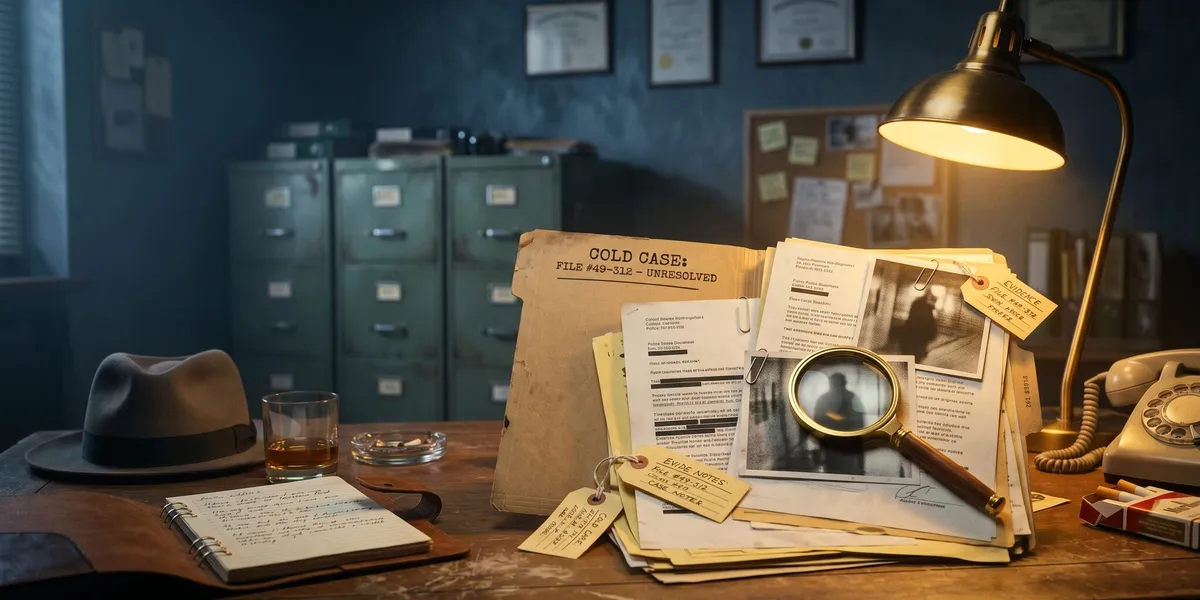
Cold case novel — A mystery or crime fiction novel centered on an unsolved crime from the past that gets reopened in the present, typically featuring dual timelines and a protagonist who must piece together fragmentary, degraded, or suppressed evidence.
Cold case novels sit at the intersection of mystery, thriller, and historical fiction. Unlike a traditional whodunit where the crime happens on page one and the detective chases a hot trail, your protagonist inherits a cold trail. Witnesses have died. Evidence has degraded. Memories have warped. The Mystery Writers of America classifies cold case fiction as one of the fastest-growing mystery subcategories.
That’s what makes the subgenre so compelling. Your detective isn’t racing against a killer — they’re racing against time itself.
How to Choose Your Cold Case Premise
Every cold case novel starts with two questions: what happened back then, and why does it matter now?
The “why now” trigger is the engine of your entire story. Something has to force the case open again. A deathbed confession. New forensic technology. A copycat crime. A body discovered during construction. Without a strong reopening trigger, your protagonist’s investigation feels arbitrary.
Pick a trigger that connects your past and present timelines emotionally, not just procedurally. If a daughter discovers her mother was a suspect in a 1985 murder, the emotional stakes are built into the premise.
Building Your Case File Before You Write
Create a physical or digital case file before you draft a single chapter. Include:
- The original crime: What happened, when, where, who was involved
- The original investigation: What did police do? What did they miss?
- The evidence inventory: Physical evidence, witness statements, forensic reports
- The decay timeline: What evidence still exists versus what’s been lost or corrupted
- The reopening trigger: Why this case, why now
This case file becomes your plotting bible. Every reveal in your novel pulls from this document. Every planted clue connects back to it.
How to Structure a Cold Case Novel With Dual Timelines
The dual-timeline structure is what separates cold case novels from standard mysteries. You’re telling two stories simultaneously: the original crime and the present-day investigation.
Most writers default to alternating chapters — Chapter 1 is present, Chapter 2 is past, repeat. That mechanical approach works, but the best cold case novels vary the rhythm. Sometimes you need three present-day chapters in a row to build investigative momentum. Sometimes a long past-timeline section reveals the emotional truth behind a key witness’s silence.
Three Structural Approaches
The Investigation-Led Structure: The present-day investigation drives the story. Past-timeline sections appear only when the detective uncovers something that triggers a flashback or historical scene. This keeps the reader anchored in the present and makes each past-timeline scene feel earned.
The Parallel Structure: Past and present timelines get roughly equal weight. Each timeline has its own rising action and climax. The connections between them become the story’s central puzzle.
The Convergence Structure: Timelines start far apart and gradually merge. Early chapters show wide separation between past and present. By the final act, the timelines practically overlap as the truth emerges.
Choose your structure based on where your story’s emotional center lives. If the present-day detective’s personal stakes drive the story, go investigation-led. If the original crime is equally compelling, go parallel.
How to Manage Evidence Across Two Timelines
Evidence management is where cold case novels succeed or fail. Your reader needs to track what the past-timeline characters knew, what the original investigators found, what got lost over the years, and what your present-day detective uncovers.
Build an evidence spreadsheet with these columns:
| Evidence Item | Known in Past? | In Original Case File? | Survived to Present? | When Discovered by Protagonist | Chapter Revealed |
|---|---|---|---|---|---|
| Bloody glove | Yes | No — hidden by suspect | Yes — found in wall during renovation | Chapter 12 | Chapter 14 |
| Witness testimony (neighbor) | Yes | Yes | Partial — witness has dementia | Chapter 3 | Chapter 8 |
| Security camera footage | Yes | Reviewed but missed detail | Tape degraded | Chapter 18 | Chapter 20 |
This table prevents the most common cold case plotting mistake: having your detective discover evidence that shouldn’t logically still exist, or miss evidence that obviously would have surfaced earlier.
The Evidence Degradation Rule
Real cold cases lose evidence over time. Your novel needs to respect this. According to the National Institute of Justice, physical evidence in cold cases often degrades significantly within the first decade. DNA samples degrade. Witnesses die or develop memory issues. Physical evidence gets contaminated, lost, or destroyed. Case files get misfiled or incomplete.
This isn’t a limitation — it’s a storytelling asset. Every piece of lost evidence creates a gap your detective must fill with deduction, psychology, or creative investigation. Every degraded piece of evidence creates ambiguity that fuels suspense.
How to Write Authentic Police Procedural Scenes
Cold case units operate differently from active homicide squads. Your detective isn’t first on scene at a fresh crime. They’re sitting in a records room, reading faded reports, and making phone calls to reluctant witnesses.
Here’s what cold case investigators actually do:
- Review the original case file — Look for missed leads, untested evidence, investigative errors
- Reinterview witnesses — People who were afraid to talk in 1995 may have different loyalties in 2026
- Submit evidence for modern testing — DNA, fingerprint databases, digital forensics on old media
- Build a timeline — Reconstruct the victim’s last days using fragmentary records
- Identify the original investigator’s blind spots — Personal biases, jurisdictional limits, era-specific limitations
You don’t need to be a former detective to write these scenes convincingly. But you do need to understand the rhythm of cold case work: long stretches of document review punctuated by sudden breakthroughs when a small detail clicks into place.
Avoiding the Procedural Info-Dump
The biggest trap in police procedural writing is stopping the story to explain procedure. Your reader doesn’t need a forensics lecture. They need to see your detective reacting to what the evidence reveals.
Instead of: “She submitted the sample to the state crime lab for polymerase chain reaction testing, which amplifies DNA segments for comparison against the Combined DNA Index System.”
Write: “She packaged the sample and drove it to the state lab herself. CODIS had thirty years of new entries since the original case. If the killer’s DNA was in the system now, she’d have a name by Friday.”
The second version conveys the same information while maintaining narrative momentum and showing rather than telling.
How to Plant Clues and Red Herrings in a Cold Case
Clue planting in a cold case novel requires a different approach than a traditional mystery. Your clues exist in two layers: what happened in the past, and what your detective finds in the present.
The best cold case clues are things that were visible all along but misinterpreted. An original witness statement that seemed irrelevant takes on new meaning when your detective discovers a connection the first investigators missed.
The Three-Layer Clue System
Surface clues: Evidence your detective finds through standard investigation. These move the plot forward and feel earned.
Embedded clues: Details planted in past-timeline scenes that the reader can spot before the detective does. These create the satisfying “I knew it!” moments mystery readers crave.
Misdirection clues: Real evidence that points toward the wrong conclusion. The original investigators followed these leads and hit dead ends — your detective must figure out why they led nowhere and what the evidence actually means.
Red herrings work especially well in cold case novels because time itself creates natural misdirection. A suspect who seemed guilty in 1990 might have a perfect alibi that only becomes verifiable decades later. A witness who lied back then might have been protecting someone who’s now dead.
How to Create a Compelling Cold Case Protagonist
Your cold case detective needs a personal reason to care about a decades-old crime. The case itself provides intellectual motivation, but you need emotional fuel.
Common but effective approaches:
- The personal connection: The detective discovers a link between the cold case and their own family or past
- The career stakes: A detective trying to prove themselves by solving the department’s oldest unsolved case
- The justice obsession: A detective who can’t let go, haunted by victims who never got closure
- The inherited case: A retiring detective passes an unsolved case to a younger investigator as a final request
Whatever you choose, your protagonist’s personal stakes should escalate as they dig deeper. The case should threaten something in their present life — a relationship, their career, their understanding of someone they trusted.
Give your detective a specific investigative skill set. Maybe they’re exceptional at reading old witness statements and catching inconsistencies. Maybe they have a background in forensic genealogy. A well-defined character with specific strengths makes investigation scenes more engaging than a generic “good detective.”
How to Write the Reveal That Pays Off Both Timelines
The climax of a cold case novel must resolve both timelines simultaneously. Your reader has invested in two stories — the crime and the investigation — and both need satisfying conclusions.
The strongest cold case reveals work through convergence. The present-day investigation leads your detective to the exact moment of truth, and the final past-timeline scene shows what actually happened. These two scenes should mirror each other structurally.
Structuring Your Reveal
Step 1: The realization — Your detective connects the final piece. This should feel both surprising and inevitable. The clue that cracks the case was available all along, but its significance only becomes clear with the full context.
Step 2: The confrontation — Your detective faces the truth, which usually means confronting someone who’s had decades to build a life on top of their secret. This creates a different kind of tension than catching an active killer.
Step 3: The past-timeline truth — Show the reader exactly what happened. After an entire novel of fragmentary evidence and competing theories, give them the unfiltered truth.
Step 4: The aftermath — Cold case resolutions rarely bring clean closure. The victim is still dead. Decades have been lost. Families have been destroyed by both the crime and the uncertainty. Let your ending carry that weight.
How to Write a Police Procedural That Feels Real
Writing police procedural elements in your cold case novel means balancing accuracy with readability. You don’t need to replicate every step of real-world cold case investigation — but the steps you include need to ring true.
Research sources that will keep your procedural details honest:
- Court transcripts: Public records show how real investigations unfold and where they break down — PACER provides access to federal case records
- Cold case documentaries: Watch how real investigators describe their process and frustrations
- Retired investigators: Many retired detectives consult with authors or write their own books about methodology
- Forensic science journals: The Forensic Science International journal covers evolving techniques you can reference for timeline accuracy
The gap between past and present forensic capabilities is one of your most powerful plotting tools. DNA profiling didn’t exist before 1985. Genetic genealogy databases became investigative tools around 2018 — the technique that cracked the Golden State Killer case. Cell tower location data wasn’t routinely collected until the early 2000s.
These technological gaps create natural plot structure opportunities. A piece of evidence that was useless in your past timeline could break the case wide open in your present timeline.
Common Mistakes to Avoid in Cold Case Novels
- Timeline confusion: Anchor every scene with clear temporal markers. Your reader should know within the first paragraph whether they’re in 1992 or 2026.
- Impossible evidence survival: Don’t have your detective find a crisp, legible document that’s been sitting in a leaky basement for 30 years. Respect entropy.
- Treating the past timeline as backstory: Your historical scenes need their own dramatic stakes. Characters in the past don’t know they’re in a flashback — they’re living their present.
- Neglecting the present-day story: If your detective’s personal life disappears while they investigate, your reader loses their emotional anchor.
- Solving it too cleanly: Real cold cases involve ambiguity, compromise, and imperfect justice. Let your resolution carry some of that complexity.
How Long Should a Cold Case Novel Be?
A cold case novel typically runs between 75,000 and 95,000 words, which aligns with the standard word counts for mystery and crime fiction. The dual-timeline structure naturally supports this length because you’re telling two interconnected stories.
Shorter cold case novels (65,000-75,000 words) work well when the past-timeline story is simple and the present-day investigation drives everything. Longer entries (90,000-100,000 words) suit complex cases with multiple suspects, extensive character arcs, and rich historical settings.
Don’t pad your word count. If your cold case novel tells its story effectively at 70,000 words, that’s the right length.
Can You Write a Cold Case Novel With AI?
AI writing tools can accelerate specific parts of cold case novel development. Outlining your novel with AI helps you map dual timelines, test different reveal structures, and identify plot holes before you draft.
Our Pick — Chapter
Chapter’s AI writing assistant helps you build complex mystery structures, outline dual timelines, and generate draft scenes that you refine into your own voice. It’s particularly useful for managing the structural complexity of cold case novels, where keeping track of evidence across two timelines challenges even experienced authors.
Best for: Fiction writers who want AI-assisted outlining and drafting with full creative control Pricing: $97 one time, 2 books included (fiction or nonfiction), 30-day money-back guarantee Why we built it: Because structuring a dual-timeline mystery shouldn’t require a wall of sticky notes and a conspiracy board
AI is especially useful for cold case novels when you need to pressure-test your evidence trail. Feed your plot outline to an AI tool and ask it to find logical gaps — moments where your detective should have found a clue earlier, or evidence that couldn’t realistically survive decades.
Cold Case Novel Examples to Study
Read widely in the subgenre before you write. Browse the Goodreads Cold Case shelf for highly rated examples and study how published authors handle the challenges you’ll face:
- Notice how they manage timeline transitions — what signals do they use?
- Track their evidence reveals — when do they give the reader information the detective doesn’t have?
- Pay attention to their pacing — how do they maintain tension across decades?
- Study their endings — how do they resolve both timelines satisfyingly?
Reading cold case novels as a writer, with attention to craft rather than just story, will teach you more than any guide.
FAQ
What Is the Difference Between a Cold Case Novel and a Mystery Novel?
A cold case novel is a subtype of mystery fiction where the central crime happened years or decades before the main narrative. Unlike standard mysteries where the crime occurs at the story’s start, cold case novels feature dual timelines, degraded evidence, and the challenge of investigating across time. The detective works with incomplete information and must overcome obstacles that time itself created.
How Do You Handle Dual Timelines in a Cold Case Story?
You handle dual timelines by choosing a clear structural approach — investigation-led, parallel, or convergence — and anchoring each scene with specific temporal markers. Use different tense, setting details, or chapter headings to signal timeline shifts. The key is ensuring both timelines carry their own dramatic stakes rather than treating the past as simple backstory.
What Makes a Good Cold Case Reopening Trigger?
A good cold case reopening trigger is an event that makes the unsolved crime suddenly relevant again — a deathbed confession, new forensic technology, a construction crew discovering remains, a copycat crime, or a family member pressing for answers. The strongest triggers connect emotionally to both timelines and give your protagonist personal stakes in solving the case.
How Do You Research Police Procedure for Crime Fiction?
You research police procedure through court transcripts, cold case documentaries, retired investigator interviews, and forensic science publications. Focus on understanding what technology and methods were available during your past timeline versus your present timeline, as this gap creates natural plot opportunities. Many retired detectives consult with fiction authors.
Can You Write a Cold Case Novel as a First Novel?
You can write a cold case novel as a first novel, but understand that the dual-timeline structure adds complexity. Start with a strong outline that maps both timelines, build a detailed evidence spreadsheet, and consider using an investigation-led structure where the present drives the story. This keeps you anchored in one primary narrative while learning to manage the past timeline.