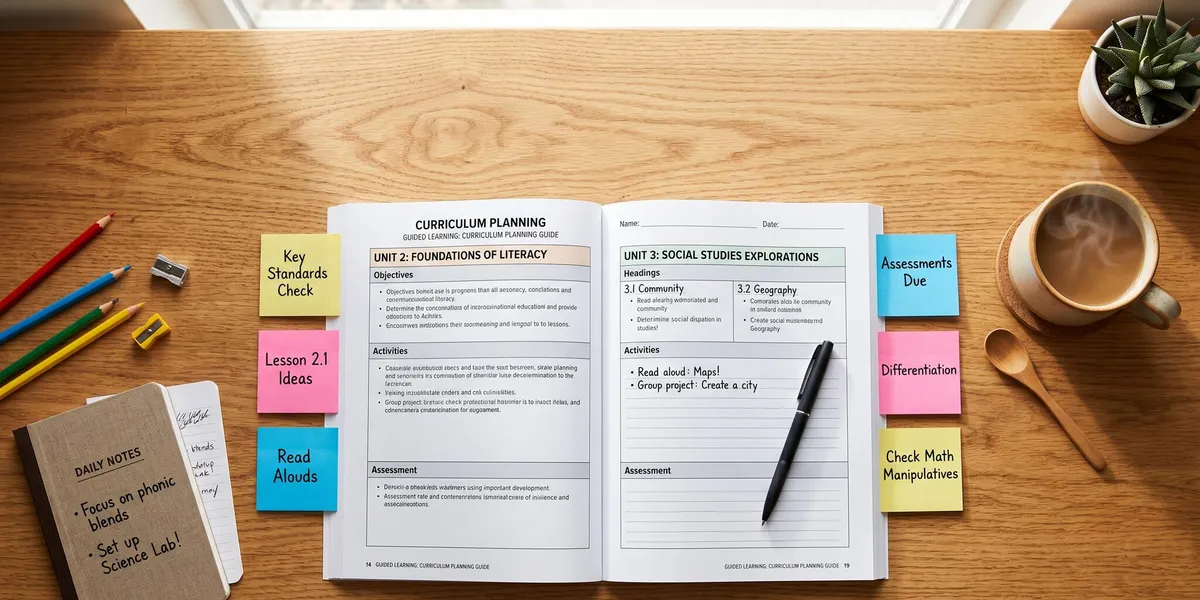
You can write a curriculum book — even without a background in instructional design. The process comes down to defining what your learners need, organizing that knowledge into a logical sequence, and writing lessons that actually produce results.
In this guide, you’ll learn:
- How to define learning outcomes that drive every chapter
- The scope and sequence framework that keeps your curriculum organized
- How to write lessons, activities, and assessments that work together
- The publishing path that fits your goals (traditional, self-published, or institutional)
Here is the step-by-step process.
What Is a Curriculum Book?
A curriculum book is a structured educational resource that guides learners through a subject in a deliberate sequence, with defined learning outcomes, lessons, activities, and assessments built into each chapter. Unlike a textbook that presents information for reference, a curriculum book tells the instructor (or self-directed learner) exactly what to teach, in what order, and how to measure whether learning happened.
Curriculum books serve teachers, homeschool parents, corporate trainers, and independent educators. They range from K-12 classroom curricula to professional development programs to self-help frameworks delivered as structured learning paths.
The key difference between a curriculum book and other nonfiction formats: a curriculum book is designed to produce a specific, measurable change in the learner by the end.
Who Should Write a Curriculum Book?
You are a good candidate for writing a curriculum book if you meet at least two of these criteria:
- You teach a subject repeatedly. Classroom teachers, online course creators, workshop facilitators, and corporate trainers all have material they deliver over and over. A curriculum book captures and systematizes that delivery.
- You have a proven method. If your students consistently get results using your approach, you have something worth documenting. The method is the curriculum.
- You see a gap in existing materials. Maybe the available curricula are outdated, too theoretical, or missing key topics. Your firsthand experience with learners tells you what is actually needed.
- You want to scale your impact. A curriculum book lets other instructors teach your method without you being in the room. According to the U.S. Department of Education’s Curriculum Development Toolkit, well-designed curricula are the foundation of effective instruction at scale.
If you already teach courses and want to package your material into a book, this guide is exactly what you need.
How to Define Learning Outcomes for Your Curriculum
Learning outcomes are the foundation of your entire curriculum book. Every chapter, lesson, and activity traces back to a specific outcome you want learners to achieve.
Write outcomes using the ABCD framework
Strong learning outcomes follow four components:
| Component | What It Means | Example |
|---|---|---|
| Audience | Who is learning | ”The student…” |
| Behavior | What they will do | ”…will write a five-paragraph essay…” |
| Condition | Under what circumstances | ”…given a prompt and 45 minutes…” |
| Degree | How well they must do it | ”…scoring 80% or higher on the rubric.” |
Vague outcomes like “understand persuasive writing” give you nothing to build on. Specific outcomes like “write a persuasive essay using three supporting arguments, scored against a provided rubric” tell you exactly what to teach, what to practice, and what to assess.
Align outcomes to standards (when applicable)
If your curriculum targets K-12 classrooms, align your outcomes to relevant standards — Common Core, Next Generation Science Standards, state-specific frameworks, or industry certifications. According to a Connecticut Department of Education curriculum guide, grade-level objectives represent the core of any curriculum and should map directly to institutional requirements.
For professional development or independent curricula, you have more flexibility. Define your own competency benchmarks, but make them just as specific and measurable.
Organize outcomes into a hierarchy
Not all outcomes are equal. Organize them into three tiers:
- Course-level outcomes — What the learner can do after completing the entire curriculum (3-5 outcomes)
- Unit-level outcomes — What the learner can do after completing a unit or chapter (2-4 per unit)
- Lesson-level outcomes — What the learner can do after a single lesson (1-2 per lesson)
This hierarchy ensures that each lesson builds toward something larger. It also makes your table of contents practically write itself.
How to Build Your Scope and Sequence
A scope and sequence document is the blueprint of your curriculum book. The scope defines what topics you cover. The sequence defines the order in which you cover them.
Map your scope first
List every topic, skill, and concept your curriculum needs to cover. Be exhaustive — you will trim later. Group related items into units or chapters.
For a writing curriculum, your scope might include:
- Sentence structure
- Paragraph development
- Essay organization
- Research skills
- Persuasive writing
- Narrative writing
- Revision and editing
- Publishing and presenting
Sequence for building knowledge
Arrange your units so each one builds on the previous. There are three common sequencing approaches:
- Simple to complex — Start with foundational skills and layer difficulty (most common for skills-based curricula)
- Chronological — Follow a timeline (works for history, science, or process-based subjects)
- Thematic — Organize by themes or big ideas rather than linear progression (works for literature, social studies, or interdisciplinary curricula)
Most curriculum books use a blend. A writing curriculum might follow simple-to-complex for skills while using thematic units (persuasive, narrative, informational) to organize practice.
Set your pacing
Decide how long each unit should take. The U.S. Department of Education’s Curriculum Development Toolkit recommends units spanning four to nine weeks for K-12 settings, depending on the instructional calendar.
For self-paced or professional development curricula, define units by hours of study or number of sessions rather than calendar weeks.
Your scope and sequence becomes the table of contents of your book — and the roadmap that keeps you on track during writing.
How to Structure Each Chapter
Every chapter in a curriculum book should follow a consistent internal structure. This predictability helps both instructors and learners know what to expect.
A proven chapter framework
Use this structure for each chapter or unit:
- Chapter overview — What this chapter covers and why it matters (2-3 paragraphs)
- Learning outcomes — The specific, measurable outcomes for this chapter (bulleted list)
- Core instruction — The teaching content, broken into logical sections with headings
- Examples and models — Concrete examples that show the concept in action
- Practice activities — Exercises, prompts, or tasks that let learners apply what they learned
- Assessment — A way to measure whether the learner met the outcomes
- Chapter summary — Key takeaways in a concise list or paragraph
This structure mirrors what the EducationCloset curriculum writing framework calls the “lesson cycle” — the repeated pattern that makes curriculum coherent and teachable.
Write the core instruction clearly
Your teaching content should be clear, direct, and free of unnecessary jargon. Write as if you are explaining the concept to a smart person who has never encountered it before.
Keep these principles in mind:
- One concept per section. Do not combine multiple ideas into a single section. Give each concept its own heading.
- Show, then tell. Lead with an example or scenario before explaining the underlying principle. Learners grasp concrete before abstract.
- Use the language of your field accurately. Introduce key terms with clear definitions and use them consistently throughout.
If you are writing for other instructors, include teaching notes — brief suggestions for how to present the material, common student misconceptions to watch for, and pacing recommendations.
How to Design Activities and Exercises
Activities transform a curriculum book from something people read into something people do. This is where learning actually happens.
Match activity types to learning outcomes
Different outcomes require different kinds of practice:
| Learning Outcome Type | Best Activity Types |
|---|---|
| Knowledge (recall facts) | Quizzes, matching exercises, fill-in-the-blank |
| Comprehension (explain concepts) | Short-answer questions, summarization tasks, discussion prompts |
| Application (use skills) | Case studies, projects, hands-on exercises, simulations |
| Analysis (break down problems) | Compare/contrast tasks, data interpretation, research assignments |
| Creation (produce something new) | Writing assignments, design projects, presentations, portfolios |
This mirrors Bloom’s Taxonomy, the standard framework for educational objectives. The higher you go on the taxonomy, the more complex and open-ended your activities should be.
Build in scaffolding
Scaffolding means providing structured support that gradually decreases as the learner builds competence. In practice:
- Early activities include step-by-step instructions, templates, and worked examples
- Mid-unit activities reduce the guidance and ask learners to make more decisions
- End-of-unit activities give learners a goal and let them figure out the approach
A workbook approach works well here. Include fill-in-the-blank exercises early, guided practice in the middle, and independent projects at the end.
Include answer keys and rubrics
For activities with defined answers, include an answer key in an appendix or instructor’s guide. For open-ended activities, provide scoring rubrics that define what excellent, proficient, developing, and beginning work looks like.
Rubrics serve double duty: they help instructors grade consistently, and they help learners self-assess before submitting.
How to Write Assessments That Measure Real Learning
Assessments prove whether your curriculum works. Without them, you have a book of information — not a curriculum.
Use three assessment types
-
Diagnostic assessments — Given before instruction to gauge what learners already know. Include a pre-assessment at the beginning of each unit. This helps instructors differentiate and learners see their own growth.
-
Formative assessments — Given during instruction to check understanding. These include exit tickets, quick quizzes, journal reflections, and classroom discussions. Build 2-3 formative checks into each chapter.
-
Summative assessments — Given after instruction to measure mastery. These are your end-of-unit tests, final projects, or portfolio reviews. Each unit needs at least one summative assessment tied directly to the unit-level outcomes.
Write assessment items that match your outcomes
If your learning outcome says “the student will compare and contrast two historical events,” your assessment must require comparing and contrasting — not just recalling dates. This alignment between outcomes, instruction, and assessment is called constructive alignment, and it is the single most important principle in curriculum design.
Include both traditional and performance-based assessments
Traditional assessments (multiple choice, short answer, essay) are efficient for measuring knowledge and comprehension. Performance-based assessments (projects, presentations, portfolios) are better for measuring application, analysis, and creation.
A strong curriculum book includes both types. Balance is key — do not rely entirely on tests or entirely on projects.
How to Create Supplementary Materials
The best curriculum books come with supplementary resources that make them easier to use in real classrooms or learning environments.
Essential supplementary materials
- Instructor’s guide — Teaching notes, pacing suggestions, discussion facilitation tips, and answer keys. This can be a separate section, an appendix, or a companion document.
- Student handouts and worksheets — Printable or downloadable materials that support the activities in each chapter. Consider offering these as a digital download.
- Assessment tools — Pre-built tests, rubrics, and grading sheets that match your assessments.
- Scope and sequence chart — A visual overview of the entire curriculum showing units, weeks, topics, and standards alignment. Include this at the front of the book.
- Resource lists — Curated lists of additional readings, websites, tools, and materials for each unit.
Digital vs. print considerations
If your curriculum includes activities that require digital tools, interactive media, or video content, you will need a companion website or digital platform. Many curriculum authors use a combination:
- Print book for core instruction and reference
- Digital downloads for worksheets, templates, and handouts
- Online portal for video lessons, interactive activities, and community discussion
This hybrid approach gives you the permanence of a printed book and the flexibility of digital resources. It also creates multiple revenue streams — the book itself, digital supplements, and potential course offerings.
How to Write a Curriculum Book With AI
AI tools can significantly accelerate the curriculum writing process — especially for generating first drafts of lessons, creating practice activities, and building assessment items.
Our Pick — Chapter
Chapter helps nonfiction authors write structured, organized books faster. For curriculum writers, it is particularly useful for outlining unit structures, generating lesson drafts, and maintaining consistency across chapters.
Best for: Nonfiction authors who need to organize and write educational content systematically Pricing: $97 one-time (nonfiction) Why we built it: Over 10,000 authors have used Chapter to create books, including educational and instructional titles. The structured approach fits curriculum writing perfectly.
Where AI helps most in curriculum writing
- Outlining — Generate a complete scope and sequence from your list of topics and outcomes
- Lesson drafting — Create first drafts of instructional content that you then revise with your expertise
- Activity generation — Produce practice exercises, discussion questions, and writing prompts at scale
- Assessment creation — Build quiz questions, rubric criteria, and test items aligned to your outcomes
- Consistency checking — Ensure that vocabulary, tone, and formatting are consistent across chapters
Where you still need human expertise
AI cannot replace your understanding of your learners, your subject-matter depth, or your pedagogical judgment. Use AI to handle the repetitive structural work. Reserve your time for the decisions that require experience: sequencing choices, example selection, difficulty calibration, and real-world relevance.
If you are new to using AI for nonfiction writing, start by generating your book outline first, then draft one chapter to test the workflow before committing to the full manuscript.
How to Format and Publish Your Curriculum Book
Publishing a curriculum book involves choices that differ from standard nonfiction publishing. The format, distribution, and pricing all depend on your audience.
Choose your format
| Format | Best For | Considerations |
|---|---|---|
| Print (perfect bound) | Classroom adoption, bookstores, institutional sales | Durable, familiar, easy to flip through. Higher production cost. |
| Spiral bound | Hands-on curricula, workbooks, trainer guides | Lies flat for easy use during lessons. Feels less “bookstore” quality. |
| Digital PDF | Self-paced learners, homeschool families, international distribution | Lowest cost, easy to update, can include hyperlinks. No physical presence. |
| Print + digital bundle | Maximum flexibility | Offers both formats. Most curriculum buyers prefer this option. |
Publishing paths
Traditional educational publishers like Pearson, McGraw-Hill, and Houghton Mifflin Harcourt acquire curriculum books through a proposal process similar to textbook publishing. The upside is institutional distribution and credibility. The downside is slow timelines (18-36 months) and loss of control over updates.
Self-publishing through Amazon KDP, IngramSpark, or your own website gives you full control over content, pricing, and revision cycles. This works especially well for independent educators, homeschool curriculum authors, and corporate trainers who sell directly to their audience.
Institutional publishing — some school districts, universities, and organizations will fund and distribute curriculum books created by their own staff. If you are writing for an institution, clarify ownership, distribution rights, and revision responsibilities before you start.
Price your curriculum appropriately
Curriculum books command higher prices than standard nonfiction because they include instructional design, activities, and assessments. Print curriculum books typically range from $29 to $99 depending on scope, supplementary materials, and target market.
Digital-only curricula often sell for $19 to $49, with bundles (book + digital resources) in the $49 to $149 range. If you are selling directly to institutions, volume pricing and site licenses add another revenue layer.
Common Mistakes to Avoid
- Writing content without defined learning outcomes. If you do not know what learners should be able to do after each chapter, you are writing a reference book, not a curriculum. Start with outcomes, then build everything around them.
- Skipping the scope and sequence. Jumping straight into writing lessons without mapping the full curriculum leads to gaps, redundancies, and poor pacing. Build the blueprint before you build the house.
- Overloading chapters with information. Curriculum books teach through structure and practice, not through exhaustive coverage. If a chapter has 30 pages of instruction and 1 page of activities, the ratio is wrong.
- Ignoring your audience’s skill level. A curriculum for first-year teachers needs different scaffolding than one for experienced instructors. Write for your actual audience, not an idealized one.
- Never testing with real learners. Pilot at least two or three chapters with real students or instructors before finalizing. Their feedback reveals problems you cannot see as the author.
How Long Does It Take to Write a Curriculum Book?
How long it takes to write a curriculum book depends on scope, complexity, and how much original material you already have. A focused, single-subject curriculum (20-30 lessons) typically takes 3 to 6 months. A comprehensive, multi-year program can take 12 to 18 months.
If you already teach the material and have lesson plans, slides, and handouts, you have a significant head start. Converting existing teaching materials into a curriculum book cuts the timeline by 30-50%, because the core content already exists — you are organizing and refining, not creating from scratch.
Using AI writing tools like Chapter can compress the drafting phase further. Authors who use AI for first drafts and structural organization report cutting their writing time roughly in half, according to data from Chapter’s 10,000+ active authors.
Can You Self-Publish a Curriculum Book?
Yes, you can self-publish a curriculum book, and it is increasingly the preferred path for independent educators. Self-publishing gives you control over content, pricing, updates, and distribution — all critical factors for curriculum that needs regular revision.
The process works like this:
- Write and format your manuscript (including all activities and assessments)
- Design or commission a professional cover and interior layout
- Upload to a distribution platform (Amazon KDP, IngramSpark, or direct sales)
- Market to your target audience (teachers, homeschool parents, trainers)
Self-published curriculum authors often sell through their own websites, teacher marketplaces like Teachers Pay Teachers, and direct outreach to schools and districts.
How Is a Curriculum Book Different From a Textbook?
A curriculum book and a textbook serve different purposes. A textbook presents subject matter knowledge for reference and study. A curriculum book provides a complete instructional plan — including what to teach, how to teach it, what learners should practice, and how to assess mastery.
Think of it this way: a textbook is a resource that supports teaching. A curriculum book is the teaching plan itself.
| Feature | Textbook | Curriculum Book |
|---|---|---|
| Primary user | Student | Instructor (and student) |
| Structure | Organized by topic | Organized by learning sequence |
| Includes activities | Sometimes | Always |
| Includes assessments | Rarely | Always |
| Includes pacing | No | Yes |
| Designed for | Reference and study | Guided instruction |
Many authors create both — a textbook for students to read and a curriculum guide for instructors to follow. Some combine both into a single book with separate instructor notes.
FAQ
What is a curriculum book?
A curriculum book is a structured educational resource that provides a complete teaching plan for a subject. It includes learning outcomes, sequenced lessons, practice activities, and assessments. Unlike a textbook that presents information for reference, a curriculum book guides instructors through what to teach, in what order, and how to measure learning.
How do you write learning objectives for a curriculum?
You write learning objectives for a curriculum using the ABCD framework: Audience, Behavior, Condition, and Degree. Each objective specifies who is learning, what they will do, under what conditions, and to what standard. Strong objectives use measurable action verbs like “write,” “analyze,” or “demonstrate” instead of vague terms like “understand” or “appreciate.”
How much does it cost to publish a curriculum book?
Publishing a curriculum book costs between $500 and $5,000 for self-publishing, depending on editing, design, and supplementary materials. Traditional educational publishers cover production costs but take 12-18 months and offer 10-15% royalties. Self-publishing through Amazon KDP or IngramSpark has minimal upfront costs if you handle formatting yourself.
Can you write a curriculum book without teaching experience?
You can write a curriculum book without formal teaching experience if you have deep subject-matter expertise and a proven method for helping people learn. However, you should partner with experienced educators for pedagogical review, or pilot your curriculum with real learners before publishing. Instructional design knowledge — even from online courses — strengthens a curriculum significantly.
What is the difference between a curriculum and a lesson plan?
A curriculum is the complete educational plan for an entire course or program, including scope, sequence, objectives, and assessments. A lesson plan is a single session within that curriculum. Think of the curriculum as the blueprint for a building and each lesson plan as the instructions for one room. A curriculum book contains many lesson plans organized into a coherent learning sequence.