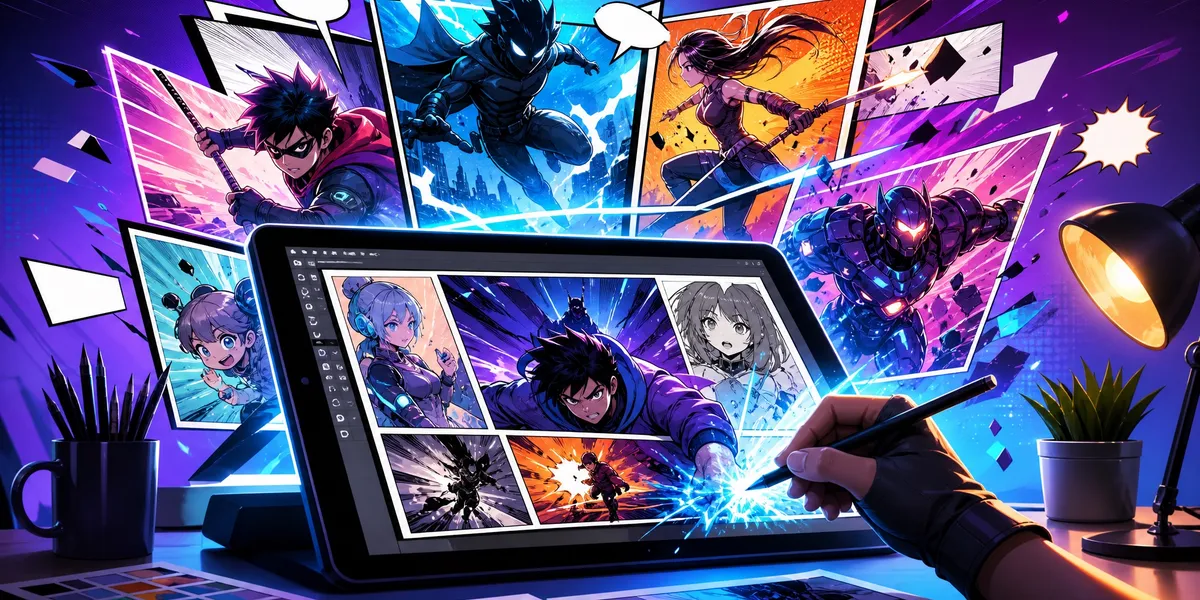
You can create a full comic book with AI — characters, panels, dialogue, and all — even if you’ve never drawn a single line.
In this guide, you’ll learn:
- Which AI comic generators actually produce consistent, publishable results
- How to write scripts that give AI the context it needs for great panels
- The character consistency techniques that keep your hero looking the same across 50+ pages
- A complete workflow from story idea to finished comic
Here’s how to make AI-generated comics that look intentional, not random.
What Is an AI Comic Generator?
An AI comic generator is software that uses artificial intelligence to create comic book panels, characters, backgrounds, and complete pages from text descriptions. You write the script or prompt, and the AI produces the visual artwork — no drawing skills required.
These tools range from simple prompt-to-image generators to full production platforms that handle panel layouts, speech bubbles, character consistency, and even publishing pipelines. The best ones in 2026 combine text-to-image generation with comic-specific features like sequential panel creation and style locking.
Research from arxiv on visual narrative AI systems found that while AI excels at producing professional-quality artwork, it struggles with visual storytelling coherence between panels. The practical takeaway: you still need to write the story and direct the visual flow. AI handles the art — you handle the narrative.
Best AI Comic Generators in 2026
Here’s what actually works for creating comics with AI right now. I’ve tested each of these for character consistency, ease of use, and output quality.
Our Pick — Chapter
Chapter helps you write the story and script that drives your comic. While it’s not an image generator, it’s the best tool for creating the narrative backbone — character arcs, dialogue, plot structure, and panel descriptions — that you’ll feed into any AI comic generator.
Best for: Writing comic scripts, developing characters, structuring visual stories Pricing: $97 one-time (nonfiction) | Varies (fiction) Why we built it: Great comics start with great scripts. Over 2,147 authors use Chapter to structure their stories before bringing them to life visually.
Dashtoon — Best All-in-One Comic Creator
Best for: Creators who want everything in one platform — writing, generation, and publishing.
Dashtoon scored highest in testing for character consistency across panels. It uses identity embedding technology to maintain your character’s appearance across an entire project. You create a character reference sheet, and the AI locks that visual identity for every subsequent panel.
The platform includes Story to Comic mode, Storyboard to Comic conversion, and a built-in publishing pipeline for Webtoon-style distribution.
Pricing: Free tier available | Pro plans from $15/month
LlamaGen — Best for Character Consistency
Best for: Manga and webtoon creators who need the same characters across hundreds of panels.
LlamaGen focuses specifically on the hardest problem in AI comics: keeping characters visually consistent after panel one. You define characters once with reference images, and the AI maintains their appearance through poses, angles, and scene changes.
Pricing: Free tier | Premium from $12/month
Canva — Best for Beginners
Best for: Assembling AI-generated images into professional comic layouts without a learning curve.
Canva isn’t a pure AI comic generator, but it’s excellent for assembling panels, adding speech bubbles, and building clean page layouts. Pair it with a dedicated image generator for the art, and use Canva for the comic book production workflow.
Pricing: Free tier | Pro $13/month
AI Comic Factory (Hugging Face) — Best Free Option
Best for: Experimenting with AI comics at zero cost.
This open-source tool on Hugging Face generates multi-panel comic pages from text prompts. Quality varies, but it’s completely free and runs in your browser. Great for prototyping ideas before committing to a paid platform.
Pricing: Free
Adobe Firefly — Best Image Quality
Best for: Professional-quality panel art in multiple comic styles.
Adobe Firefly generates stunning artwork in superhero, anime, retro, and classic comic styles. It’s not a full comic production platform — you’ll need to assemble panels yourself — but the raw image quality is top-tier for anyone who wants their AI comic to look polished.
Pricing: Free tier (limited) | Creative Cloud from $10/month
How to Create a Comic With an AI Generator (Step-by-Step)
The biggest mistake creators make is jumping straight into image generation. The workflow that produces the best results follows a clear sequence.
Step 1: Write Your Script First
Every great comic starts with a script — not a prompt. Before opening any AI tool, write out:
- Your story concept (one paragraph)
- Character descriptions (physical features, clothing, personality)
- Scene breakdowns (what happens in each panel)
- Dialogue for each panel
This is where a tool like Chapter saves you hours. Use it to develop your plot structure and character profiles before generating a single image.
Step 2: Create Character Reference Sheets
Character consistency is the single biggest challenge in AI-generated comics. A character who looks different in every panel breaks the reader’s immersion instantly.
Before generating story panels:
- Generate 3-5 reference images of each main character in neutral poses
- Include front view, side view, and three-quarter angles
- Lock down specific details: hair color, eye color, clothing, distinguishing features
- Save these as your character reference sheet
Most serious AI comic generators (Dashtoon, LlamaGen) let you upload these references and maintain that visual identity across your entire project.
Step 3: Write Detailed Panel Prompts
Generic prompts produce generic art. Instead of writing “the hero walks into a room,” write:
Weak prompt: “A man enters a building”
Strong prompt: “Medium shot, Marcus (dark leather jacket, short black hair, scar on left cheek) pushes open a heavy metal door. Neon-lit corridor behind him casts blue light on his face. Determined expression. Noir comic style, high contrast shadows.”
Include in every panel prompt:
- Shot type (close-up, medium, wide, bird’s eye)
- Character name and key visual identifiers
- Action and body language
- Environment and lighting
- Art style reference
- Emotional tone
Step 4: Generate and Arrange Panels
With your script and character references ready:
- Generate each panel individually for maximum control
- Review for character consistency — regenerate any panels where characters drift off-model
- Arrange panels on your page using a layout tool (Canva, Clip Studio Paint, or your platform’s built-in layout editor)
- Add speech bubbles and lettering
- Adjust pacing — vary panel sizes for dramatic effect
Step 5: Edit and Polish
AI-generated panels often need minor fixes:
- Touch up any visual inconsistencies between panels
- Ensure reading flow is clear (left to right, top to bottom for Western comics)
- Add sound effects and motion lines if needed
- Check that dialogue is legible against backgrounds
How to Maintain Character Consistency Across Panels
This deserves its own section because it’s the make-or-break factor for AI comics. Research shows nothing breaks a visual story faster than a character who looks different in every panel.
Technique 1: Reference-Based Generation
Upload 1-3 reference images of your character. The AI extracts facial structure, hair style, skin tone, and clothing patterns, then applies these features to every new generation. This is the most common approach in 2026 tools like Midjourney (Character Reference parameter) and Ideogram.
Technique 2: Identity Embeddings
Advanced platforms create a mathematical fingerprint of your character from reference images. This embedding loads automatically with every panel generation, maintaining consistency even across 200+ pages and dramatic pose changes.
Technique 3: LoRA Training
For maximum consistency on large projects, some creators train a lightweight LoRA model on their specific characters. Platforms like Leonardo AI and OpenArt support this. It’s more time-intensive upfront but produces the best results for long-form comics.
Technique 4: Style Locking
Lock your art style across the entire project — not just characters. Consistent line weights, color palettes, and shading approaches make panel-to-panel inconsistencies far less noticeable.
Visual Novel Writing Software: AI Tools for Interactive Comics
Visual novels blend comic art with interactive storytelling — readers make choices that affect the narrative path. If you’re creating an interactive comic or visual novel, you need different tools than standard comic generators.
Best visual novel writing software in 2026:
| Tool | Best For | Interactive Features | Pricing |
|---|---|---|---|
| Ren’Py | Full interactive visual novels | Branching paths, save states, character sprites | Free (open source) |
| TyranoBuilder | No-code visual novels | Drag-and-drop scene builder, choice systems | $15 one-time |
| Twine | Text-heavy interactive fiction | Branching narrative, variables, conditional logic | Free |
| Chapter | Writing the story/script | Character development, plot structure, dialogue | $97 one-time |
The workflow for visual novels: write your branching script (including all choice paths) first, generate character sprites and backgrounds with AI, then assemble in your visual novel engine.
For writing the narrative backbone of a visual novel — character development, branching dialogue trees, and multiple story paths — Chapter helps you organize complex narratives before visual production begins.
Best Practices for AI Comic Creation
After testing dozens of workflows, these practices consistently produce the best results:
Script quality determines art quality. The more specific your panel descriptions, the better your AI output. Invest 60% of your time in writing and 40% in generation.
Start with a style test. Before committing to 50 pages, generate 5-10 test panels to nail down your art style. Try different style prompts until you find one that works consistently.
Work in batches by scene. Generate all panels for a single scene together while the AI “remembers” your style and character settings. Jumping between unrelated scenes increases inconsistency.
Keep a prompt library. Document every successful prompt. When you find phrasing that produces great results for a character or environment, save it as a template for future panels.
Use the right panel count. Most AI comic pages work best with 4-6 panels. Cramming 9 panels onto a page with AI-generated art creates visual chaos. Give each panel room to breathe.
Common Mistakes to Avoid
- Skipping the script phase — Prompting random images and hoping they form a story never works. Write first, generate second.
- Ignoring character consistency — If you don’t create reference sheets before starting, you’ll waste hours regenerating panels where characters look wrong.
- Using generic prompts — “A superhero fighting a villain” gives you clip art. Specific, detailed prompts give you art.
- Forgetting panel flow — Comics are sequential art. Each panel must lead the reader’s eye naturally to the next one.
- Over-relying on AI for storytelling — AI produces images, not narratives. You still need to understand story structure, pacing, and visual rhythm.
How Long Does It Take to Create an AI Comic?
Creating a full AI comic takes 2-5 days for a 20-page comic with a polished workflow, compared to weeks or months for traditionally illustrated comics. Here’s a realistic breakdown:
| Phase | Time |
|---|---|
| Script and character development | 4-8 hours |
| Character reference sheet creation | 2-3 hours |
| Panel generation (20 pages, ~100 panels) | 6-10 hours |
| Layout, lettering, and polish | 4-6 hours |
| Total | 16-27 hours |
The script phase is the biggest time investment — and it’s the phase that matters most. A strong script with AI art beats a weak script with perfect art every time.
Can You Sell AI-Generated Comics?
Yes. AI-generated comics are sold on platforms like Amazon KDP, Gumroad, Webtoon, and personal websites. However, keep these legal considerations in mind:
- Copyright varies by jurisdiction. In the US, purely AI-generated images may not be copyrightable, but the overall creative arrangement, selection, and text/dialogue you write IS protectable.
- Platforms have different policies. Amazon KDP requires disclosure of AI-generated content. Webtoon allows AI-assisted comics. Check each platform’s current terms.
- Your script is always yours. The story, dialogue, and creative direction you write are copyrighted regardless of how the art is produced.
The safest approach: use AI for base imagery, add your own creative modifications, and ensure your overall work reflects substantial human authorship in the selection, arrangement, and creative direction.
From Script to Comic: Connecting Your Writing to AI Art
The bridge between a great story and a great comic is the script. This is where most creators get stuck — they know how to write prose but not how to write for a visual medium.
Key differences when writing for comics:
- Show, don’t tell — literally. If a character is angry, describe their clenched fists and narrowed eyes for the AI. Don’t write “he felt angry.”
- Think in shots — each panel is a camera angle. Specify close-ups for emotional beats, wide shots for establishing scenes.
- Less dialogue, more action — comic panels can hold 2-3 speech bubbles before they feel cramped. Let the art carry the story.
- Write panel descriptions like a filmmaker — include blocking, lighting, and mood in every panel description.
If you’re coming from prose writing or manga storytelling, the shift to visual scripting takes practice. Chapter can help you structure your comic book script before you generate a single panel.
FAQ
What is the best free AI comic generator?
The best free AI comic generator is AI Comic Factory on Hugging Face, which generates complete multi-panel comic pages from text prompts at no cost. For layout and assembly, Canva’s free tier provides comic templates, panel grids, and speech bubble tools to arrange your AI-generated artwork into professional pages.
Can AI generate a full comic book?
Yes, AI can generate a full comic book including characters, backgrounds, panels, and page layouts. Tools like Dashtoon and LlamaGen produce complete pages from scripts. However, you still need to write the story, direct the visual flow, and ensure character consistency — AI handles the art, not the storytelling.
How do you keep characters consistent in AI comics?
You keep characters consistent in AI comics by creating reference sheets before generating story panels. Upload 3-5 reference images showing your character from multiple angles, then use platforms with identity embedding (like Dashtoon or LlamaGen) that lock your character’s visual identity across every subsequent panel generation.
Is AI comic generation legal?
AI comic generation is legal to create and sell in most jurisdictions. Your script, dialogue, creative arrangement, and overall direction are copyrightable. However, purely AI-generated images alone may lack copyright protection in the US. Platforms like Amazon KDP require AI content disclosure. Always check current platform terms before publishing.
What’s the difference between an AI comic generator and visual novel writing software?
An AI comic generator creates static comic panels and pages from text prompts for traditional reading. Visual novel writing software (like Ren’Py or TyranoBuilder) creates interactive stories with branching paths where readers make choices. Both use AI-generated art, but visual novels add gameplay mechanics, choice systems, and multiple endings.