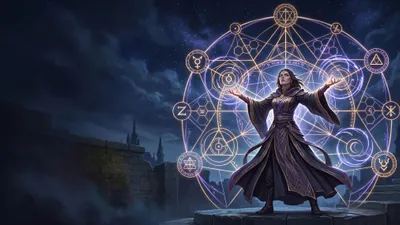
You can build a fictional religion that feels genuinely lived-in by designing four layers in order — what the faith claims about the universe, what it tells people to do, what people actually do, and who profits from the gap between the last two.
In this guide, you’ll learn:
- How to write a cosmology and origin myth that generates plot instead of just backstory
- Why the gap between doctrine and practice is where your best scenes live
- How to design rituals, holy days, clergy hierarchies, schisms, and heresies
- How belief bleeds into law, language, and architecture on the page
- How to avoid the thin real-world reskin that readers spot instantly
Here is the process, layer by layer.
What Is a Fictional Religion in Worldbuilding?
Fictional religion — an invented belief system within a story world, complete with claims about the origin and purpose of existence, a moral code, ritual practices, and an institution that maintains all three.
The last part is what most writers skip. A pantheon is not a religion. A list of gods with domains and symbols is a mythology, and mythology is only the raw material.
Religion is what happens when a community organizes around that mythology — when it builds temples, appoints priests, collects tithes, decides who is wrong, and passes laws. That organizing is where your story finds conflict.
This post is a deep dive on one element of the larger craft. If you’re building a world from scratch, start with the complete worldbuilding guide and use this as the religion chapter.
Start With Cosmology and an Origin Myth
Begin with the origin myth, because every other layer descends from it. Your cosmology answers three questions — where did the world come from, why are people here, and what happens after death.
Those answers determine everything downstream. A faith that teaches the world was made deliberately for humans will produce very different laws than one teaching the world is the corpse of a slain god and humans are lice in its hair.
Write the myth as a story, not a summary
Do not write “the goddess Vaelen created the world from her tears.” Write the version a grandmother tells a child by a fire — with characters, a mistake, a cost, and a moral.
Myths do work. Anthropologists have long noted that myths function to validate customs, rituals, and social order, not merely to explain natural phenomena. Yours should justify at least one strange thing your society does.
Make the myth contradict itself somewhere
Real scriptures contain inconsistencies — two creation accounts, a merciful god who commands slaughter, a prophet whose lineage is recorded two different ways. Those seams are not flaws. They are where interpretation, argument, and eventually schism enter.
Plant one deliberate contradiction in your origin myth. You will use it in act three.
Decide whether the gods are real in your world
This is a structural choice, not a flavor choice.
| Divine status | What it does to your story |
|---|---|
| Gods are confirmed real and present | Faith becomes politics — the question is not “is it true” but “whose side are they on” |
| Gods are real but silent or absent | Faith becomes interpretation — clergy gain enormous power as the only channel |
| Gods are ambiguous | Faith becomes a genuine choice, and doubt is a live character arc |
| Gods are demonstrably false | Faith becomes a study of why people believe anyway — often your most humane option |
Ambiguity gives you the widest range of character positions. Confirmed divinity is the hardest to write well, because it collapses doubt — and doubt is your most reliable source of internal conflict.
If your world has magic, this choice interacts directly with your magic system design. Miracles and spells that look identical create fascinating problems for a priesthood.
Separate Doctrine From Practice
Doctrine is what the faith officially teaches. Practice is what believers actually do on a Tuesday. The distance between them is where almost every good religious scene in fiction happens.
Doctrine says give a tenth of your harvest. Practice says everyone gives a twentieth, the temple knows, and nobody says anything until a new archpriest decides to make an example.
Build a doctrine-versus-practice table for your faith
Write five doctrinal rules, then write what people actually do about each one. Then mark who enforces the gap and who benefits from it.
| Doctrine says | Practice looks like | Who tolerates the gap and why |
|---|---|---|
| No labor on the seventh day | Farmers work quietly at dusk during harvest | Village priest, because he eats their grain |
| Only the ordained may read the texts | Merchants keep smuggled copies for contracts | Nobody, until someone needs leverage |
| Marriage requires a temple blessing | Rural couples marry themselves, register later | The crown, because registration means taxes |
That third column is your plot engine. Every entry is a favor someone can withdraw.
Folk religion is the layer readers believe
Alongside official doctrine, ordinary people run a parallel system of charms, luck rituals, house spirits, and half-remembered prayers. They nail a horseshoe over a door and could not tell you which god it honors.
This layer sells the world faster than any theology. A soldier kissing a knuckle before a fight tells your reader more than a page of scripture.
Design Rituals, Holy Days, and Taboos
Rituals are the most visible part of any faith, and the part your reader experiences directly. Design them so they can be dramatized — something must be done, in a place, at a time, with a cost.
Scholars have argued for a century about whether myth precedes ritual or ritual precedes myth, and the honest modern answer is that the relationship runs both ways. For your purposes that means you can design in either direction — invent the rite first and back-fill the story, or vice versa.
The five ritual categories worth designing
- Life-cycle rites — birth naming, coming of age, marriage, death. These are your emotional set pieces.
- Calendar rites — the harvest festival, the fast, the vigil. These give your plot a clock.
- Crisis rites — what you do during plague, drought, or before battle. These reveal what the faith is really for.
- Purity rites — washing, dietary rules, what makes a person or place unclean. These generate social friction constantly.
- Sacrifice or offering — what the faith asks you to give up, and to whom it actually goes.
Give every ritual a cost and a cheat
A ritual with no cost is decoration. Make each rite demand time, money, pain, silence, or a possession. Then design the shortcut wealthy people use to avoid the cost — indulgences, proxies, hired mourners, a paid substitute faster.
The cheat is where your class conflict lives.
Taboos should have visible consequences
A taboo that nobody punishes is not a taboo. Decide what happens when someone eats the forbidden thing, speaks the unspoken name, or enters the closed room — social shunning, fines, exile, execution, or a quiet ruin that takes ten years.
Then break one on the page, early, so the reader learns the stakes without exposition.
Build the Clergy, Hierarchy, and Power
Ask one question about your priesthood and everything else follows — where does the money come from?
Tithes, land ownership, a state stipend, pilgrimage fees, banking, selling blessings, controlling literacy, monopolizing burial. Each answer produces a completely different institution with different vulnerabilities.
Map the hierarchy in five slots
- The apex — one figure, a council, or a rotating office. Note how succession works, because contested succession is a whole novel.
- Regional authority — the bishops, abbots, or circuit priests who translate central doctrine into local reality, badly.
- The local officiant — the village priest who knows everyone’s secrets and depends on their goodwill.
- The specialists — scribes, inquisitors, healers, exorcists, temple guards, archivists.
- The devout laity — lay orders, tertiaries, pilgrims, the widow who cleans the sanctuary and quietly runs the parish.
Decide the relationship with secular power
There are only a handful of stable arrangements, and each one carries built-in tension.
| Arrangement | Built-in conflict |
|---|---|
| Church subordinate to crown | Clergy resent it and build shadow influence |
| Crown subordinate to church | Nobles fund heretics as leverage |
| Formally separate | Constant boundary disputes over courts, schools, marriage |
| Fused — the ruler is divine | Any royal failure becomes a theological crisis |
Whichever you pick, the fault line is your political plot. This pairs naturally with the power-structure work in the worldbuilding template.
Let charisma break the institution
Institutions run on office. Movements run on charisma. Sooner or later a barefoot preacher with no ordination draws bigger crowds than the cathedral, and the hierarchy must decide whether to co-opt, ignore, or destroy them.
That decision is one of the most reliable plot generators in all of religious worldbuilding.
Write Schisms, Heresy, and Reform
Every religion that lasts more than two generations splits. Design the split, because a monolithic faith is the clearest sign of a shallow one.
The four things faiths actually split over
- Authority — who has the right to decide. Most schisms are really about this, whatever they claim.
- Interpretation — the contradiction you planted in the origin myth, now weaponized.
- Practice — a rite that changed, a calendar reform, a language of worship.
- Politics — a regional lord who wants a church he controls, dressed in doctrinal language.
Heresy is defined by the winner
Heresy — a belief declared unacceptable by an institution with the power to make the declaration stick.
That framing matters for your fiction. The same idea is orthodoxy in one province and a burning offense across the river. Your heretic should be sympathetic and internally consistent, or the conflict is a cartoon.
Write one scene from the heretic’s point of view where their position sounds obviously correct. If you can’t, you have not built the theology deeply enough.
Syncretism is what really happens at the edges
When faiths meet, they rarely produce a clean winner. They blend. Religious syncretism — the fusion of distinct beliefs and practices — has shaped traditions across the Hellenistic world, Japan, the Caribbean, and the Americas.
Your conquered province will keep its old goddess under a new saint’s name. Your frontier town will run both calendars. This is the single most underused texture in fantasy worldbuilding.
How Religion Shapes Law, Language, and Architecture
This section is what separates a designed religion from a decorative one. If you removed the faith from your world, at least a dozen visible things should break.
Law
Religious law is usually the oldest law. Decide what the faith controls even in a secular state — marriage and divorce, inheritance, oaths and testimony, burial, dietary regulation, lending at interest, the calendar of court sessions.
Then find a case where religious law and civil law contradict, and put a character in the middle of it.
Language
Faith saturates speech more than any other force. Build a short list and use it consistently.
- Oaths and curses — what people say when they hit their thumb with a hammer
- Greetings and farewells — most real-world greetings are worn-down blessings
- Idioms — “past the third gate” for someone dying, “a two-coin priest” for a hypocrite
- Naming conventions — saint names, virtue names, names forbidden to commoners
- Registers — a liturgical language ordinary people can’t read, which is a power structure disguised as grammar
If you want to go further, the same logic drives creating fantasy languages — sacred vocabulary is usually the oldest, most conservative layer of any tongue.
Architecture and landscape
Sacred building is the loudest thing a religion says. Göbekli Tepe in southeastern Turkey — monumental carved pillars raised roughly 11,000 years ago by people without pottery or metal tools — predates Stonehenge by around 6,000 years and predates settled agriculture in the region. Archaeologists have argued the coordinated labor of building it may have helped drive the shift to complex society, rather than the other way around.
That is a gift for worldbuilders. Your monument does not have to follow your civilization. It can be the reason your civilization exists.
Decide these details and put them on the page:
- Orientation — which direction do temples face, and why
- Materials — what is holy stone, what is profane, who may quarry it
- Access — who gets into the inner room, and what the exclusion does to everyone else
- Ruins — abandoned shrines of the previous faith, still visited quietly
- The graveyard — where the dead go says more about a religion than its scripture
Sacred geography also belongs on your map. Pilgrimage routes, forbidden mountains, and contested holy sites give a map narrative weight — see fantasy map making for writers for how to place them.
Believers and Skeptics as Character Motivation
Religion is only worth building if it changes what characters want. The mistake is writing everyone at the same intensity of belief.
The seven positions on the belief spectrum
- The devout — belief structures every decision, and they are usually the kindest or the most dangerous person in the book
- The conventional — attends rites, has never examined a single claim, would be shocked to be called religious
- The professional — clergy whose faith and career are so tangled they can no longer separate them
- The doubter — still practices, no longer believes, terrified of being found out
- The convert — newer, louder, and less patient with compromise than anyone born to it
- The apostate — left, and defines themselves against it, which is its own kind of devotion
- The instrumentalist — believes nothing, uses the faith as a tool, and is often the most honest person present
Assign a position to every named character. Then check that at least two of your protagonists disagree about it.
Doubt is a plot, not a mood
The most durable religious arc in fiction is not conversion or loss of faith. It is a character discovering that the institution is corrupt and having to decide whether the faith itself is.
That question separates the two and gives you a third act. It also produces the kind of internal contradiction that drives strong character motivation throughout a novel.
Give faith a material stake
Belief that costs nothing reads as decoration. Tie your character’s faith to something concrete — a marriage that requires conversion, an inheritance conditional on orthodoxy, a job only the temple can grant, a child the priesthood wants.
How to Avoid a Thin Real-World Reskin
The most common failure is taking a real tradition, renaming the deity, swapping the symbol, and calling it invented. Readers spot this instantly, and members of that tradition find it worse than lazy.
Real faiths are also far more internally varied than the caricature. Pew Research Center’s demographic work on the global religious landscape covers 201 countries and thousands of sources precisely because no tradition behaves as one uniform block. Neither should yours.
Five ways to break the reskin
- Study structure, not surface. Take how a monastic economy funded itself, or how a canon was assembled, or how a schism resolved. Leave the specific beliefs, sacred names, and iconography where you found them.
- Cross-pollinate deliberately. Combine the institutional shape of one tradition with the cosmology of another and the ritual calendar of a third. The recombination is what makes it yours.
- Derive from your own world. A faith on a tidally locked planet, in a world where the dead demonstrably answer, or among a species with a different reproductive cycle cannot look like anything on Earth. Let your setting force the theology.
- Refuse the villain-religion shortcut. A faith that exists only to burn heretics is not worldbuilding, it is a costume for an antagonist. Show the same institution running the orphanage and the inquisition — that is what institutions do.
- Write at least one believer who is right. If every faithful character in your book is deceived or malicious, you have written an argument, not a world.
On writing about faith respectfully
If you are drawing on a living tradition, read practitioners rather than only outside commentators, and be careful with elements that are actively sacred — closed rituals, specific sacred names, initiation practices. Structural borrowing is fair game and always has been. Costume borrowing is where offense lives.
The philosophy of religion literature is a useful place to see how believers themselves argue about evidence, evil, and revelation — which will make your devout characters far smarter than the strawmen most fantasy novels give them.
Common Mistakes to Avoid
- Building a pantheon instead of a religion. Twelve gods with domains and colors is a chart, not a belief system. Nobody in the book has to do anything because of it.
- One faith for a whole continent. Even small regions hold competing sects, folk practice, and imported minorities. Monoculture is the clearest tell of shallow worldbuilding.
- Perfect internal consistency. Real doctrine is patched, contradictory, and full of compromises nobody will admit to. Polish is unrealistic.
- Theology with no economy. If you cannot say who pays for the temple, you have not built an institution.
- Info-dumping the cosmology. Nobody wants three pages of creation myth in chapter two. Deliver it through argument, ritual, insult, and half-remembered childhood prayer.
- Making atheism anachronistic or universal. Skepticism exists in every era but it rarely looks like modern secularism. Your doubter probably doubts this faith, not the category.
How Much Religion Should Actually Appear on the Page?
Most fictional religions should appear on roughly a tenth of the pages you designed them for. Build the full system, then show it through friction — an oath, a fast day that ruins a plan, a burial dispute, a character flinching at a word.
Readers infer institutions from small consistent details far faster than from explanation. If a character refuses a meal, apologizes for a curse, and pays a fee at a gate, your reader has already built the religion in their head.
Reserve direct exposition for moments when a character has a reason to explain — teaching a child, arguing with a heretic, defending themselves in court.
Do You Need a Fictional Religion If Your World Has Magic?
You do, and magic makes it more interesting rather than less. Magic answers “how does the world work.” Religion answers “why does it work that way and what do we owe it” — a question no spell resolves.
The genuinely rich territory is the overlap. If a mage can heal and a priest can heal, one of them is going to be declared a fraud. If a summoned spirit contradicts scripture, the temple must either suppress the mage or reinterpret the text.
Decide early whether clergy and mages are the same profession, rival professions, or one profession that split. That single choice generates more conflict than any pantheon. It also feeds directly into the soft versus hard magic system question — a hard, testable magic system puts enormous pressure on any faith making unverifiable claims.
Tools for Building Your Fictional Religion
You can do all of this in a notebook. If you’d rather work faster and keep it consistent across a long manuscript, a few tools help.
Our Pick — Chapter
Chapter is an AI book writing platform built for full manuscripts rather than snippets. For religion building, the useful part is that it holds your world context across the whole draft — so the fast day you invented in chapter three still lands correctly in chapter thirty, and the priest who takes tithes in gold does not start taking grain halfway through.
Best for: Novelists drafting a full book in an invented world who need worldbuilding consistency across 80,000+ words Pricing: $97 one time, 2 books included (fiction or nonfiction), 30-day money-back guarantee Why we built it: Writers kept telling us the hard part was not inventing the world, it was remembering it — 10,000+ authors later, continuity is still the request we hear most.
Other options worth knowing:
- A wiki tool (Obsidian, Notion, World Anvil) — best for the reference layer. Linked notes for deities, sects, rites, and holy days. Free to cheap, and genuinely good at cross-referencing.
- Scrivener — strong for keeping research documents beside your manuscript. No AI assistance, but excellent organization.
- A plain spreadsheet — underrated. One tab for the ritual calendar, one for the hierarchy, one for the doctrine-versus-practice table above.
For a broader survey, see the roundup of AI worldbuilding tools, and if you want prompt scaffolding to start faster, ChatGPT prompts for worldbuilding covers the religion-specific ones.
FAQ
How do you create a fictional religion for a fantasy novel?
To create a fictional religion, build four layers in order — a cosmology and origin myth, an official doctrine, the everyday practice that diverges from it, and the institution that profits from the gap. Then decide how the faith shapes law, language, and architecture on the page.
What is the difference between mythology and religion in worldbuilding?
Mythology is the body of stories a culture tells about gods and origins. Religion is the organized system built around those stories — clergy, rituals, moral rules, property, and enforcement. Most fictional worlds have detailed mythology and no religion, which is why their faiths feel weightless.
How do you avoid making a fictional religion offensive?
Borrow structure rather than surface. Study how real institutions funded themselves, resolved schisms, or assembled a canon, and leave specific sacred names, closed rituals, and iconography alone. Also write at least one sympathetic, intelligent believer — faiths that exist only to be villains read as caricature.
Should my fictional gods be real within the story?
Ambiguous gods give you the most range, because doubt stays a live option for every character. Confirmed gods turn faith into politics rather than belief. Absent gods hand enormous interpretive power to your clergy. Pick based on which conflict you want to write, not which sounds grandest.
How much of my invented religion should go in the book?
Show roughly a tenth of what you build. Readers construct a whole institution from small consistent details — an oath, a refused meal, a fee at a temple gate. Save direct explanation for scenes where a character has a genuine reason to explain, like teaching a child or arguing with a heretic.
Do fictional religions need multiple sects?
Yes. Any faith older than two generations splits over authority, interpretation, practice, or politics. A single unified religion across a whole continent is the clearest sign of shallow worldbuilding, and sects give you built-in conflict without inventing new factions.
Religion is the highest-leverage element in worldbuilding because it touches everything else — law, art, language, family, war, and the private interior of every character. Build the four layers, find the gaps, and let your characters disagree.
When you’re ready to put it into a manuscript, the complete guide to writing a fantasy novel covers where all this worldbuilding actually goes on the page.