You can write cosmic horror that leaves your reader staring at the ceiling at 2 AM — not because something jumped out at them, but because the universe suddenly feels too large and too indifferent for comfort.
In this guide, you’ll learn:
- The core principles that separate cosmic horror from every other horror subgenre
- How to build existential dread without relying on monsters or gore
- Techniques for writing unknowable entities that terrify through suggestion
- The narrative structures and POV choices that amplify cosmic terror
- How to avoid the most common mistakes that deflate Lovecraftian fiction
Here’s how to write cosmic horror that makes the infinite feel personal.
What Is Cosmic Horror?
Cosmic horror — also called Lovecraftian horror or cosmicism — is a subgenre of horror fiction built on humanity’s insignificance in a vast, indifferent, and fundamentally unknowable universe. The terror doesn’t come from a serial killer or a haunted house. It comes from the realization that human existence is a footnote in a cosmos that neither notices nor cares.
H.P. Lovecraft formalized the genre in the early twentieth century with stories like The Call of Cthulhu, At the Mountains of Madness, and The Colour Out of Space. But the philosophical roots go deeper — drawing from nihilism, existentialism, and the anxiety that followed Darwin’s revelations about humanity’s place in the natural world.
What separates cosmic horror from general horror fiction is the source of fear. A gothic novel traps you in a decaying house with human ghosts. A thriller pits you against a human adversary. Cosmic horror dissolves the floor beneath your feet and shows you there was never any floor to begin with.
How Do You Create Existential Dread on the Page?
Existential dread is the emotional engine of cosmic horror. You create it by systematically dismantling your protagonist’s understanding of reality — not all at once, but through a series of discoveries that each make the world feel less stable and less knowable.
Start with normalcy. Your opening should establish a world that feels rational, ordered, and comprehensible. The more grounded and believable your setup, the more devastating the collapse.
Then introduce hairline fractures. A measurement that doesn’t add up. A pattern in the wallpaper that wasn’t there yesterday. A sound from beneath the ice that the recording equipment can’t capture. Each detail should be small enough to explain away — but the accumulation becomes impossible to ignore.
The key technique is epistemological erosion. Your protagonist doesn’t just encounter something scary. They encounter something that makes their entire framework for understanding reality inadequate. The astronomer who discovers that the stars are rearranging. The archaeologist who finds a tablet written in a language that predates human civilization by three billion years. The unreliable narrator who realizes their own perception can’t be trusted.
An academic PDF from Aalborg University calls this “the sensation of dread delivered with seriousness of tone” — distinguishing it from horror that shocks or startles. Cosmic dread is quieter and far more persistent.
How Do You Write Unknowable Entities?
The single most important rule in cosmic horror: never fully describe your entity. The moment you give your cosmic being a complete physical description, a clear motivation, or a comprehensible origin, it stops being cosmic and becomes just another monster.
Lovecraft understood this instinctively. He used words like “cyclopean,” “non-Euclidean,” “gibbous,” and “squamous” — not because they’re precise, but because they force your imagination to do the work. The reader’s mind will always conjure something more terrifying than anything you can describe.
Here are four techniques for writing the unknowable:
1. Describe the reaction, not the thing. Instead of detailing the entity’s appearance, describe what happens to people who see it. Eyes bleeding. Language failing. A physicist who suddenly can’t remember what numbers are. The human response becomes the horror.
2. Use sensory contradictions. “A sound that was also a color.” “A geometry that hurt to perceive.” “A smell like burning mathematics.” These contradictions signal that the entity operates outside the rules your reader’s brain relies on.
3. Show the aftermath. A perfectly circular clearing where a forest stood yesterday. A town where every clock runs backward. Footprints pressed into solid granite. The evidence of the entity is more terrifying than the entity itself.
4. Let the entity break the narrative itself. When your protagonist encounters the unknowable, let the prose fragment. Sentences can become disjointed. The narrator can lose time. Pages can repeat. The form of the story bends under the weight of what it’s trying to describe.
This is where cosmic horror diverges from folk horror, which roots its terror in specific landscapes and traditions. Cosmic horror’s entities belong to no place and no tradition — they simply are.
What Narrative Structures Work Best for Cosmic Horror?
Cosmic horror gravitates toward specific narrative structures because the genre demands a progression from understanding to incomprehension. Your plot doesn’t resolve — it unravels.
The Investigation Structure
The most common cosmic horror structure follows a protagonist investigating something: a disappearance, an artifact, a signal, an inheritance. Each discovery deepens the mystery rather than resolving it. By the end, the protagonist knows more facts but understands less.
This is the structure of The Call of Cthulhu, The Shadow Over Innsmouth, and most of Lovecraft’s major works. It works because investigation implies the possibility of answers — and the genre’s power comes from denying those answers.
The Descent Structure
A protagonist travels physically deeper — into a cave, an ocean trench, an ancient city, a space station’s lower decks — while simultaneously descending psychologically. Each level strips away another layer of certainty. The physical descent mirrors the mental one.
The Contamination Structure
Something alien enters the protagonist’s world — a meteorite, a book, a frequency, a new neighbor — and slowly transforms everything it touches. The horror comes from watching the familiar become foreign while the protagonist desperately clings to normalcy.
The Revelation Structure
Your protagonist doesn’t discover something external. They discover something about themselves — that they’re not human, that their memories are implanted, that their entire species is an experiment. The call is coming from inside the house, except the house is the universe.
Each of these structures works because they move in one direction: from order to chaos, from knowledge to madness, from confidence to collapse. If your plot resolves neatly, with the monster defeated and the world restored, you’ve written horror with cosmic set dressing — not cosmic horror.
Which Point of View Works Best?
First person is the dominant POV in cosmic horror for a reason: it traps the reader inside a deteriorating mind.
When your narrator is the one losing their grip on reality, the reader can’t escape to an omniscient perspective for reassurance. They’re locked into a viewpoint that might be lying, hallucinating, or disintegrating. This makes first person the natural home for the unreliable narrator — a technique that cosmic horror practically demands.
The confessional frame — a character writing a letter, recording a journal entry, or leaving a document for whoever finds it — adds another layer. If someone is writing down what they witnessed, it implies they survived. But in cosmic horror, “survived” doesn’t mean “escaped.” It means “was changed irrevocably.”
Third person limited also works, especially when you want to follow multiple characters encountering different facets of the same cosmic event. The gap between what each character perceives becomes its own source of dread.
Avoid omniscient narration in cosmic horror. An all-knowing narrator undermines the genre’s central premise — that knowledge is impossible.
How Do You Build Atmosphere in Cosmic Horror?
Atmosphere in cosmic horror is built through accumulation, not spectacle. You’re not constructing a haunted house — you’re constructing a reality that feels slightly, persistently wrong.
Setting as Symptom
Your settings should feel like symptoms of something larger. An Antarctic research station where the ice makes sounds it shouldn’t. A coastal town where the architecture follows geometries that predate human mathematics. A university library where one shelf contains books that no catalog lists.
The setting isn’t where the horror happens — the setting is the horror. Every detail you include should whisper that the world is not what your protagonist assumed.
Scale and Isolation
Cosmic horror thrives in vast, isolating environments. The deep ocean. Antarctica. Space. A desert that stretches beyond the visible horizon. These settings work because they remind the reader — viscerally — of how small humans are.
But isolation doesn’t require physical remoteness. A character can be isolated in a crowded city if they’re the only person who’s noticed that the shadows are falling in the wrong direction. Intellectual isolation — knowing something no one else can perceive — is the most terrifying kind.
The Role of Sound and Silence
Silence is one of your most powerful tools. A submarine at crush depth where the sonar picks up nothing. A cave where echoes don’t return. A night sky where the crickets stop.
When you do use sound, make it wrong. A frequency below human hearing that your character can somehow feel. A voice coming from a direction that doesn’t exist. Music that plays in a key that no instrument can produce.
This approach to tone and mood separates cosmic horror from subgenres that rely on jump scares or visceral shock. The atmosphere should unsettle before any entity appears.
How Do You Use Forbidden Knowledge as a Plot Device?
Forbidden knowledge — the idea that some truths are too dangerous for the human mind to contain — is cosmic horror’s most distinctive plot device. It separates the genre from horror that merely frightens and enters territory that fundamentally destabilizes.
The forbidden knowledge trope works on a simple mechanism: curiosity is the protagonist’s fatal flaw, and understanding is the punishment.
Your character finds an ancient text, translates an alien signal, or completes a mathematical proof that shouldn’t be possible. The knowledge itself changes them — not because it’s cursed in a supernatural sense, but because the human brain wasn’t built to hold it.
This is where foreshadowing becomes critical. Plant early clues that the knowledge exists and that others have been destroyed by it. A predecessor’s journal that ends mid-sentence. A colleague who went silent after their breakthrough. Warnings written in languages that shouldn’t overlap.
The most effective forbidden knowledge follows a pattern:
- Discovery — the protagonist finds something they shouldn’t
- Obsession — they can’t stop pursuing it despite warnings
- Comprehension — they understand it, and the understanding is irreversible
- Transformation — they’re no longer the person they were before
The transformation doesn’t have to be physical. A character who now understands the true nature of reality but can’t communicate it — because language itself is inadequate — is undergoing a transformation more terrifying than any tentacle sprouting from their back.
How Do You Handle Pacing in Cosmic Horror?
Cosmic horror pacing is a slow burn. The genre resists fast pacing because dread requires time to accumulate. You’re not building toward a jump scare — you’re building toward a paradigm shift.
The opening third should be deceptively normal. Establish your character’s world, their expertise, their confidence in rational frameworks. Let the reader settle in. The normalcy makes the fractures more noticeable when they appear.
The middle third introduces escalating anomalies. Each one is slightly more impossible than the last. Your character tries to explain each anomaly rationally — and each explanation is less convincing. The gap between what they observe and what they can explain widens with every scene.
The final third abandons the pretense of normalcy entirely. The revelations come faster. The prose can become more fragmented. The character’s voice changes as their worldview collapses.
The pacing mistake most writers make in cosmic horror is rushing to the reveal. If your reader encounters the cosmic entity on page 30 of a 300-page novel, you’ve spent 90% of the book with the mystery already solved. The entity works best when it appears — or doesn’t fully appear — in the final quarter.
Build suspense through what your character almost sees. The figure at the edge of the telescope’s range. The shape beneath the ice that’s gone when they look again. The door that opens to a room that shouldn’t exist — but only when no one is looking.
What Are the Most Common Cosmic Horror Mistakes?
These five mistakes will deflate your cosmic horror faster than anything:
-
Over-describing the entity. The moment you give your cosmic being a full physical description, it becomes a creature feature. Leave gaps. Let the reader’s imagination do the heavy lifting.
-
Giving the entity human motivations. Cosmic entities don’t want revenge, dominion, or worship. They don’t want anything comprehensible. An entity that “wants to destroy the world” is a supervillain, not a cosmic horror.
-
Resolving the mystery completely. If your protagonist defeats the entity, decodes the signal, or “solves” the cosmic threat, you’ve written a standard adventure story with horror set dressing. Cosmic horror ends with unanswered questions — or with answers that are worse than the questions.
-
Neglecting the human story. Cosmic horror fails if the reader doesn’t care about the protagonist before the cosmic elements arrive. Build a real character with real stakes before you dissolve their reality. The character arc matters even — especially — when it ends in collapse.
-
Mistaking purple prose for atmosphere. Lovecraft’s verbosity was a product of his era. Modern cosmic horror is more effective when it’s precise. One perfectly wrong detail does more work than three paragraphs of adjectives. Show, don’t tell remains the stronger technique.
Can You Write Cosmic Horror With AI Tools?
You can use AI writing tools to draft, outline, and develop cosmic horror — but the genre demands a human sensibility that current AI handles unevenly.
Our Pick — Chapter
Chapter lets you outline your cosmic horror novel’s structure, generate draft scenes, and refine prose while keeping full creative control. The AI handles the scaffolding so you can focus on the atmosphere, dread, and philosophical weight that makes the genre work.
Best for: Fiction writers who want AI assistance without losing their voice Why it matters for cosmic horror: The genre requires deliberate pacing and cumulative dread. Chapter’s scene-by-scene approach lets you build that progression intentionally rather than generating everything at once.
AI is particularly useful for cosmic horror in three areas:
- Worldbuilding documentation — generating histories, timelines, and lore for your fictional universe (worldbuilding tips)
- Brainstorming entity concepts — using AI to generate sensory contradictions and impossible geometries, then selecting the most unsettling ones
- Drafting investigation sequences — letting AI handle procedural research scenes while you focus on the psychological deterioration
Over 10,000 authors have used Chapter to write books across genres, and the platform has helped produce books. For horror writers specifically, the ability to generate and iterate on scene drafts means you can test multiple approaches to your most critical sequences — the ones where dread tips into revelation.
What Are the Best Modern Examples of Cosmic Horror?
Reading widely in the genre is the fastest way to internalize its techniques. These modern works have expanded cosmic horror beyond Lovecraft’s framework:
- Jeff VanderMeer’s Southern Reach trilogy — The Annihilation series reimagines cosmic horror through an ecological lens, with Area X as an unknowable zone of biological transformation
- Thomas Ligotti’s Songs of a Dead Dreamer — Philosophical horror that strips the genre down to pure existential dread
- Laird Barron’s The Imago Sequence — Combines hardboiled prose with cosmic horror to devastating effect
- Victor LaValle’s The Ballad of Black Tom — Directly responds to Lovecraft’s racism while crafting a powerful cosmic horror story from a Black protagonist’s perspective
- John Langan’s The Fisherman — A grief story that spirals into cosmic horror through nested narratives
- Caitlín R. Kiernan’s work — Consistently pushes cosmic horror into new territory with precise, literary prose
These authors demonstrate that cosmic horror doesn’t require Lovecraft’s specific style or worldview. The genre’s philosophical core — humanity’s insignificance, the limits of knowledge, the indifference of the cosmos — is endlessly adaptable.
How Long Should a Cosmic Horror Story Be?
A cosmic horror story can be anywhere from 3,000 words (short story) to 100,000+ words (novel), depending on the scope of the cosmic revelation and the depth of the protagonist’s deterioration.
Short stories work well for single-revelation cosmic horror — one character, one discovery, one irreversible shift. Lovecraft’s most effective stories (The Colour Out of Space, Dagon) are novella-length or shorter.
Novels work best for investigation structures where the protagonist peels back layers over time. VanderMeer’s Annihilation and Langan’s The Fisherman use the novel’s length to build dread through accumulation.
The genre doesn’t reward padding. If your cosmic horror story feels long, you’re probably revealing too much too slowly — or not enough at all.
How Do You Write Cosmic Horror Without Copying Lovecraft?
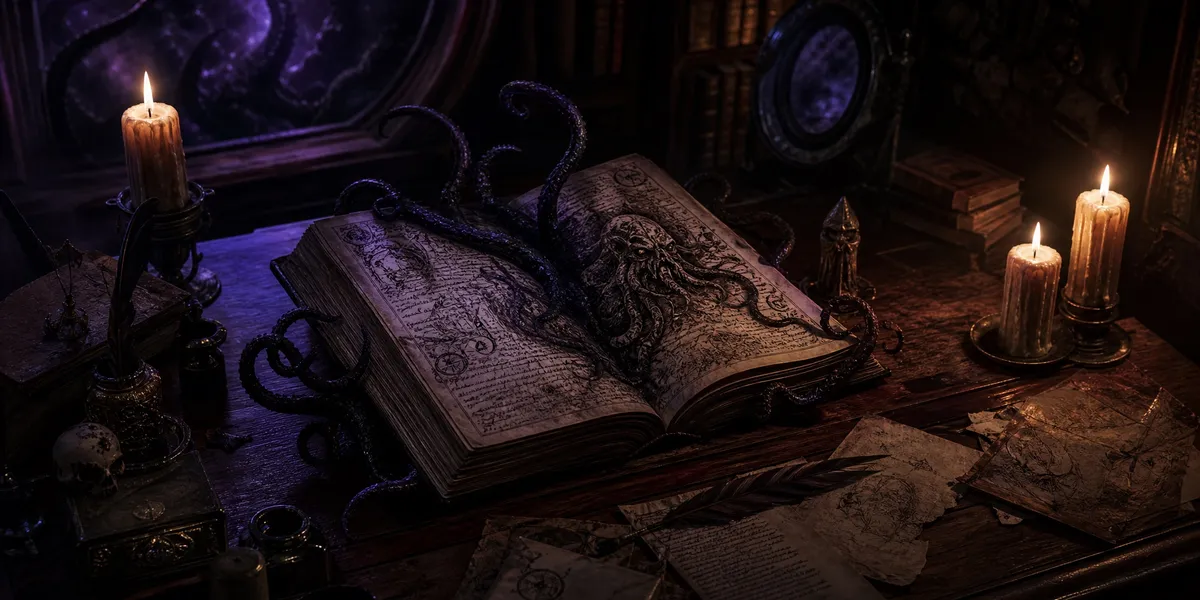
You keep the philosophical core and discard the aesthetic trappings. Tentacles, ancient tomes, New England academics, and unpronounceable names are Lovecraft’s furniture — not the genre’s requirements.
Modern cosmic horror proves this. Set your story in a space station, a deep-sea research lab, a suburban neighborhood, or a tech startup. Replace the Necronomicon with a machine learning model that produces outputs no one can explain. Replace Cthulhu with a signal from a star that died before Earth formed.
The genre’s requirements are philosophical, not aesthetic:
- Human insignificance — your characters must confront their irrelevance
- Unknowability — the central mystery cannot be fully resolved
- Irreversibility — encountering the cosmic truth changes the protagonist permanently
- Indifference — the cosmic force doesn’t care about humanity, for good or ill
Keep those four principles and you can write cosmic horror in any setting, any time period, and any style. Lovecraft himself acknowledged that the genre needed to evolve — his essay “Supernatural Horror in Literature” traces the tradition across centuries and cultures.
You also need to address Lovecraft’s racism directly if you’re working in this tradition. His fear of “the other” infected his fiction in ways that are now widely recognized. Modern cosmic horror writers like Victor LaValle, P. Djèlí Clark, and Cassandra Khaw have demonstrated that the genre becomes stronger when it sheds that bigotry and centers perspectives Lovecraft would have feared.
FAQ
What is cosmic horror in simple terms?
Cosmic horror is a type of horror fiction where the terror comes from humanity’s insignificance in a vast, unknowable universe. Unlike slasher or ghost stories, cosmic horror doesn’t rely on a villain you can fight. The fear comes from realizing that the universe is indifferent to human existence — and that some truths are too large for the human mind to hold.
What is the difference between cosmic horror and Lovecraftian horror?
The difference between cosmic horror and Lovecraftian horror is scope versus style. Cosmic horror is the broader genre focused on existential dread and human insignificance. Lovecraftian horror specifically refers to stories that use H.P. Lovecraft’s aesthetic — tentacled entities, ancient tomes, New England settings, and archaic prose. You can write cosmic horror without any Lovecraftian elements.
How do you make cosmic horror scary?
You make cosmic horror scary by never fully revealing the source of terror and by systematically dismantling your protagonist’s understanding of reality. Focus on atmosphere over action, suggestion over description, and existential dread over physical threats. The reader should feel unsettled long after finishing — not from a single scare, but from a shift in how they perceive the world.
Can you write cosmic horror as a short story?
You can absolutely write cosmic horror as a short story — and many of the genre’s greatest works are under 10,000 words. Short cosmic horror works best when it focuses on a single revelation or encounter that fundamentally changes the protagonist. Lovecraft’s Dagon is roughly 3,000 words and remains one of the genre’s most effective pieces. The key is compressing the dread cycle: normalcy, fracture, and collapse.
What is the difference between cosmic horror and gothic horror?
Cosmic horror and gothic horror differ in their source of fear and setting. Gothic horror confines terror to human-scale spaces — crumbling mansions, family curses, and buried secrets. Cosmic horror explodes outward into the infinite. Gothic horror says “this house is haunted.” Cosmic horror says “the universe was never what you thought it was.” Both use atmosphere heavily, but gothic horror’s threats are ultimately human in origin.