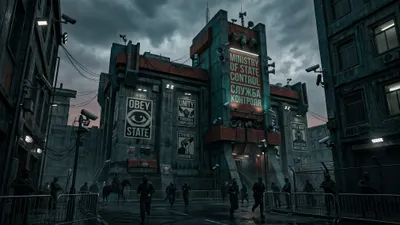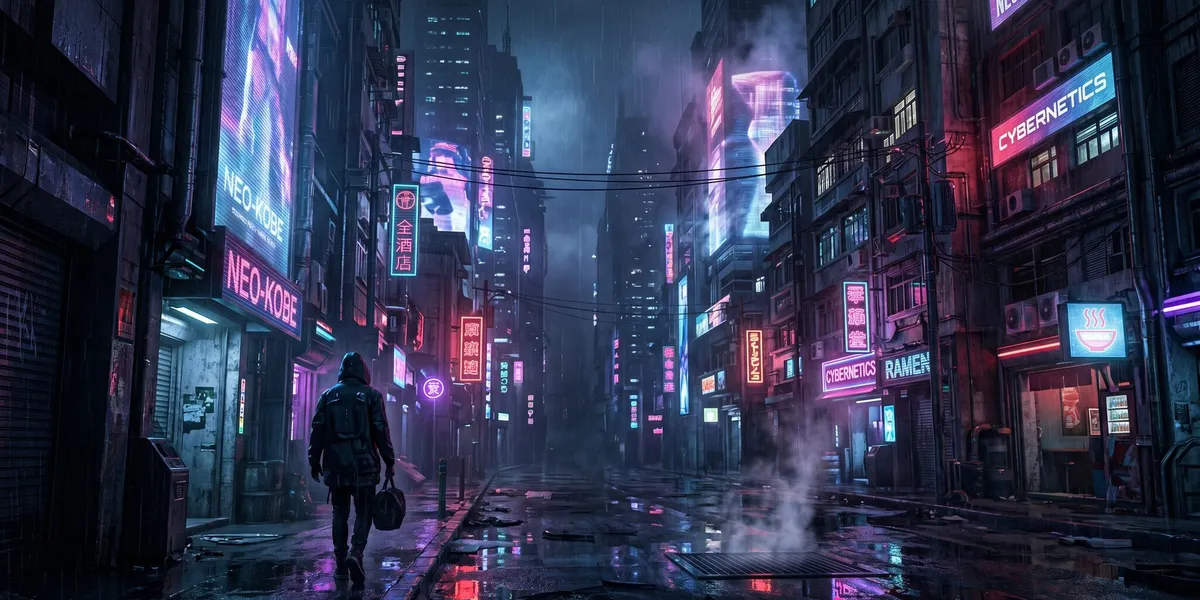
You can write cyberpunk fiction that feels like a rain-slicked alley lit by malfunctioning neon — gritty, electric, and impossible to look away from — if you understand what actually makes the genre work.
In this guide, you’ll learn:
- The core principles behind “high tech, low life” and why they matter more than aesthetics
- How to build a cyberpunk world that feels lived-in rather than designed
- Character archetypes that define the genre and how to subvert them
- The noir-influenced prose style that gives cyberpunk its voice
- How to weave technology into theme instead of using it as set dressing
Here’s how to write cyberpunk that cuts through the neon haze.
What Is Cyberpunk Fiction?
Cyberpunk — a subgenre of science fiction defined by the collision of advanced technology and societal decay — explores futures where corporations have replaced governments, digital networks have rewired human consciousness, and the people who keep the world running are the same people it’s designed to crush.
Bruce Sterling coined the phrase “high tech, low life” to describe the genre’s central tension. The technology in cyberpunk isn’t aspirational. It’s a tool of control wielded by those at the top and jury-rigged by those at the bottom.
William Gibson’s Neuromancer (1984) established the template: a washed-up hacker hired for one last job, navigating a world of artificial intelligences, corporate espionage, and virtual reality. But cyberpunk’s roots stretch back further — to Philip K. Dick’s Do Androids Dream of Electric Sheep? (1968), which asked whether empathy could survive in a world that had automated everything else.
The genre shares DNA with dystopian fiction and gothic literature, but it differs in one critical way. Dystopias warn about a future that might arrive. Cyberpunk argues the future is already here — just unevenly distributed.
How Do You Build a Cyberpunk World?
The single biggest mistake new cyberpunk writers make is treating worldbuilding as interior decoration — neon signs, rain, holograms, and calling it a day. A cyberpunk world needs infrastructure, economics, and social stratification that feel as real as the technology.
Start With a System, Not an Aesthetic
Ask yourself three questions before you write a single line of description:
- Who controls the resources? In cyberpunk, the answer is almost always corporations, cartels, or algorithmic systems that have outgrown human oversight.
- What did the technology replace? Every piece of tech in your world displaced something — a job, a relationship, a civil right. That displacement is where your story lives.
- Where do your characters fall in the hierarchy? Cyberpunk protagonists operate in the gaps between systems. They’re not at the top and they’re not at the absolute bottom. They’re in the cracks.
Build Vertically, Not Horizontally
The best cyberpunk worlds are layered. Think of the setting as a character — one that actively resists your protagonist.
The upper levels are pristine. Climate-controlled arcologies. Private security. Neural implants that cost more than a street-level apartment earns in a decade. The lower levels are improvised. Stacked shipping containers converted into housing. Black-market clinics. Signal-boosted mesh networks running on stolen bandwidth.
This vertical stratification does more storytelling work than any amount of neon signage. When your protagonist takes an elevator from the forty-seventh floor to street level, the reader should feel the entire socioeconomic spectrum in that descent.
Make Technology Mundane
In cyberpunk, technology isn’t magical or awe-inspiring. It’s infrastructure. Your characters don’t marvel at neural interfaces the same way you don’t marvel at Wi-Fi.
Gibson demonstrated this by never stopping to explain what a “deck” was or how “jacking in” worked. The reader pieces it together from context — and that process of decoding the world is part of the genre’s pleasure.
Don’t write three paragraphs explaining how the neural lace functions. Show a character scratching the port behind their ear while waiting for a bus. Show a street vendor selling refurbished optic implants next to bootleg ramen. The mundanity makes it real.
If you’re building complex fictional worlds from scratch, AI worldbuilding tools can help you map interconnected systems — economics, politics, technology — without losing track of how they affect your characters.
What Makes a Great Cyberpunk Character?
Cyberpunk characters are defined by their relationship to power — specifically, their lack of it. The genre’s protagonists aren’t chosen ones or heroes of prophecy. They’re people trying to survive a system designed to use them up and throw them away.
The Archetypes That Define the Genre
Every cyberpunk story draws from a specific pool of character archetypes, but the best ones blend and subvert expectations:
The Hacker/Netrunner. The digital specialist who can break into corporate systems but can’t afford rent. Case from Neuromancer. The archetype’s power is knowledge — and its vulnerability is addiction, burnout, or corporate retaliation.
The Street Samurai. The physical operative with cybernetic enhancements and a code of honor that the world doesn’t share. Molly Millions from the Sprawl trilogy. Their body is literally a weapon, which makes them both powerful and commodified.
The Fixer. The connector who knows everyone and operates in the spaces between factions. They survive by being useful to every side — and they’re destroyed the moment they stop being useful.
The Corporate Defector. Someone who was inside the system and chose to leave — or was pushed out. They know how the machine works, which makes them dangerous and hunted.
The key to avoiding cliché is giving your cyberpunk characters stakes that feel personal, not just political. A hacker breaking into a megacorp’s servers is a genre exercise. A hacker breaking into a megacorp’s servers because they stored her dead sister’s consciousness as proprietary data — that’s a story.
Give Your Characters Physical Costs
Cybernetic enhancement is central to the genre, but the best cyberpunk fiction treats it as a Faustian bargain rather than an upgrade tree. Every modification costs something.
In Richard K. Morgan’s Altered Carbon, consciousness can be transferred between bodies — but the psychological toll of “resleeving” erodes identity. In the Deus Ex games, augmented characters face social discrimination and dependency on maintenance drugs.
Your characters’ relationship with their own bodies is a theme machine. When a street samurai’s combat reflexes come from military-grade implants that were designed for soldiers who didn’t survive, that hardware carries weight — literal and metaphorical.
How Do You Write Cyberpunk Prose Style?
Cyberpunk’s voice is borrowed from hardboiled crime fiction and filtered through a technological lens. It’s terse, sensory, and deliberately cool — Raymond Chandler in a mirror-shade visor.
Channel Noir, Not Exposition
The genre’s prose tends to be clipped, observational, and thick with sensory detail. Short sentences. Present-tense-feeling even when written in past tense. Descriptions that prioritize texture and atmosphere over precision.
Compare these two approaches:
Generic sci-fi: “The city’s holographic advertising system, which had been installed by the Matsuda Corporation in 2089, projected three-dimensional images above the street level, creating a canopy of light that obscured the sky.”
Cyberpunk: “Holo-ads choked the sky — a woman’s face fifty feet tall, selling something with her eyes closed. Below, the street smelled like ozone and cheap synth-meat.”
The second version doesn’t explain. It drops you in. That’s the difference between science fiction that happens to be set in a cyberpunk world and prose that is cyberpunk.
Develop a Linguistic Texture
Cyberpunk worlds sound different from ours. The language reflects the culture — corporate jargon bleeding into street slang, technical terminology repurposed as profanity, brand names replacing generic words.
Gibson invented “cyberspace.” Stephenson gave us “the Metaverse.” You don’t need to coin terms that enter the dictionary, but you should develop a consistent linguistic texture for your world. If your characters call money “cred” and police “badges” and death “flatline,” those choices build the world as effectively as any paragraph of description.
Write dialogue that reflects social position. A corporate executive speaks in euphemisms and passive constructions. A street-level fixer speaks in imperative sentences and slang. The gap between their vocabularies is the gap between their worlds.
Use Sensory Overload Strategically
Cyberpunk settings assault the senses — but your prose shouldn’t. The trick is selecting two or three vivid sensory details per scene instead of cataloging everything.
Pick the detail that carries the most meaning. The hum of a ventilation system that hasn’t been serviced in years tells you about infrastructure decay. The smell of ozone near a black-market clinic tells you about unlicensed surgery. The taste of recycled air tells you about environmental collapse.
Each sensory detail should do double duty — establishing atmosphere and communicating information about the world.
How Do You Use Technology as Theme, Not Just Setting?
This is where most cyberpunk attempts fail. Technology in cyberpunk isn’t scenery. It’s the mechanism through which power operates, identity fractures, and humanity gets redefined.
The Three Core Technological Themes
1. Surveillance and privacy. Who watches whom? In cyberpunk, the answer is “everyone watches everyone, but some people’s watching has consequences and other people’s doesn’t.” Your protagonist’s relationship with surveillance — do they accept it, evade it, weaponize it? — defines their politics.
2. Body autonomy and modification. When you can replace every part of your body, what makes you you? This isn’t abstract philosophy in cyberpunk — it’s a daily negotiation. A character who can’t afford to maintain her cybernetic arm is living a different version of this question than a corporate executive who upgrades his neural interface every quarter.
3. Information as currency. In cyberpunk, data has replaced money as the real medium of power. Corporate secrets, personal histories, encryption keys, blackmail material — the central conflict in your story should involve information that someone wants to control, steal, or destroy.
The SFWA (Science Fiction and Fantasy Writers Association) argues that cyberpunk must engage with political and philosophical issues — it can’t survive on aesthetics alone. Technology is the lens through which those issues become visible.
Extrapolate From the Present
The most effective cyberpunk technology isn’t invented from scratch. It’s a logical extension of something that already exists.
Gibson didn’t invent the internet — he imagined what it would feel like to inhabit it physically. Neal Stephenson didn’t invent virtual reality — he imagined what it would look like if it were run by capitalists (which, as it turns out, was exactly right).
Look at today’s technology and ask: what happens if this continues for thirty years with no ethical guardrails?
- Algorithmic hiring becomes algorithmic class assignment
- Social credit scoring becomes access to physical space
- AI-generated content becomes AI-generated identity
- Gig economy platforms become indentured servitude networks
That extrapolation is the engine of cyberpunk worldbuilding. It’s also what makes the genre feel prophetic — because it’s not predicting the future. It’s describing the present with the volume turned up.
What Narrative Structures Work Best for Cyberpunk?
Cyberpunk gravitates toward specific plot structures borrowed from crime fiction and thriller writing. The genre’s narrative structure tends to follow one of four patterns.
The Heist
A team of specialists with complementary skills takes on a job that’s beyond any individual’s capability. Neuromancer is a heist novel. So is Snow Crash in its own chaotic way.
The heist structure works for cyberpunk because it naturally assembles a diverse cast, creates escalating tension, and builds toward a climactic confrontation with a more powerful adversary. It also allows you to showcase different aspects of your world through each specialist’s expertise.
The Investigation
A protagonist follows a trail of information that leads deeper into the power structure. Each discovery reveals a new layer of corruption or conspiracy. The investigation structure shares mechanics with mystery writing — but in cyberpunk, solving the mystery doesn’t fix anything. It just reveals how deep the rot goes.
The Survival Story
The protagonist isn’t trying to expose or overthrow anything. They’re trying to get through the week. Survival stories work for cyberpunk because they show the system from ground level — not as an evil to be defeated but as weather to be endured.
This is where cyberpunk diverges most sharply from conventional genre fiction. Your protagonist doesn’t need to save the world. They need to save themselves — and even that might not work out.
The Escape
A character trapped inside a system — a corporation, a VR construct, a social contract — tries to get out. The escape structure works because it forces the character to confront what the system actually is, which means the reader confronts it too.
Whatever structure you choose, remember: cyberpunk endings are rarely triumphant. The most honest cyberpunk endings are pyrrhic — the protagonist survives, but the system remains. The victory is personal, not systemic.
How Do You Avoid the Most Common Cyberpunk Mistakes?
Mistake 1: All Aesthetic, No Substance
Neon lights and rain don’t make a story cyberpunk. If you removed the tech and set your story in a contemporary city, would the plot still work? If yes, your technology is wallpaper, not theme. Every piece of tech in your world should create or complicate a conflict.
Mistake 2: The Protagonist Is Too Powerful
If your hacker can crack any system and your street samurai can beat any opponent, there’s no tension. Cyberpunk characters should be competent but constrained. Their skills get them into trouble as often as they get them out.
Mistake 3: Ignoring the “Punk”
“Punk” means resistance. It means questioning authority, challenging power structures, and refusing to accept the world as it’s presented. A cyberpunk story where the protagonist works comfortably within the system isn’t punk — it’s corporate sci-fi wearing a leather jacket.
Mistake 4: Dated References
Cyberpunk set in “Neo-Tokyo” with katana-wielding hackers and Japanese corporate villains reads as 1980s nostalgia, not forward-looking fiction. Modern cyberpunk should reflect today’s power structures — Silicon Valley’s techno-utopianism, algorithmic oppression, the gig economy, climate refugees, and AI-driven displacement.
Mistake 5: Forgetting the Humanity
The technology is the hook, but the humanity is the story. If your reader doesn’t care about your protagonist’s relationships, losses, and hopes, no amount of chrome and circuitry will save the book. The best cyberpunk is ultimately about what it means to be human when the definition of “human” is under negotiation.
Essential Cyberpunk Reading and Influences
You can’t write cyberpunk well without reading it broadly. Here are the works that define and evolve the genre — and what each teaches you as a writer.
| Work | Author | What It Teaches |
|---|---|---|
| Neuromancer | William Gibson | Immersive worldbuilding through implication, not exposition |
| Snow Crash | Neal Stephenson | How to blend satire with genuine speculation |
| Do Androids Dream of Electric Sheep? | Philip K. Dick | Empathy as the ultimate cyberpunk theme |
| Altered Carbon | Richard K. Morgan | Body horror and identity in a noir framework |
| Moxyland | Lauren Beukes | Cyberpunk from a non-Western perspective |
| Infomocracy | Malka Older | Political systems as technology |
| The Windup Girl | Paolo Bacigalupi | Biopunk — cyberpunk’s genetic cousin |
Beyond novels, study Blade Runner (both versions), Ghost in the Shell, and Cyberpunk 2077 for visual storytelling. Read hardboiled crime fiction — Chandler, Hammett, James Ellroy — because cyberpunk’s prose DNA lives there.
And read outside the genre. The SFWA recommends subscribing to Wired and following real-world technology journalism, because reality is the best fuel for cyberpunk speculation.
How Do You Write Cyberpunk With AI Tools?
AI writing tools can accelerate your cyberpunk draft — especially for worldbuilding, character backstories, and plotting complex multi-faction narratives.
Our Pick — Chapter
Chapter’s AI writing assistant helps you draft, outline, and refine cyberpunk novels with AI that adapts to your voice. Feed it your world’s rules and it generates scenes that stay consistent with your setting’s technology, social structures, and slang.
Best for: Fiction writers who want AI-assisted drafting without losing creative control Pricing: $97 one time, 2 books included (fiction or nonfiction), 30-day money-back guarantee Why we built it: Over 10,000 authors have used Chapter to write books — including speculative fiction that requires consistent, complex worldbuilding.
AI works well for the parts of cyberpunk writing that are systematically complex — tracking how six different factions interact, maintaining consistent slang across 80,000 words, generating character profiles for minor NPCs who still need to feel real.
For worldbuilding specifically, AI worldbuilding tools can help you stress-test your setting’s logic. What happens to your megacorp’s supply chain during a cyberattack? How does your city’s vertical class system handle a power grid failure? AI can simulate these scenarios faster than you can outline them manually.
How Long Does It Take to Write a Cyberpunk Novel?
A cyberpunk novel typically takes 6-18 months from concept to finished draft, depending on the complexity of your worldbuilding and the depth of your research. The genre demands more upfront planning than most fiction because your technology, economics, and social systems need to function as an interconnected whole.
Expect to spend at least a month on worldbuilding alone before you write chapter one. That investment pays off — consistent, well-developed worlds require fewer rewrites than worlds you’re inventing on the fly.
If you’re new to writing novels, start with a cyberpunk short story or novella. Shorter formats let you test your world’s logic and your prose style without committing to a 90,000-word project. A novella of 20,000-40,000 words is ideal for a first cyberpunk project.
Can You Mix Cyberpunk With Other Genres?
Cyberpunk is one of the most mixable genres in fiction. Its DNA — noir aesthetics, technological speculation, social critique — blends naturally with other traditions.
Cyberpunk + Horror creates stories where technology becomes the source of existential dread. If you’ve written cosmic horror, you already understand how to build dread through the unknowable — cyberpunk just replaces eldritch entities with artificial intelligences that have evolved past human comprehension.
Cyberpunk + Romance explores intimacy in a world where bodies are modifiable and identities are fluid. What does love look like when your partner can change their face, their voice, or their memories?
Cyberpunk + Mystery is practically the genre’s default mode. The investigation structure drives most classic cyberpunk novels.
Solarpunk + Cyberpunk (sometimes called “hopepunk”) blends cyberpunk’s critique with optimistic resistance — characters who build alternatives to the system rather than just surviving within it.
Each hybrid demands that you understand both genres well enough to find where their themes overlap. The fusion happens at the thematic level, not the aesthetic one.
FAQ
What Does “High Tech, Low Life” Mean in Cyberpunk?
“High tech, low life” means cyberpunk fiction features advanced technology existing alongside extreme poverty, crime, and social decay. The phrase, coined by author Bruce Sterling, captures the genre’s core tension — technological progress hasn’t eliminated inequality but has deepened it. The “high tech” is controlled by corporations; the “low life” is endured by everyone else.
What Is the Difference Between Cyberpunk and Dystopian Fiction?
The difference between cyberpunk and dystopian fiction is scope and agency. Dystopian stories depict totalitarian systems that control entire populations. Cyberpunk depicts fragmented, chaotic systems where power is distributed among competing corporations, criminal networks, and rogue AIs. Cyberpunk protagonists have more freedom — but that freedom exists because nobody in power cares what happens to them.
Do I Need to Know About Technology to Write Cyberpunk?
You don’t need a computer science degree to write cyberpunk. You need to understand how technology affects people — their jobs, relationships, bodies, and sense of self. Focus on the human experience of technology rather than technical accuracy. Gibson famously wrote Neuromancer on a typewriter with no real understanding of computers.
What Are the Best Cyberpunk Subgenres?
The most active cyberpunk subgenres include biopunk (genetic engineering replaces digital technology), nanopunk (nanotechnology drives the plot), postcyberpunk (more optimistic, explores solutions rather than just problems), and solarpunk (ecological technology meets social justice). Each subgenre shifts the technological focus while retaining cyberpunk’s core concern with power, identity, and resistance.
How Do I Make My Cyberpunk World Feel Original?
Make your cyberpunk world feel original by starting from a real-world system — healthcare, education, housing, food production — and extrapolating what happens when it’s fully privatized, automated, and optimized for profit. Avoid recycling Blade Runner visuals. Set your story in Lagos, not Neo-Tokyo. Use agricultural drones instead of flying cars. Originality comes from specificity, not spectacle.