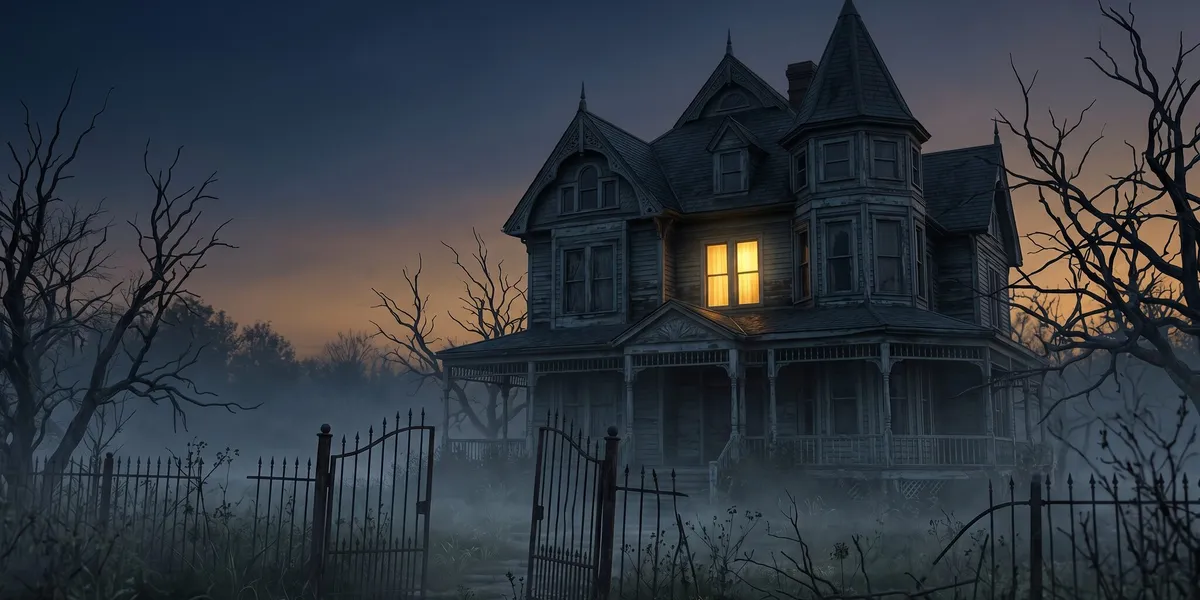
You can write a haunted house story that follows your readers home — the kind that makes them check the basement door before bed and listen a little too hard to the sounds their house makes at 2 AM.
In this guide, you’ll learn:
- How to turn a house into your story’s most terrifying character
- The four-phase corruption arc that structures every great haunted house narrative
- Psychological techniques for building dread instead of relying on jump scares
- How to write a possession story thread that raises the stakes
- The body horror elements that make physical space feel wrong
Here’s the step-by-step process for writing a haunted house story that genuinely unsettles.
Why the Haunted House Works as a Horror Premise
The haunted house story terrifies because it violates the one place you’re supposed to feel safe. Your home is your refuge — the locked door between you and everything that could hurt you. A haunted house story takes that safety and turns it into the threat itself.
That’s why this subgenre has endured from Shirley Jackson’s The Haunting of Hill House (1959) through Mike Flanagan’s Netflix adaptation and into modern literary horror like Paul Tremblay’s A Head Full of Ghosts. The core fear never expires. You can’t run from a haunting when the haunting lives where you sleep.
Every effective haunted house story rests on a single question: why doesn’t the protagonist just leave? Answer that convincingly, and you’ve got a story that traps your reader as completely as it traps your characters.
How to Build Your Haunted House as a Character
Your house isn’t a backdrop — it’s the antagonist. The most memorable gothic fiction treats the house as a living entity with personality, history, and intention.
Give the house a psychology. Decide what the house wants before you write a single scene. Hill House wanted to isolate Eleanor. The Overlook Hotel wanted to consume Jack Torrance’s rage. The house in House of Leaves wanted to disorient and unmake. Your house’s desire shapes every creak, cold spot, and impossible hallway.
Design architecture that traps. Create rooms that don’t connect logically, hallways that feel longer at night, doors that stick when you need them to open. The floor plan should feel subtly wrong — not obviously supernatural at first, but increasingly disorienting as the story progresses.
Layer the house’s history. Every haunted house needs what CrimeReads calls “the old bones” — the accumulated weight of everyone who lived and suffered there. Previous owners, tragedies, buried secrets. The history doesn’t need to be revealed all at once. Let your protagonist discover it in fragments: a name carved inside a closet, a stain that won’t scrub out, a locked room with no key in the house.
Use sensory details beyond sight. The most effective haunted houses attack every sense. Temperature drops. A smell of decay that comes and goes. The sound of breathing from inside the walls. A sticky residue on doorknobs that wasn’t there yesterday. When you engage multiple senses, you create an atmosphere readers can almost physically feel.
How to Write Atmosphere and Dread That Builds
Atmosphere is the difference between a haunted house story that scares and one that just describes scary things. It’s the emotional weather of your narrative — the feeling that something is deeply, fundamentally wrong before anything overtly supernatural happens.
Start Normal, Then Corrupt
Begin with a house that feels almost welcoming. The sunlight through the kitchen windows. The charming original woodwork. The garden that just needs a little love. Readers need to understand why your characters moved in and why they want to stay.
Then introduce wrongness in small doses. A door that’s closed when you left it open. A cold draft with no source. The way the house settles at night sounds almost like footsteps — almost, but not quite. The key word is almost. Ambiguity is your greatest tool in early chapters.
Escalate Through the Uncanny
The uncanny — the familiar made strange — is more disturbing than the outright supernatural. A child’s laughter from an empty room at 3 PM is creepy. A child’s laughter that sounds exactly like your daughter’s voice, from a room you know is empty, while your daughter sits beside you — that’s uncanny. It suggests that the house knows your family. It’s personal.
Use foreshadowing to plant seeds of dread your reader will only recognize on a second reading. A casual mention of a stain on the ceiling in chapter two becomes horrifying when the reader discovers what happened in the room above in chapter eight.
Control Your Pacing
Dread needs silence to grow. If every page contains a scare, nothing is scary. Build long stretches of normalcy punctuated by brief, sharp disturbances. The quiet chapters — where your characters try to rationalize what’s happening — are where the real horror lives.
Think of your pacing like a heartbeat monitor. Long, steady rhythms broken by sudden spikes. Each spike should be slightly more intense than the last, and the quiet stretches between them should grow shorter as the story accelerates toward its climax.
The Four-Phase Corruption Arc
The best haunted house stories follow a corruption timeline that mirrors psychological deterioration. Here’s the structure that drives classics from The Shining to The Haunting of Hill House.
Phase 1: Arrival and False Sanctuary
Your characters arrive with hope. They’re escaping something — a bad marriage, financial ruin, grief, a fresh start after trauma. The house initially seems like the answer. This phase establishes what your characters have to lose and why they desperately need this place to work.
Key scenes: The first walkthrough where the house feels full of potential. Unpacking boxes and imagining a future. The first night, where everything is almost perfect — except for one small detail the protagonist dismisses.
Phase 2: First Disturbances
Small things go wrong, and your characters explain them away. Old houses settle. Pipes bang. Doors warp with humidity. This phase is about denial — your characters aren’t stupid for staying. They’re human. People explain away what frightens them because acknowledging it would mean their sanctuary is a trap.
Key scenes: The first undeniable anomaly that gets rationalized. A conversation between characters where one expresses concern and the other dismisses it. A moment alone in the house where the protagonist feels watched — then laughs at themselves.
Phase 3: Escalating Corruption
The house stops being subtle. Supernatural events become undeniable, but by now your characters are psychologically entangled with the house. They’ve invested money, emotion, identity. Leaving would mean admitting they were wrong. And the house is working on them — amplifying existing fractures in their relationships, feeding anxieties, isolating the most vulnerable family member.
This is where character motivation becomes critical. The reader must understand — viscerally — why your characters stay despite mounting evidence that they should flee. Financial ruin if they abandon the mortgage. A custody battle where leaving looks like instability. The protagonist’s stubborn refusal to be driven from their own home. Or the most chilling motivation of all: one character is starting to like what the house is doing to them.
Key scenes: A major supernatural event that can’t be explained away. A character defending the house against someone trying to help. The first sign that the house is changing a character’s personality.
Phase 4: Complete Corruption and Crisis
The house has what it wants. One character is fully under its influence, or the family has fractured beyond repair, or the protagonist must make an impossible choice — leave someone behind or stay and be consumed. This is your climax, and it should feel both devastating and inevitable.
Key scenes: The confrontation where everything is revealed. A moment where the protagonist could escape but chooses not to — and the reader understands why, even as they’re screaming at the page. The final image that tells the reader whether the haunting ended or just claimed new victims.
How to Write Characters for a Haunted House Story
Your characters need psychological vulnerabilities the house can exploit. Haunted house stories aren’t really about ghosts — they’re about people whose inner damage makes them perfect victims.
Match the Character to the Haunting
If your house amplifies anger, your protagonist should be someone suppressing rage. If the house exploits grief, your protagonist should be someone who hasn’t finished mourning. The haunting and the character arc should be mirrors of each other.
Jack Torrance in The Shining is a recovering alcoholic with violent impulses. The Overlook doesn’t create his demons — it feeds the ones he already has. Eleanor Vance in Hill House is lonely and desperate for belonging. Hill House offers her exactly that, which is why she can’t leave.
Create Disagreement About What’s Happening
The most psychologically rich haunted house stories put characters in conflict about the haunting itself. One person experiences events the others don’t see. A child communicates with something the parents can’t perceive. A spouse dismisses what the other person knows is real. This disagreement is often more frightening than the supernatural elements because it isolates the person who’s telling the truth.
Give Characters a Reason to Stay
This is non-negotiable. If your characters can simply pack a bag and drive away, you have no story. The best reasons are layered:
- Financial: They’ve sunk everything into this house and can’t afford to leave
- Emotional: Leaving means admitting the fresh start failed
- Psychological: The house is giving them something they secretly want
- Physical: The house won’t let them leave (use sparingly — this works best as a late-stage reveal)
How to Write a Possession Story Within Your Haunted House
A possession thread raises the stakes by turning a character into an extension of the house’s will. A possession story is a narrative where a supernatural entity takes control of a person’s body, mind, or both — erasing their identity and replacing it with something else.
Gradual vs. Sudden Possession
Gradual possession is almost always more effective. Small personality shifts — a character who’s suddenly colder, or who starts using phrases they’ve never used before, or who knows things about the house’s history they couldn’t have learned. The people around them notice something is off but can’t articulate what changed.
Sudden possession works for shock moments but sacrifices the psychological tension that makes haunted house stories resonate. If you use a sudden possession scene, earn it by building up to it with chapters of subtle wrongness.
Writing the Possessed Character
Show the possession through behavior changes, not exposition. Don’t write “the entity had taken control of Sarah.” Instead, show Sarah standing in the kitchen at 4 AM, staring at the wall, humming a song none of the family recognizes — a song that matches one the previous owner sang, which the reader learned about three chapters ago.
Use show don’t tell techniques to let readers piece together what’s happening before the other characters do. This creates dramatic irony that amplifies dread.
Body Horror Writing Guide: When the House Attacks the Physical
Body horror in haunted house fiction works because it makes the threat tangible. Psychological dread is powerful, but body horror grounds supernatural terror in physical sensation — readers flinch because they can imagine it happening to their own bodies.
Subtle Body Horror
The most effective body horror in haunted house stories is often understated. A character finds bruises they don’t remember getting. Fingernails that grow faster on one hand. A tooth that loosens without cause. Hair that changes texture. These small physical violations suggest the house is rewriting the body, not just the mind.
Environmental Body Horror
The house itself can exhibit body horror qualities. Walls that sweat a substance that isn’t water. Pipes that pulse like veins. A crack in the foundation that looks uncomfortably organic. Mold that grows in patterns resembling faces. When the house’s architecture mimics biology, the boundary between building and body dissolves — and that dissolution is deeply unsettling.
The Physical-Psychological Bridge
The strongest body horror connects physical changes to psychological corruption. As a character falls deeper under the house’s influence, their body changes too. They stop feeling cold in rooms that freeze everyone else. They develop an appetite for foods they used to hate — foods the previous occupant loved. Their reflection starts looking subtly different, as if the face staring back isn’t entirely theirs.
Common Mistakes in Haunted House Stories
- Revealing too much too early. The house’s full history and the ghost’s identity should unfold gradually. Mystery is what keeps readers turning pages.
- Making characters stupid instead of trapped. “Why don’t they just leave?” should have a compelling answer, not require the reader to accept that your characters lack common sense.
- Over-relying on jump scares. A door slamming is startling the first time. The tenth time, it’s boring. Build suspense through atmosphere, not shock.
- Neglecting the human story. The haunting should amplify a real human conflict — a failing marriage, unprocessed grief, a family secret. Without emotional stakes, supernatural scares feel hollow.
- Making the house generic. A “creepy old house” is a cliché. Give your house specific, memorable details. The house in The Shining has a topiary garden. Hill House has angles that are slightly off. Specificity creates reality.
What Are the Best Haunted House Books to Study?
If you want to write a haunted house story, you need to read the ones that defined the genre. Study how these authors handle the techniques covered in this guide:
| Book | Author | What to Study |
|---|---|---|
| The Haunting of Hill House | Shirley Jackson | Atmosphere, unreliable narration, the house as character |
| The Shining | Stephen King | Character corruption, isolation, family dynamics |
| House of Leaves | Mark Z. Danielewski | Experimental structure, the house as impossible space |
| A Head Full of Ghosts | Paul Tremblay | Modern possession, media and horror, ambiguity |
| Mexican Gothic | Silvia Moreno-Garcia | Colonial horror, body horror, non-Western gothic |
| The Little Stranger | Sarah Waters | Class anxiety, unreliable narrator, slow-burn dread |
| Hell House | Richard Matheson | Escalation, ensemble cast, physical manifestation |
Each of these novels takes a different approach to the haunted house framework. Read them not just for entertainment but as craft studies — notice how each author handles the four-phase corruption arc, even when they subvert it.
How to Use AI to Draft Your Haunted House Story
You can use AI writing tools to accelerate your haunted house story — especially for brainstorming backstories, generating floor plans, and drafting atmospheric description passages.
Our Pick — Chapter
Chapter’s AI fiction tools help you draft scenes, develop your house’s backstory, and maintain consistent atmosphere across chapters. Feed it your house’s history and character profiles, and it generates draft material you can shape into genuinely creepy prose.
Best for: Writers who want AI-assisted drafting without losing their creative voice Pricing: $97 one time, 2 books included (fiction or nonfiction), 30-day money-back guarantee Why we built it: Because the best horror comes from human imagination — AI just helps you get it on the page faster
The key is using AI for scaffolding, not finished prose. Generate a first draft of your house’s century-long history, then rewrite it with the specific sensory details and emotional weight that only you can provide. AI excels at structure and volume. You excel at the uncanny details that make readers’ skin crawl.
How Long Should a Haunted House Story Be?
A haunted house story works at nearly any length, but the format shapes your approach.
Short story (3,000-7,500 words): Focus on a single night or a single encounter. Skip the slow-burn corruption arc and drop your protagonist into Phase 3 or 4. The reader fills in the backstory through implication.
Novella (20,000-40,000 words): The sweet spot for haunted house fiction. Enough room for the full four-phase arc without padding. Many of the genre’s best works — The Haunting of Hill House, Hell House — are closer to novella length.
Novel (60,000-90,000+ words): You’ve got space for a full ensemble cast, multiple haunting threads, deep backstory, and extensive character development. But you’ll need strong subplots and pacing discipline to sustain dread across 300+ pages.
Can You Set a Haunted House Story Somewhere Besides a House?
Absolutely. The “haunted house” framework applies to any enclosed space where characters are trapped with a supernatural presence. Hotels, hospitals, ships, apartment buildings, boarding schools, churches — any location with history, enclosed architecture, and the potential for isolation works.
The essential ingredients remain the same: a confined space with a past, characters who can’t easily leave, and a presence that corrupts over time. Whether that space is a Victorian mansion or a brutalist apartment tower, the story structure doesn’t change.
Some of the most interesting modern haunted house stories deliberately subvert expectations by choosing unexpected settings. A haunted suburban McMansion is scarier than a gothic castle precisely because it’s familiar. A haunted IKEA-furnished apartment feels more real — and therefore more threatening — than a cobwebbed manor.
Writing Your Haunted House Story: A Quick-Start Checklist
Use this checklist to plan your story before you start drafting:
- Define the house’s desire. What does it want from its occupants?
- Write the house’s history. At least three generations of tragedy, with one central death that anchors the haunting
- Create your protagonist’s vulnerability. What psychological wound makes them the perfect victim?
- Establish the reason to stay. Why can’t they leave — and how does that reason erode as the story progresses?
- Map the corruption arc. Outline your four phases with specific scenes for each
- Choose your horror mode. Psychological dread, body horror, supernatural manifestation, or a blend
- Plan your ending. Does the protagonist escape, surrender, or become part of the house’s history?
Then start writing. Your first draft will be imperfect — every first draft is. The important thing is getting the bones of the story down so you can layer in atmosphere, refine your scares, and deepen your characters in revision.
FAQ
What Is a Haunted House Story?
A haunted house story is a horror narrative set in a confined space — usually a house — where a supernatural presence terrorizes the occupants. The genre’s power comes from violating domestic safety. The best examples, like Shirley Jackson’s The Haunting of Hill House, use the haunting to externalize psychological conflicts the characters already carry.
How Do You Make a Haunted House Story Scary?
You make a haunted house story scary by building atmosphere through sensory detail, pacing disturbances with long stretches of normalcy, and creating characters whose psychology makes them vulnerable to the specific haunting. Rely on dread — the feeling that something terrible is coming — rather than jump scares. Ambiguity about whether the haunting is real or psychological adds a layer of unease.
What Are the Key Elements of a Haunted House Story?
The key elements of a haunted house story are a confined setting with a dark history, a protagonist with psychological vulnerabilities, a supernatural presence with motivation, and a reason the characters can’t leave. The house itself functions as a character. The best haunted house stories also include a corruption arc where the haunting progressively breaks down the characters’ relationships and sanity.
How Is a Haunted House Story Different From a Ghost Story?
A haunted house story is different from a ghost story because the location is the source of horror, not just the spirit. Ghost stories can happen anywhere — a ghost story might follow a spirit that haunts a person, not a place. In a haunted house story, the house itself is malevolent, and the haunting is tied to the building’s history, architecture, and accumulated trauma.
Can You Write a Haunted House Story Without Ghosts?
You can write a haunted house story without ghosts by focusing on the house’s psychological effect on its occupants. The haunting can manifest as environmental wrongness — rooms that change dimensions, temperatures that defy physics, sounds with no source. Some of the genre’s most unsettling works, like House of Leaves, never confirm a ghostly presence. The ambiguity itself becomes the horror.